



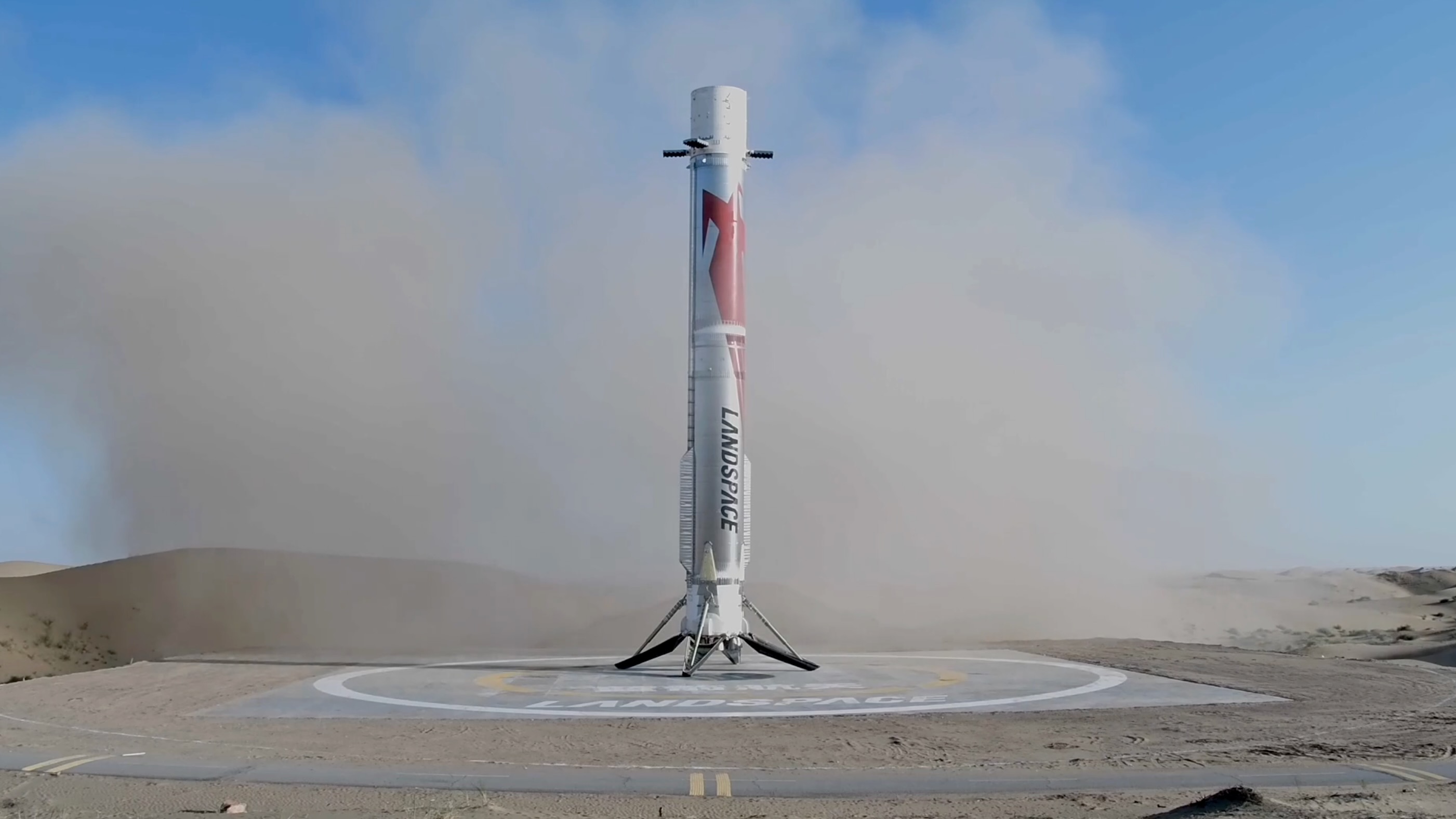
(Image credit: LandSpace)
China just notched another big spaceflight milestone.
The Beijing startup LandSpace successfully landed the first stage of its Zhuque-3 rocket this evening (Aug. 18), becoming the first Chinese company ever to do so during an orbital launch.
It was just the second Chinese orbital rocket touchdown overall. The first was pulled of on July 10 by a Long March 10B, which is built by the state-owned China Aerospace Science and Technology Corporation (CASC).
The Long March 10B had some help returning to Earth, settling softly into a net-like device affixed to a ship at sea. But Zhuque-3 came down on terra firma and stayed upright thanks to a set of landing legs, like those sported by SpaceX‘s workhorse Falcon 9 rocket.
“This mission marks China’s first-ever successful recovery attempt of the first stage of an orbital-class launch vehicle using landing legs, and China’s first successful booster recovery on land,” LandSpace said via X this evening.
“It is a pivotal flight test for Zhuque-3 as it transitions from the technological demonstration and verification phase toward the engineering application phase of reusability,” the company added. “This mission further verified the design correctness and reliability of the Zhuque-3 reusable launch vehicle system, validated its first-stage recovery capability and engineering maturity.”
Zhuque-3 broadly resembles the Falcon 9, which made its first landing way back in 2015 and now has more than 600 of them under its belt. Both feature a reusable booster and an expendable upper stage, and they’re about the same height — 230 feet (70 meters) for the Falcon 9 and 216 feet (66 m) for Zhuque-3.
Their lifting power is similar as well. Zhuque-3 can haul about 40,350 pounds (18,300 kilograms) to low Earth orbit, while the Falcon 9’s LEO payload capacity is 50,265 pounds (22,800 kg).
The two rockets use two very different fuels, however — a combination of liquid oxygen (LOX) and rocket-grade kerosene for the Falcon 9, compared to LOX and liquid methane for Zhuque-3. This “methalox” mixture is also used by Starship, the fully reusable megarocket that SpaceX is developing to help humanity settle the moon and Mars, among other spaceflight tasks.
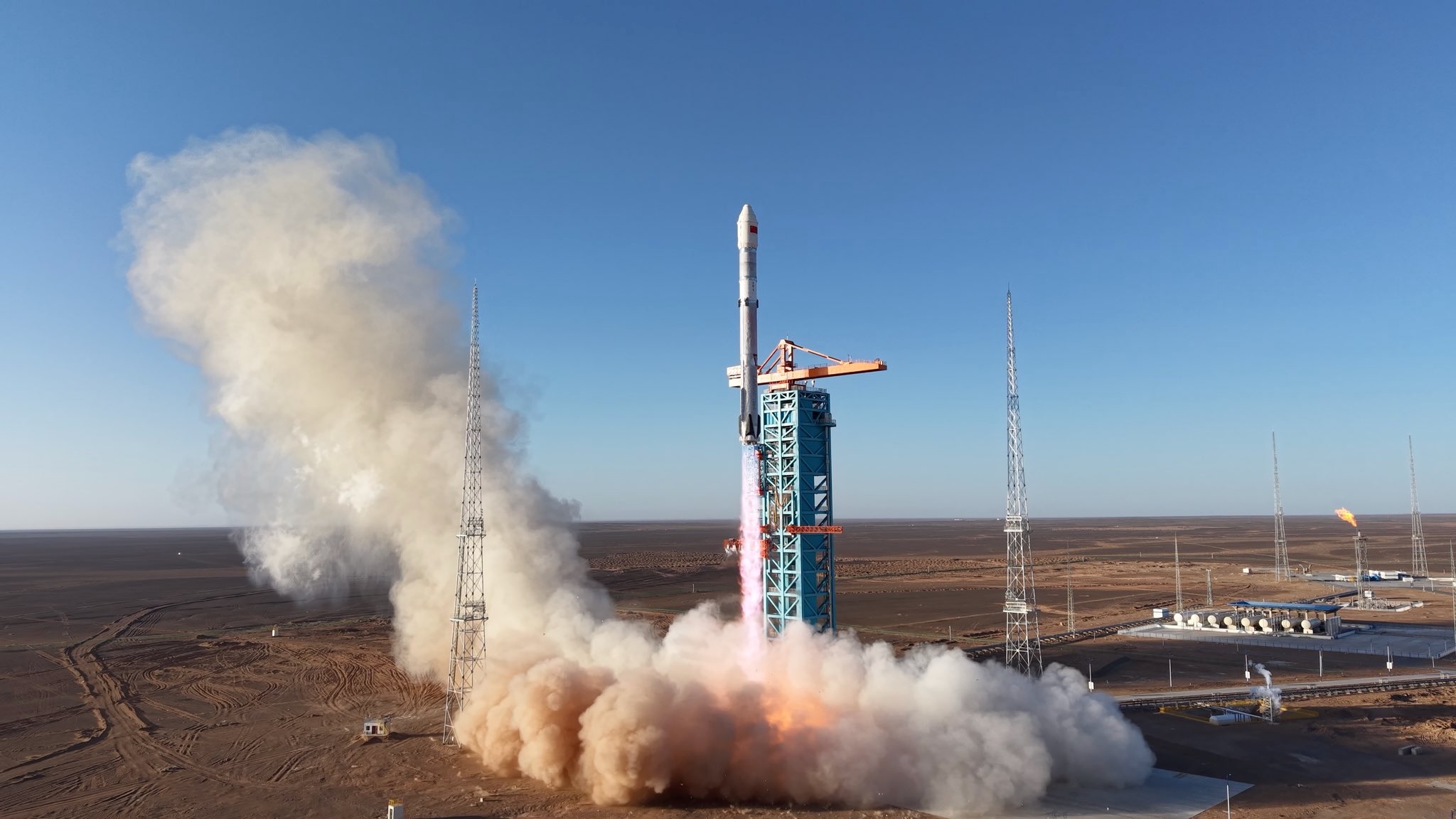
Today’s launch — which occurred from the Dongfeng Commercial Space Innovation Pilot Zone in northwest China at 7:35 p.m. EDT (2335 GMT; 7:35 a.m. on Aug. 19 Beijing time) — was the second overall for the Zhuque-3. The rocket first flew on Dec. 2, 2025, on a mostly successful debut; Zhuque-3’s upper stage reached orbit as planned, which is rare for a first flight.
LandSpace tried to bring the booster back for a touchdown that day as well, but the attempt failed. Zhuque-3 suffered “an abnormal combustion” as it neared the ground, according to the state-run outlet Xinhua (translation by Google), and ended up exploding near the designated landing pad.
Today’s mission, however, was an unqualified success for the Zhuque-3: The rocket’s upper stage delivered a satellite called Honghu 03, which was developed by Hongqing Technology, to its designated orbit, LandSpace wrote in another X post today.
MISSION SUCCESS | ZhuQue-3 Y2 Reusable Launch Vehicle Achieved Full Success in Orbital Insertion and First-Stage RecoveryOn August 19, 2026, at 07:35 (UTC+8), the ZhuQue-3 (ZQ-3) Y2 reusable launch vehicle lifted off from the Dongfeng Commercial Space Innovation Pilot Zone.… pic.twitter.com/fshijOxgtcAugust 19, 2026
Zhuque-3 is part of a concerted Chinese push toward rocket reusability, an efficiency-boosting feature that has helped make the Falcon 9 the world’s leading launcher by far. (The SpaceX rocket flew 165 times in 2025, roughly equalling the activity of all other orbital launchers combined.)
For example, CASC isn’t just working on the Long March 10 line (which includes the 10A crew-carrying variant); its Long March 12A and 12B rockets will also have reusable first stages. The Long March 12A has lifted off once to date, in December 2025, and its debut was similar to that of Zhuque-3: The Long March 12A second stage reached orbit successfully, but its booster failed to stick the landing.
And then there are the private rockets. A number of Chinese companies in addition to LandSpace are working on vehicles with reusable first stages, including CAS Space, Deep Blue Aerospace, Galactic Energy, iSpace, Orienspace and Space Pioneer. So Chinese rocket landings may not be a novelty for much longer.
