


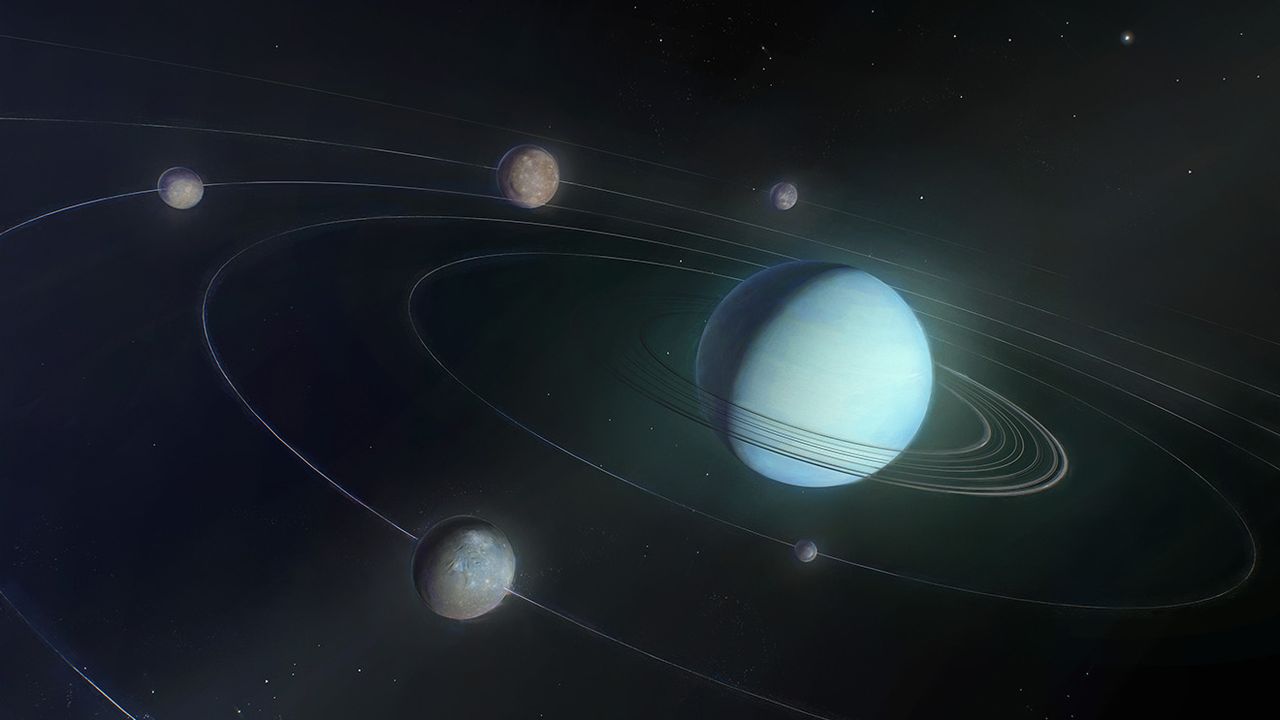
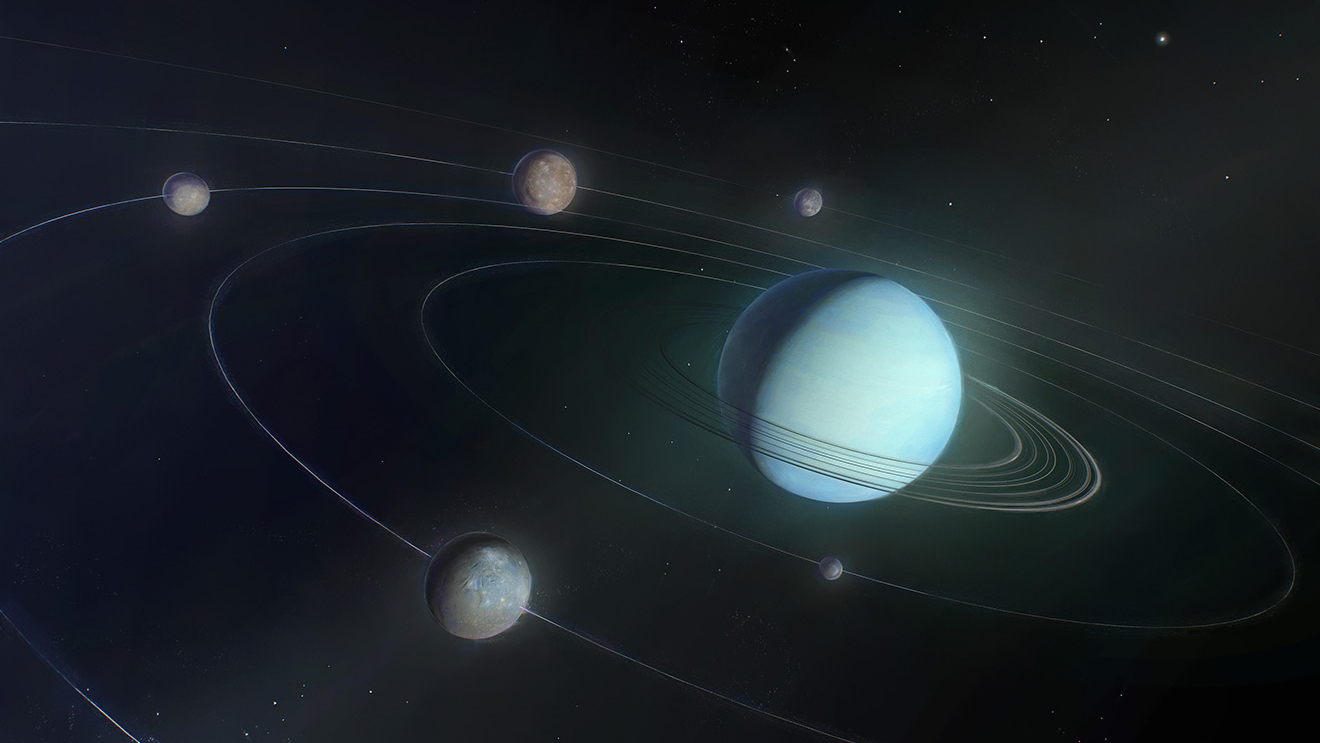
(Image credit: NASA/Johns Hopkins APL/Mike Yakovlev)
For years, astronomers have suspected that our solar system may have lost at least one world at some point in its 4.5-billion-year history. And now, new research suggests the moons of Jupiter and Uranus may indeed hint that our planetary neighborhood once had a third ice giant.
Evidence has shown that between 3 billion and 4 billion years ago, the solar system‘s largest planets likely orbited much closer to the sun (and to each other) than they do today. It’s also suggested that our four giant planets — Jupiter, Uranus, Saturn and Neptune — gradually shifted into their current orbits due to a series of interactions with one another’s gravity.
With this in mind, researchers ran some simulations to explore how all that jostling for position might have affected the moons of Jupiter and Uranus in particular — and the results suggest that these two planets’ moons only survived that tumultuous time because of a giant planet that didn’t.
Potential histories of the solar system
Clement and his colleagues ran computer simulations of 122 possible versions of the early outer solar system, using different starting combinations of planets and different scenarios for the worlds’ migration patterns. They ran each simulated version of the solar system’s history several times, taking note of which versions were more likely to produce something that looks like the outer solar system as we know it today. In particular, the researchers were interested in the moons of gas giant Jupiter and ice giant Uranus.
“Planetary encounters, and the [changes in orbit] that result from them, are thought to have played a key role in sculpting many small body populations throughout the solar system,” wrote Clement and his colleagues in their recent paper.
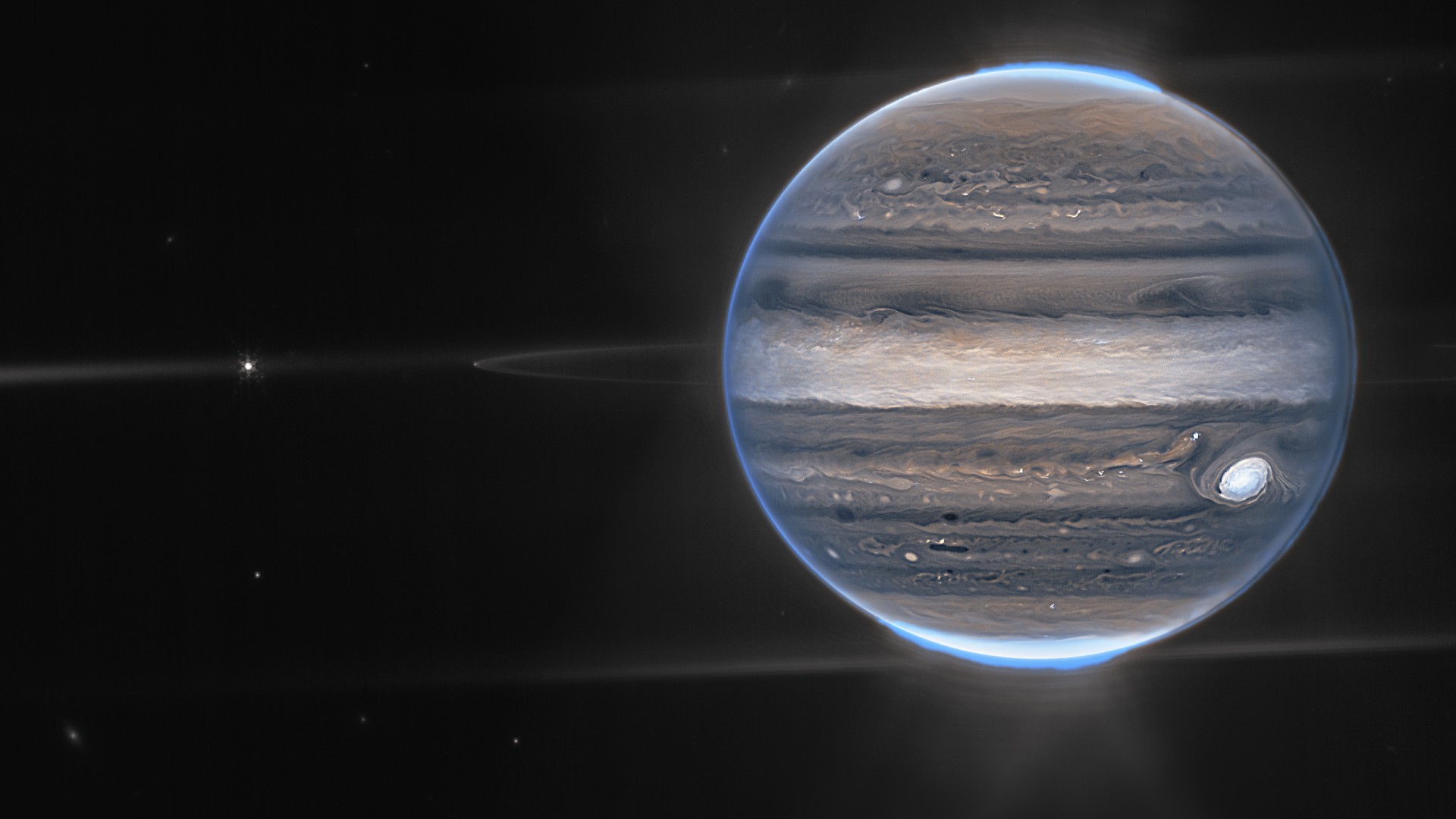
Other teams of astronomers have looked for clues about the movements of giant planets in the orbits of asteroids and other small objects, studying them like footprints to reconstruct how they might have been pushed or pulled into their current orbits by the gravity of giant planets on the move. The moons of Jupiter and Uranus offer an especially good set of clues, because it’s likely that they’ve been more-or-less in their current orbits around their planets for most of our solar system’s history. Jupiter’s moons are in a chain of orbital resonances that could only have formed by the moons tugging gently on each other in passing over a long period of time, and crater records also suggest that Jupiter’s moons are very, very old.
We live in an unlikely solar system
As it turns out, Jupiter and Uranus are lucky to have their entourages of moons at all.
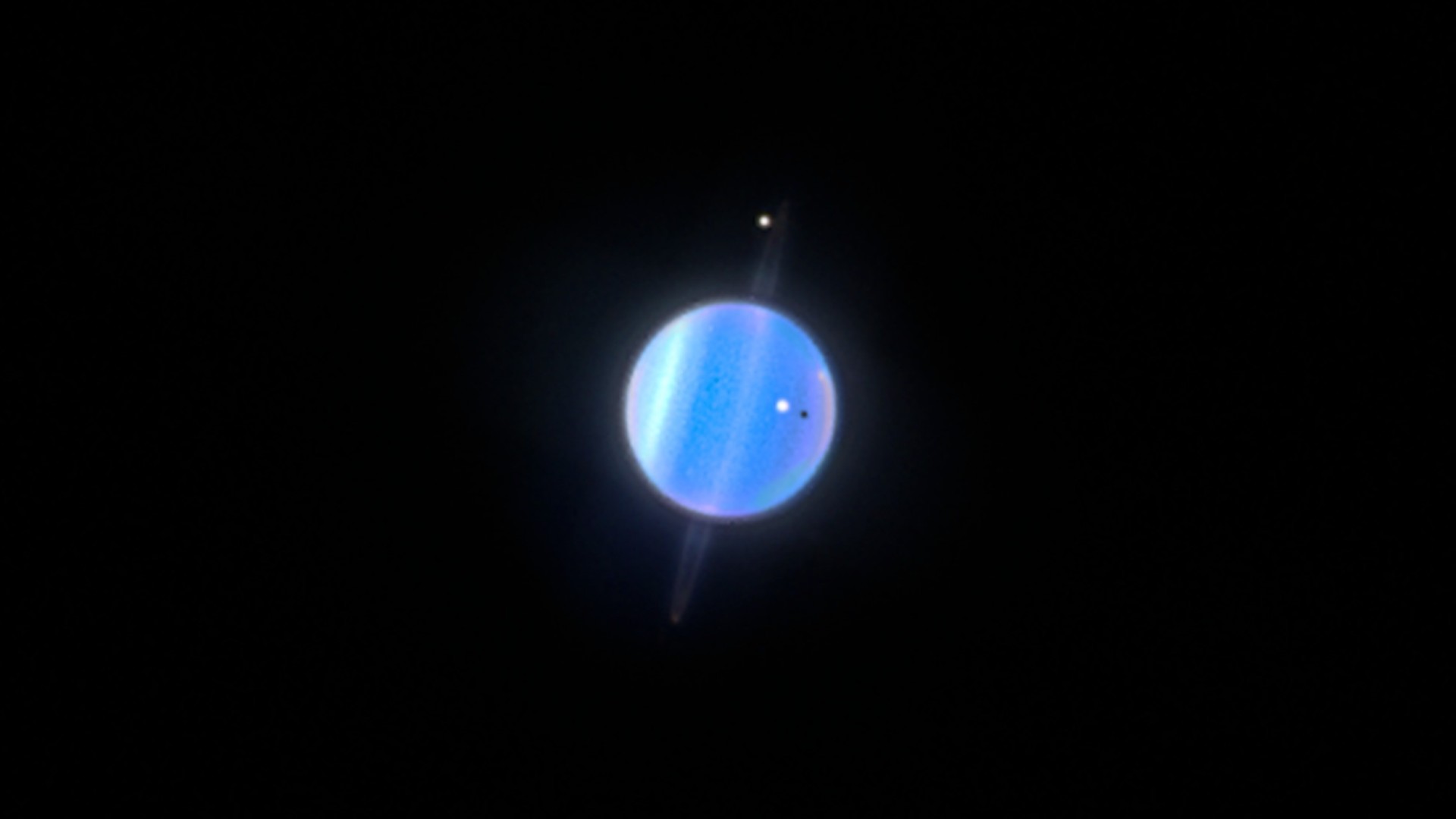
Jupiter’s moons only made it through the era of migrating giants in less than 15% of simulations; Uranus’s moons survived only about 9% of the time.
In fact, scenarios that worked out well for one set of moons tended to be bad for the other: Jupiter’s moons had better chances in simulations that started with two extra ice giants, while Uranus’s moons survived more often when there was a single, but larger, ice giant. The probability that both giants’ moons survive the same scenario is only about 1%.
Clement and his colleagues found only two scenarios in which both planets’ moons survived, and both of those included one extra ice giant in the beginning.
“The solar system is the result of fairly unlikely instability evolution,” wrote Clement and his colleagues. In other words, picture Dr. Strange grimly holding up two fingers during that battlefield scene in Avengers: Infinity War.
Our solar system’s secret, long-lost ice giant
In the most likely scenario, the solar system starts with five giant planets: the big four we know and love today, plus an extra ice giant — sort of the Pete Best of planets. Sometime in the solar system’s first billion years or so, Jupiter’s migration brings it within about 4.3 million miles (7 million kilometers) of the unlucky ice giant, giving the latter enough of a gravitational shove to achieve escape velocity. That long-lost ice giant is probably still drifting somewhere out there in interstellar space, cold and alone.
The ice giant getting booted out of the solar system isn’t the thing that spared Jupiter’s and Uranus’ moons from a similar fate. But the fact that the ice giant was ever there in the first place altered the course of the other four planets’ migrations just enough to spare Uranus more than one moderately close brush with another giant world’s gravity — and kept that period of migration shorter than it otherwise would have been.
Jupiter’s close encounter with the long-lost ice giant would’ve been enough to scramble its moons’ orbits a bit, disrupting that neat chain of orbital resonances, but not enough to cause them to crash into each other or fling them out into interplanetary space (and Clement and his colleagues argue that they should have had time to gradually fidget themselves back into their resonances). Meanwhile, Uranus and its moons probably suffered at least two major shakeups: one when something large slammed into the planet and knocked it onto its side, and again during the giant planets’ migration. But although both incidents probably caused a few dramatic collisions between the moons, they weren’t strong enough to completely wreck the systems.
We may never know the details
During their simulations, Clement and his colleagues tested several things, varying the number and mass of giant planets in the solar system, their starting orbits, and the total mass of objects out in the Kuiper belt — but “the most relevant varied parameter is the initial ice giant number,” they wrote.
Clement and his colleagues however note that simulations of the so-called “Nice model” they worked with are stochastic, meaning there’s an element of randomness involved in what happens once objects in motion start interacting. And that means it’s pretty likely that none of their simulations re-creates exactly what happened — just the general idea.
“It is highly likely that none of the modeled instabilities in the literature contain the precise sequence of encounters necessary to exactly reproduce all aspects of the solar system,” the researchers wrote. But the simulation is a strong hint about the broad strokes, like the presence of a whole other planet, now lost in the void.
Johns Hopkins University planetary scientist Matthew Clement and his colleagues published their work in the journal Icarus.
