


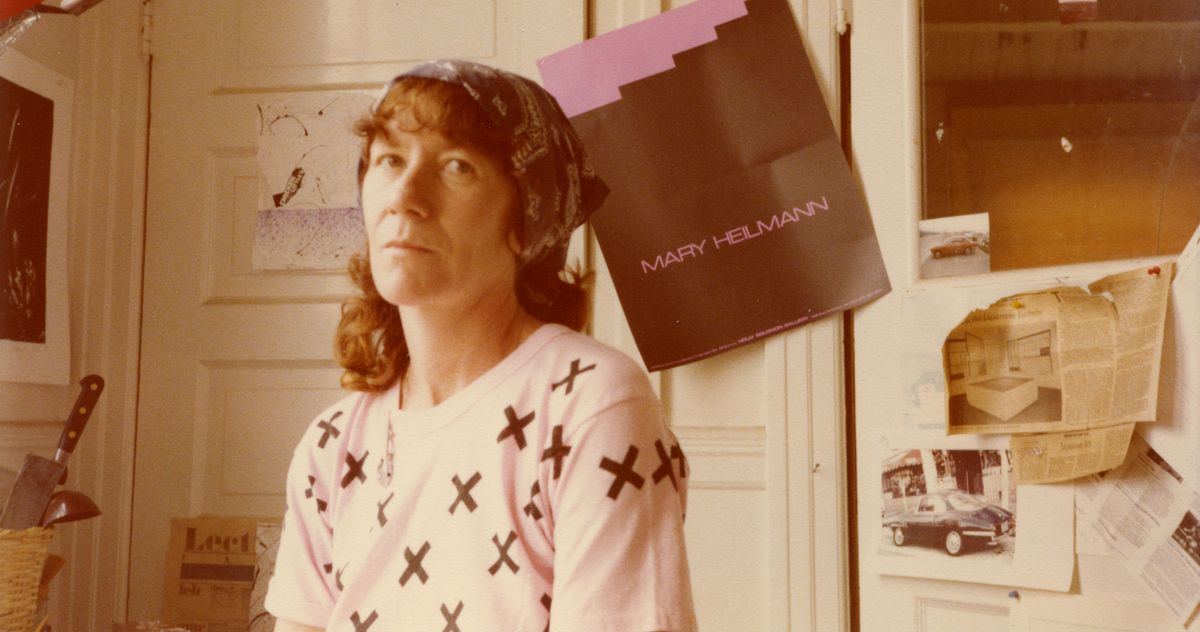
The naughty, vivid, touching paintings of the late artist gave abstraction a much-needed pulse.
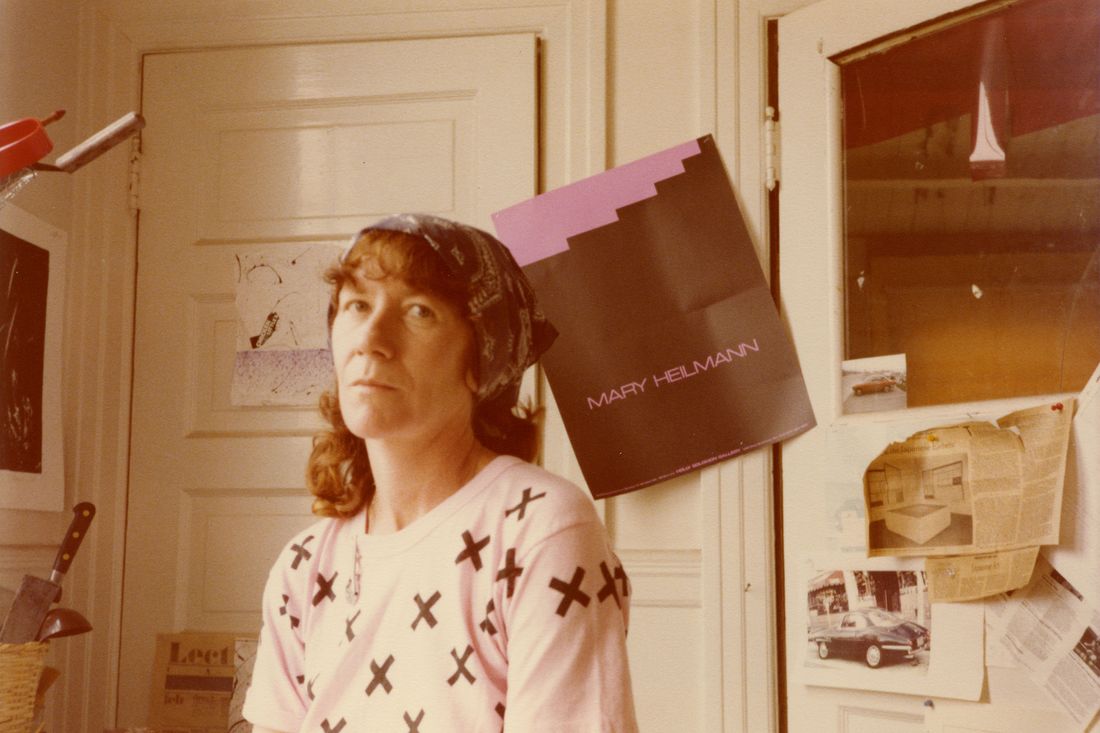
The naughty, vivid, touching paintings of the late artist gave abstraction a much-needed pulse.
Photo: Mark Magill/Courtesy the artist, Hauser & Wirth and 303 Gallery, New York
The naughty, vivid, touching paintings of the late artist gave abstraction a much-needed pulse.
Photo: Mark Magill/Courtesy the artist, Hauser & Wirth and 303 Gallery, New York
“I wanted to cause trouble,” Mary Heilmann once said. And she did. Not with manifestos or work that announced itself as political but by challenging the ridiculously male idea of what serious artists and serious painting were supposed to look like.
Heilmann, who died last week at 86, made some of the strangest, sweetest, funniest, toughest, and most deceptively stupid-looking paintings of the last 50 years. There are squares that aren’t square. Grids that seem to have forgotten the rules of grids. Her lines wobble. Her rectangles look like somebody cut them out with children’s scissors. Her colors are ebullient, mostly building-block primary colors made hot: pink, acid green, black. Paint drips and runs over the edges and down the sides. Shapes bump into one another. Things are too big for where they are. Or too small. Everything is slightly askew.
Look at “Little 9 x 9,” from 1973, a finger-painted grid of black lines floats in a field of deep red. You can follow the order in which each stroke was made, one crossing another, one line hesitating, another thickening, another thinning. It’s almost as if the painting is correcting itself while it’s being made.
Those tiny deviations are the point. Mistakes become structure. Heilmann took the supposedly impersonal unit of modern art, the rectangle, and embodied it. She turned it into something touching rather than calculated, felt rather than measured. In her paintings, geometry gets a pulse. That is one of her greatest inventions. She made abstraction remember that somebody had actually been here.
I knew Mary only from afar, but she was a wonderful person to talk with about almost anything. My wife, Roberta, and I visited her once at her tiny beach house in the Hamptons. It felt less like visiting a famous artist than spending an afternoon with someone from the Beat Generation. She was mellow, sly, and naughty, laughed easily, and carried that unmistakable California ease. She came out of San Francisco when it was still possible to believe art, music, friendship, and freedom belonged together.
“Little 9 x 9” (1973).
Photo: Stephen White/ Courtesy of 303 Gallery, New York and Hauser & Wirth
Agnes Martin was, Heilmann said, “a huge hero for me.”
You can see Martin in Heilmann’s grids. But Mary keeps the body and whimsy in the geometry. Martin’s penciled lines aspire to silence, stillness, transcendence. Heilmann’s edges are imperfect; space is never really flat. Her colors can be vulgar, vivid, or funny. We feel the hand, the wrist, the finger, the person. You can see traces of Heilmann’s freedom in younger painters as different as Pam Glick and Laura Owens.
When Heilmann arrived in New York in 1968, minimalism, post-minimalism, and Conceptual art were turning the city into one enormous male dominion. Robert Smithson. Richard Serra. Carl Andre. Steel. Bricks. Earth. Systems. Theory. Serious men being serious. She came out of ceramics and initially wanted into that smart-art world. She later described herself as “like a girl wanting to play sports with the boys.”
She was largely excluded, and rather than imitating them, she quietly changed the game. Her paintings carry almost none of the familiar signs of masculine authority that dominated so much art of that moment. There’s no industrial fabrication. No polished severity. No theoretical swagger. No immaculate surfaces announcing their own intelligence. Instead there is awkwardness, pleasure, odd scale, physical intelligence. Her paintings look almost casual. Almost dumb. Like anyone could have made them.
Yet the intelligence is brimming over. In that art world, a pink painting was already picking a fight. Heilmann called pink a “culturally hip, naughty color” and “a rough, rough color.” Asked whether her paintings were pretty or tough, she didn’t make a choice: “Pretty and tough at the same time.” Exactly. Pretty wasn’t surrender.
From left: “Tehachapi 1” (1979). Photo: Mary Heilmann/Courtesy of the artist, 303 Gallery, New York, and Hauser & Wirt“Sunny Chair for Whitechapel” (2016). Photo: Whitechapel Gallery
From top: “Tehachapi 1” (1979). Photo: Mary Heilmann/Courtesy of the artist, 303 Gallery, New York, and Hauser & Wirt“Sunny Chair for Whitechapel” (20…
From top: “Tehachapi 1” (1979). Photo: Mary Heilmann/Courtesy of the artist, 303 Gallery, New York, and Hauser & Wirt“Sunny Chair for Whitechapel” (2016). Photo: Whitechapel Gallery
In Berkeley, where California clay culture yanked ceramics out of the category of polite craft and into something huge, physical, ugly, and beautiful, Heilmann learned to weld. She learned to make molds. Above all, she learned to trust her hands. She often showed her paintings alongside her gaudy glazed ceramics — lumpy, shiny, fired things that proudly announced they had been handled. Then came the painted chairs, benches, and tables. Some look like Donald Judd furniture after somebody loosened its collar. Judd’s furniture asks you to admire it; Heilmann’s asks you to sit down and chill. At her 2007 Orange County Museum of Art retrospective, she told students that if they saw somebody interesting across the gallery, they should simply roll one of her chairs over and start talking. This tells you something fundamental about her work. A painting doesn’t stand over you demanding reverence. It involves you, invites you in, flirts with you.
“The work was always made,” she once said, “to put something physical out into the world so that people could have a conversation about it — or even a fight.”
There is another part of her life that belongs here. Heilmann spoke openly about years of drinking and drug use. “I was a real heavy drinker and stoner and drugger,” she said. In 1983, at 43, she got sober. Decades later, she was still talking about Alcoholics Anonymous and Narcotics Anonymous as central parts of her life. I know more than one artist in recovery whom Mary quietly encouraged, talked through difficult moments with, or helped find a sponsor.
She especially loved younger people getting sober. She talked about going to meetings and hanging out with “all the young, new ones getting clean,” adding that an older sober person could have “a big, fun effect on them.” Then, perfectly Mary, she immediately turned the hierarchy upside down: “I get a lot from them, too.” Sobriety changed her, but it never sobered up the paintings.
Late in life, Heilmann succinctly relayed the ambitions of her generation. “We always wanted to be not rich and famous, but poor and famous,” she said. “That was the model, like Pollock and de Kooning.” That’s an artist’s answer. Not respectable. Not successful. Just serious enough to matter.
In the end, Heilmann was famous. More important, she became indispensable to her time. She reminded us that the deepest intelligence often disguises itself as play.
Mary Heilmann, Troublemaker
Your product is saved! You’ll receive emails when your saved products go on sale. Manage preferences.
