



 7 min read
In his stand-up act, Steve Way warns people in the audience that he will fine them ten dollars if they emit anything close to a pitying “Awww” during his act. The 35-year-old was born with muscular dystrophy, which has left him with severe and obvious physical disabilities, but he’s stronger than people might assume. Doctors told him at 14 that he wouldn’t live past the age of 18, so in that regard the comedian known for his blistering and ruthless jokes has kicked the genetic disease’s ass. And he’d like to kick yours too if you feel sorry for him.
Way is a longtime disability-rights advocate, and most people know him from the comedy series Ramy, in which he plays an exaggerated version of himself. The true part of that show is that he actually grew up as the friend of the show’s creator and star, Ramy Youssef, who recruited his acid-tongued pal to join him in the sitcom. But then Way took his motorized wheelchair off the rails by playing “Steve” as a kind of wild and unhinged alter ego.
In Hulu’s sinister new serial-killer drama Furious, which is now about to close out its first season, Way isn’t playing himself or even a dastardly caricature of his id. He’s playing Alden Drummings, a man who might have the same physical condition as Way but is mentally in a much different place. “I think the world scares him,” Way says. “He just loves his mother. Dad’s out of the picture. All he has is strangers, and that’s scary enough. So he surrounds himself with the same four walls because it’s safe.”
Way also credited show creator Elizabeth Meriwether (best known for the comedy New Girl and the dramas The Dropout and Dying for Sex) for accurately capturing the experience of someone with his disabilities—and occasionally predicting lines he himself might express. “My first thought was, Wow, how does she know I would say that?” he says.
In the newly released episode 6 (“They Make a Noise Like Feathers”), Alden finally breaks out of his four walls and sheds his vulnerabilities. He proves he’s strong and clever enough to obstruct an FBI investigation to protect the woman he has come to love. Way not only delivers a powerhouse emotional performance, but he also gets to bring some levity to Furious with a unique fight scene in which he and his motorized chair do battle with FBI investigator Frank Choi (played by Rob Yang), who has been an insufferable lickspittle all season.
“They thought it would be funny if I’m just going back and forth trying to fuck with him,” Way says. It all culminates in Choi being the one who loses control of himself. “I’m so happy that we have the take where he knocks the computers over, because that was totally by accident.”

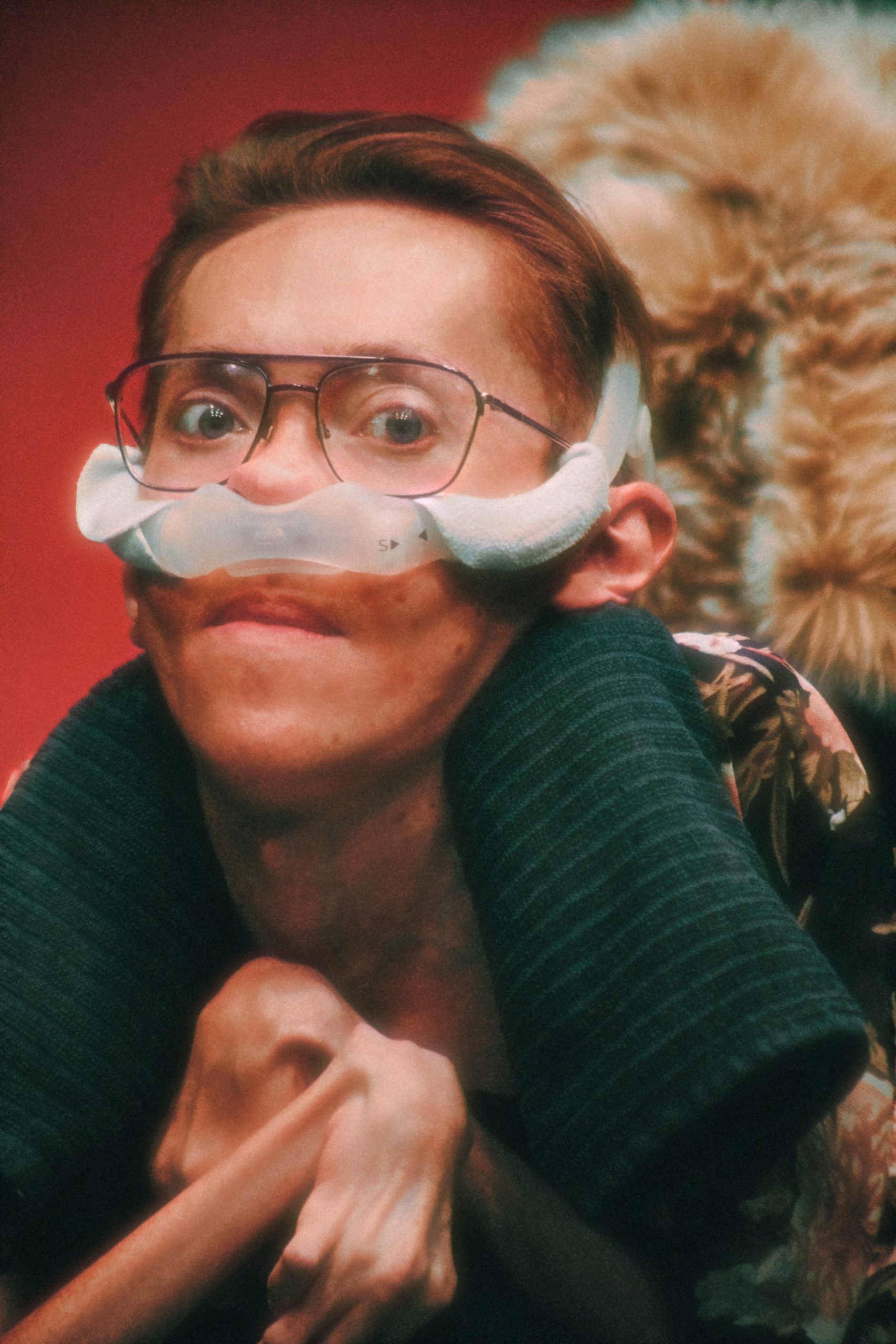
Way was born with muscular dystrophy, which has left him with severe physical disabilities, but he’s stronger than people might assume.
Way, who also works as a high school substitute teacher in real life, sees a stark difference between the two characters he has now brought to life on TV. “With Ramy, my character is very empowered, not afraid to speak up, not afraid to stand up for himself,” he says. “Alden is more timid. He is more afraid. He just wants love. That’s it. He just wants connection. And he doesn’t want to lose it.”
Except, throughout the series, Alden is never as safe as he thinks. Following the death of his mother, his live-in caregiver is “Vanessa” (played by Lola Petticrew), who is moonlighting as a righteous serial killer who hunts sex predators. “Vanessa” (real name Catherine) targets the wealthy men who participated in an Epstein-like sex-trafficking operation that ensnared her as a young girl. Vengeance is hers—now that she is older, wiser, stronger, and more familiar with the injectable sedatives that can render a grown man immobile while she flays his psyche.
Throughout the show, tensions spike as Alden ventures into Catherine’s room, discovers a strange collection of her targets’ photographs, and asks probing questions about the “uncle” who is apparently going through an excruciating “detox” in her bedroom.
Alden has never done wrong by her, but we also know Vanessa/Catherine isn’t above ending the life of an innocent bystander who discovers her secrets. (Just ask Becky, the volunteer at the domestic-violence shelter, except … oh no, you can’t, because Catherine seduced and executed her after she got too nosy.)
Miraculously, she never lashes out at Alden. Similarly, Catherine showed mercy to Mira (played by Riley Vinson), the 15-year-old daughter of Rob Delaney’s Oliver Charles, a lawyer who’d raped Catherine when she was that same age. Even though Mira is a witness to her father’s slaying, Catherine allows her to live because she’s powerless.

Furious marks Way’s latest major acting role, following his turn in the comedy series Ramy, in which he played an exaggerated version of himself.
Way says Alden was spared because Vanessa/Catherine sees him that way too. “My character is someone who doesn’t really have control,” he says. “He relies on other people for everything. But because of that, I think they’re the same. That’s why she’s able to trust me.”
As she tends to her macabre vengeance, a tentative love blossoms between the patient and his homicidal nurse. He confesses romantic feelings for her, and she welcomes them. The actors even shared several love scenes, in which Vanessa/Catherine’s work bathing him or putting him to bed gradually evolves into tender acts of romantic intimacy.
“My favorite scene is the shower scene because it’s so vulnerable, but it shows how comfortable he is with Vanessa,” Way says. “I really channeled a lot of my own experiences with partners and past relationships. I kept telling myself: This is not new. This person has bathed me before. This person has seen my full body many times before. So there’s nothing weird about it. Also, it’s my safe space. I’m in my house. I’m with the woman I love. Everything’s okay. Everything’s good. We’re happy.”
Actors about to perform a love scene know the best thing to do is dispel any awkwardness. “Before we shot anything together, we just talked. We talked about politics, our family life. We talked about wrestling,” Way says. “We just got to know each other on a human level. Lola is so fantastic. They were always very receptive to just how I would do things. And I think that put them at ease. Just, ‘Hey, this is how I do it. Try it.’ ”
Some of what he shared with Petticrew was just practical guidance. “It’s what I would tell any new caregiver,” Way says. “‘Hey, this is how you pick me up.’ ‘Hey, this is how you shower me.’ ‘This is how you feed me.’ I know what I’m doing, so I’ll show you.”
For most of the show, Alden has no idea what she’s really up to. Then, in episode 5, he saw his love gruesomely murder the lawyer (played by Campbell Scott) that she was keeping penned up in her bedroom. Even then, Alden is in disbelief. “But also he’s not totally innocent,” Way insists. “He now knows. I think that’s why in episode 6, when he finds out everything, he wants to help her. He’ll do anything for her. He’ll stall. He’ll help her get a head start.”
That obstinance leads to one of the most heartbreaking moments in the series, as N.Y.C. detective Danny Kelly (played by Scoot McNairy) suggests that Catherine/Vanessa may have killed Alden’s mother and taken her pain meds to use in her crimes. Heartbreak flickers in Alden, who fortifies himself by declaring: “Nobody’s perfect.”
Still, the suggestion cuts Alden deeply. “It’s like, ‘Did my mother sign her own death warrant by hiring this person?’ ” Way says. “This is something that every disabled person deep down feels: It’s my fault. I’m the one who needed [Vanessa]. My mother was just getting me help. Well, I wouldn’t need that help if I wasn’t disabled.”
Although it’s a common thought, the actor says it’s also one that must be disregarded. “Of course, it’s never true. It’s not his fault he’s disabled. No, he didn’t ask for it,” Way says. “But we all have that internalized ableism. Oh, it’s our fault. We’re not worthy of this. We don’t deserve love. And that’s why he wants to hold on to [Vanessa].”
As episode 6 ends, Catherine/Vanessa has her first face-to-face encounter with FBI agent Alice Black (played by Emmy Rossum), who has been tracking her all season. It’s not clear if Alden will see his love again, but after stalling the investigation for as long as he can, he finally relents and gives them a key piece of information that will point them not at her but at the men she was trying to punish.

Way sees his storyline in Furious as a kind of dark fairy tale about how there actually is someone for everyone, which echoes experiences he has had in real life.
Way hopes there is a somewhat uplifting message amid the darkness of Furious. His character discovers he has more power than anyone realizes, and he has someone he loves enough to fight for her. That alone is a contrast to the way the actor usually sees people with disabilities portrayed.
“It’s the microcosm of being told you won’t find people who love you unconditionally, people who don’t think you’re a burden. That’s what we see on television and movies,” he says, calling out one 2016 drama that starred Sam Claflin and Emilia Clarke. “In Me Before You, this guy has Daenerys Targaryen as his caretaker, and he wants to die because he’s disabled. That tells audiences that being disabled is the worst thing in the world.”
Way sees his storyline in Furious as a kind of dark fairy tale about how there actually is someone for everyone, which echoes experiences he has had in real life. “I have had people tell me to my face that ‘this is too much for me.’ ‘I wish it was different. I wish it wasn’t so much.’ Multiple times,” he says. “[These were] people I was in relationships with. And that’s okay. You’re allowed to feel however you want to feel. But for disabled people, it’s not the truth. We will find people. They’re out there.”
