


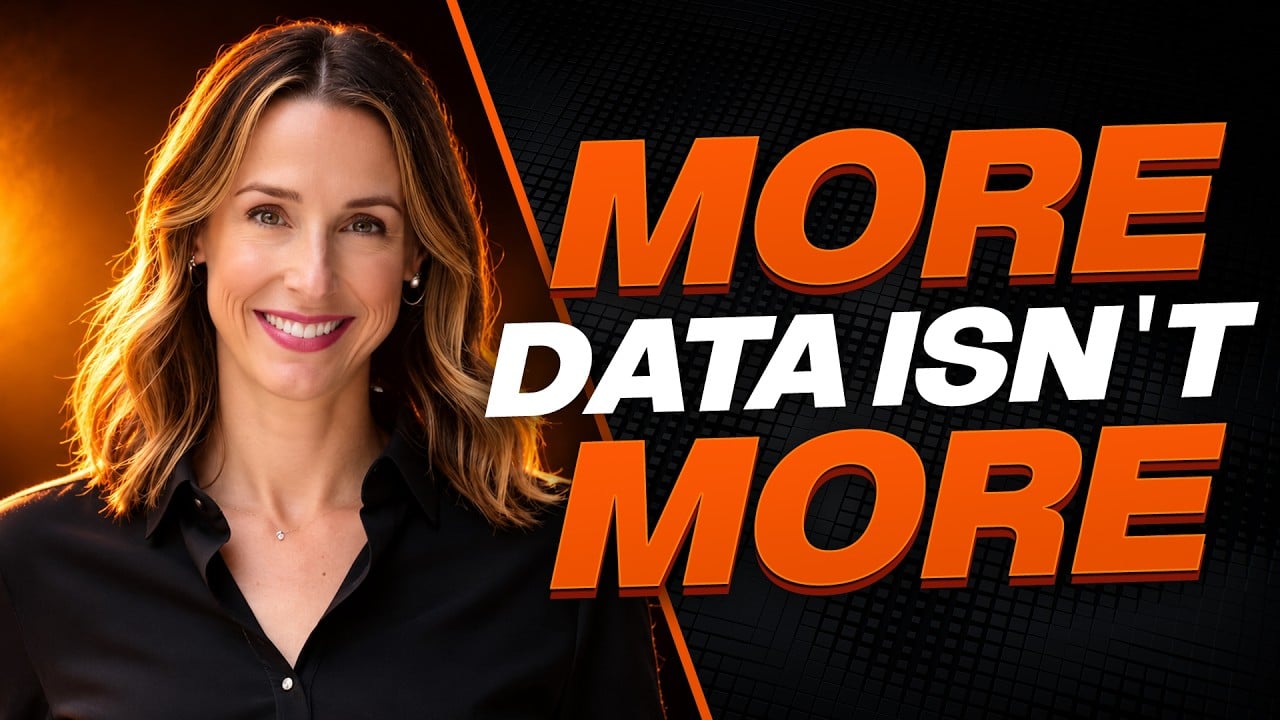
You’re swimming in data and AI tools. Is any of it really helping you better understand your customers?
Published on October 28, 2026 •
3 minutes read
Table of Contents
Table of Contents
With AI tools being introduced at a furious pace by martech vendors and advertising platforms alike, it’s time to stop and ask a crucual question: is AI making marketing easier?
In this episode of Conversations with MarTech, Malinda Sandman, global VP of marketing at Typeform, discusses how AI is reshaping the landscape for B2B and B2C marketers.
This conversation dives deep into why AI might actually be making marketing harder in the short term due to the shift toward a “clickless” environment, how marketing teams can avoid the “garbage in, garbage out” trap of AI tools, and why having more data doesn’t necessarily mean you know your customer.
Malinda also shares how Typeform uses AI to conduct scalable customer interviews and bridge the gap between B2B and B2C insights.
Key topics covered
- Is AI in paid ad platforms net positive or net negative?
- Human-centric creative vs. AI scaling: Avoiding homogeneous outputs
- Why 97% of marketers use AI, but lead follow-up is still lagging
- Does your marketing team actually have “enough” data?
- “Always On” research: Gathering customer feedback in 24 hours
- Bridging B2B & B2C marketing mindsets using video feedback
- The Biggest Lie in Marketing: Why more data ≠ knowing your customer
Episode guide
00:00 Introduction
00:40 Meet Malinda Sandman
1:27 Has the explosion of AI tools been a positive or negative for marketing?
5:03 Where should marketers be using their energy in the AI era?
7:11 “Marketers don’t necessarily have a data problem, they have an action problem.”
8:34 The “million dollar next thing to solve.”
9:37 Fundamental marketing problems AI hasn’t addressed.
13:25 What’s working for the marketing team at Typeform?
16:59 What’s the biggest lie the marketing industry tells itself?
Recommended Articles
Follow Conversations with MarTech on:
MarTech is owned by Semrush. We remain committed to providing high-quality coverage of marketing topics. Unless otherwise noted, this page’s content was written by either an employee or a paid contractor of Semrush Inc.

Mike Pastore is the Head of Content & Media at Third Door Media, the publisher of the Martech and Search Engine Land websites and the producer of the SMX and MarTech Conferences. In nearly three decades in B2B marketing, Mike has worked as an editor, writer, and marketer. He first wrote about marketing in 1998 for internet.com (later Jupitermedia). He then worked with marketers at some of the best-known brands in B2B tech, creating content for marketing campaigns at both Jupitermedia and QuinStreet. Prior to joining Third Door Media as the Editorial Director of the MarTech website, he led demand generation at B2B media company TechnologyAdvice.
Google’s “preferred sources” feature allows users to customize their search results by selecting news outlets they want to see more often in the “Top Stories” section.
Related Articles

Search and social consume the majority of digital marketing spend and rely on clicks to gauge effectiveness. Our guest this week calls that “kindergarten math.”

AI agents could be the key to meeting the crazy expectations of consumers, but only if they’re used wisely.

Traditional customer surveys, endless feedback requests, and Net Promoter Scores (NPS) are failing both consumers and brands. What should modern companies do instead.

As brands that eliminate the CMO role gain attention in marketing circles, it’s time to ask if it’s more evolution than revolution.
Related Articles
Search and social consume the majority of digital marketing spend and rely on clicks to gauge effectiveness. Our guest this week calls that “kindergarten math.”
AI agents could be the key to meeting the crazy expectations of consumers, but only if they’re used wisely.
Traditional customer surveys, endless feedback requests, and Net Promoter Scores (NPS) are failing both consumers and brands. What should modern companies do instead.
As brands that eliminate the CMO role gain attention in marketing circles, it’s time to ask if it’s more evolution than revolution.
