


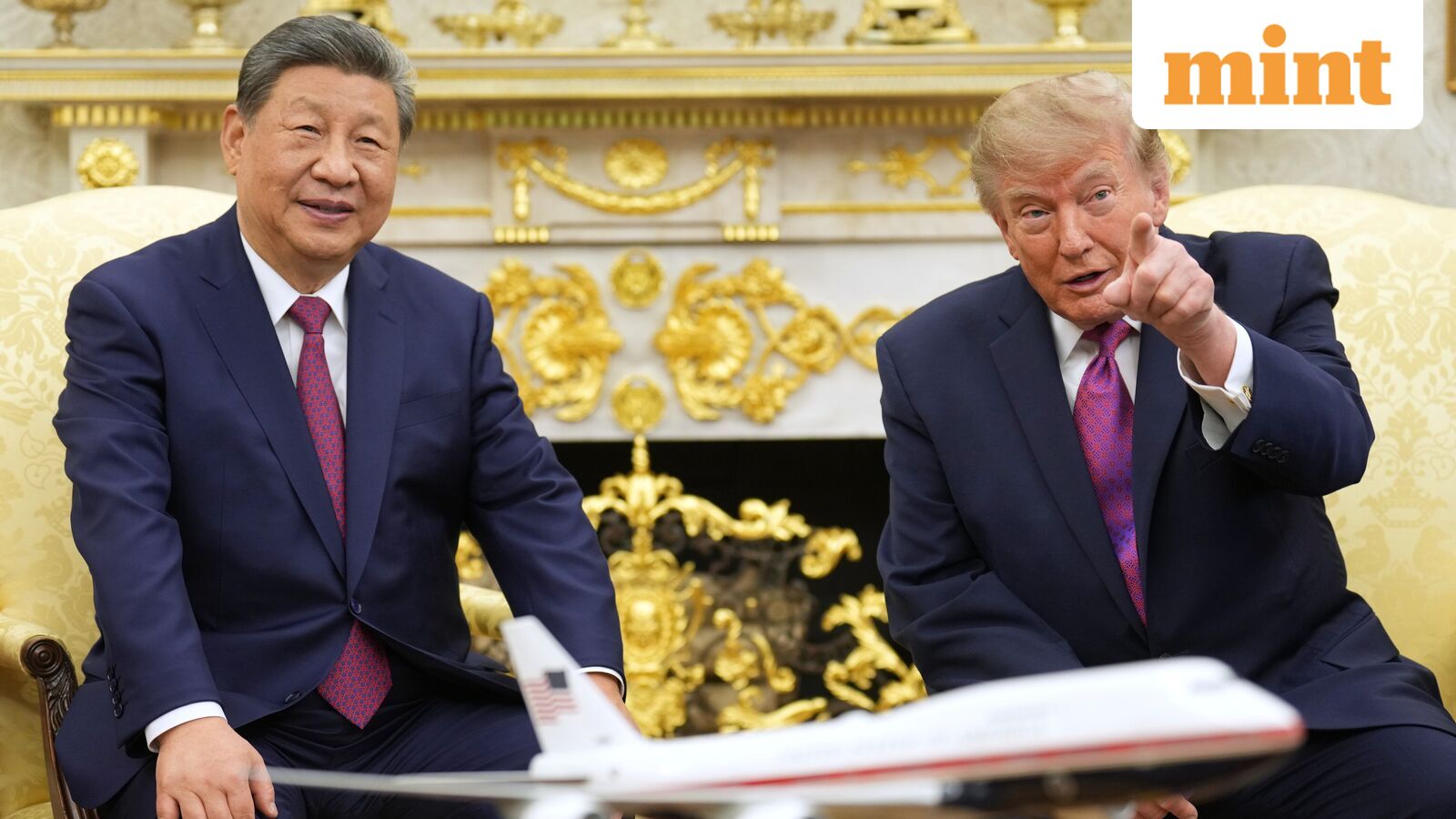
Chinese President Xi Jinping invoked an idea rooted in ancient Greek history during his White House meeting with US President Donald Trump on 24 September, saying that the “Thucydides Trap can be overcome”, Bloomberg reported.
The reference came as Xi called for the US and China to keep their competition “within bounds” and urged the two countries’ militaries to maintain regular dialogue and improve mechanisms for crisis communication and prevention, Bloomberg reported.
The phrase refers to the risk of conflict when a rising power challenges an established one. While the concept is named after the ancient Greek historian Thucydides, its application to modern US-China relations was popularized by Harvard political scientist Graham Allison.
Quick answers to key questions
The Thucydides Trap describes the heightened risk of conflict when a rising power, like China, challenges the dominance of an established power, such as the US. It’s based on historical examples where such dynamics led to war.
Xi referred to the Thucydides Trap to emphasize the need for better communication and crisis management between the US and China, urging that competition should be managed to avoid escalation into conflict.
Xi believes the Thucydides Trap can be overcome by maintaining regular military dialogue and crisis-prevention mechanisms while promoting healthy competition between the US and China.
The Thucydides Trap has significant implications for trade and technology, as ongoing geopolitical competition can affect trade arrangements, technology access, and investment decisions between the two nations.
Yes, both countries should take the Thucydides Trap seriously as it highlights the risk of conflict due to their competitive actions, and managing this rivalry effectively is crucial for global stability.
Xi had referred to the same idea during his meeting with Trump in Beijing in May, when he asked whether the two countries could overcome the trap and build a different kind of relationship. His latest remarks in Washington were more direct: the trap, he said, can be overcome.
What is Thucydides Trap?
The Thucydides Trap describes the heightened risk of conflict when an emerging power challenges the position of an established power.
The term draws on Thucydides’ account of the Peloponnesian War between Athens and Sparta. Thucydides attributed the conflict to the rise of Athens and the fear that this generated in Sparta.
Allison subsequently applied the historical idea to modern great-power competition. His Harvard Thucydides’s Trap project examined 16 cases over the past 500 years in which a rising power threatened to displace an established power. According to his research, 12 of those cases ended in war.
That figure, however, is not a prediction that the US and China are headed for war. Scholars have questioned Allison’s case selection and methodology, arguing that some historical examples do not fit the framework neatly and that the small sample size makes it difficult to draw broad conclusions.
Why did Xi Jinping invoke it at White House?
Xi’s reference came alongside a call for greater communication between Washington and Beijing.
He said the two countries should strengthen communication, better understand each other, seek common ground while managing differences, and maintain regular military dialogue. He also argued that the two sides should avoid confrontation, Bloomberg reported.
The timing is significant because the US and China remain competitors across several areas, including trade, artificial intelligence and technology. Taiwan also remains a major point of disagreement between Washington and Beijing.
Xi’s message, therefore, was not that the US and China had resolved their differences. Rather, the reference to the Thucydides Trap framed communication and crisis management as ways of preventing strategic competition from escalating into conflict.
Did Xi Jinping reject the idea that conflict is inevitable?
Xi has discussed the Thucydides Trap for years and has previously argued that it is not an unavoidable law of history.
His latest comments return to that argument: the outcome of a US-China power transition is shaped by decisions made by both governments rather than predetermined by history.
The Thucydides Trap is a framework for thinking about great-power rivalry, not a rule that says a rising power and an established power must eventually go to war.
Why does Thucydides Trap matter for US-China relationship?
The idea is particularly relevant as Washington and Beijing compete while also trying to keep their relationship stable.
Trade remains a major part of the relationship, while technology and AI have become increasingly important areas of strategic competition. The two countries are also managing disagreements over Taiwan and other geopolitical issues.
For businesses and investors, the significance lies in how geopolitical competition can affect trade arrangements, technology access, supply chains and investment decisions.
Xi’s White House remarks were therefore a call for managing competition rather than evidence that the underlying US-China rivalry has disappeared.
What did Xi Jinping mean by saying trap can be overcome?
Xi’s choice of words offered a relatively simple proposition: the US and China can remain competitors without allowing competition to become a military conflict.
His call for regular military communication and crisis-prevention mechanisms points to the practical challenge behind the historical analogy. Even if Washington and Beijing disagree over trade, technology, or Taiwan, both sides have an interest in preventing those disagreements from escalating.
Therefore, the reference to the Thucydides Trap matters. It was less a declaration that the US-China rivalry had been resolved than a statement about how Beijing wants it managed.
About the Author
Anjali Thakur
Anjali Thakur is a Senior Assistant Editor with Mint, reporting on trending news, entertainment and health, with a focus on stories driving digital conversations. Her work involves spotting early signals across news cycles and social media, sharpening stories for SEO and Google Discover, and mentoring young editors in digital-first newsroom practices. She is known for turning fast-moving developments—whether news-driven or culture-led—into clear, tightly edited journalism without compromising editorial rigour.
Before joining Mint, she was Deputy News Editor at NDTV.com, where she led the Trending section and covered viral news, breaking developments and human-interest stories. She has also worked as Chief Sub-Editor at India.com (Zee Media) and as Senior Correspondent with Exchange4media and Hindustan Times’ HT City, reporting on media, advertising, entertainment, health, lifestyle and popular culture.
Anjali holds a Bachelor of Arts degree from Miranda House, and is currently pursuing an MBA, strengthening her understanding of business strategy and digital media economics. Her writing balances newsroom discipline with a clear instinct for what resonates with readers.
