


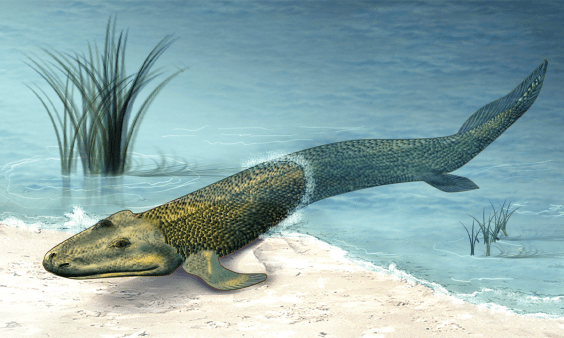
Since the discovery of a 375-million-year-old fossilized fish, Tiktaalik, that could drag itself onto land using its front limbs, paleontologists have suspected that the earliest terrestrial four-legged animals were amphibians. It would make sense that tetrapods, as they gained their footing on land, still relied on water during their early life stages, bypassing the need for adaptations to avoid dehydration and exchange gaseous oxygen.
According to the prevailing hypothesis, transitional tetrapods started as tadpole-like babies and then metamorphosed into adults. But now, a new study in Science has upended the notion that the first vertebrates to venture onto land were amphibian-like.
A pair of researchers from the Field Museum of Natural History in Chicago examined dozens of fossils from the Mazon Creek Lagerstatte site near the Windy City, which dates to the Carboniferous Period, about 309 million years ago. Mazon Creek is known for its exceptionally well-preserved fossils, thanks to rapid sediment burial followed by cementation of an iron-rich mineral coating.
Read more: “It’s a Fishapod!”
Among the finds, two tiny fossils stood out. Just about an inch long each, they proved to contain babies of crocodile-like animals called “embolomeres” that grew up to 10 feet long, making them among the top predators in ancient freshwaters. As examples of some of the earliest tetrapods that came onto land, researchers expected these babies to resemble tadpoles. However, scanning electron microscopy revealed a lack of amphibian traits such as feathered gills and delayed hardening of the skull into bone. Nor did other Mazon Creek transitional species, such as the tetrapod Phlegethontia, have tadpole features, according to the researchers.
“We looked at a number of different species that represent different lineages in the transition from fish to tetrapods, and what we found is that none of them have anything that looks remotely like a tadpole,” explained study author co-lead Jason Pardo in a press release.
The earliest tetrapods onto land apparently skipped the whole metamorphosis process that typifies amphibians. As they developed limbs, they went straight to an adult body form that wasn’t adapted for life in the water. “Our study shows that this basic underlying premise—that the first four-legged vertebrates grew up like amphibians—is wrong,” said Pardo. “These early tetrapods’ life cycles are more like ours, or like those of fish, than they are like amphibians.”
So while they couldn’t exactly stand on their own two feet, they definitely covered a lot of ground in the transition to terrestrial life. 
Enjoying Nautilus? Subscribe to our free newsletter.
Lead image: Zina Deretsky / National Science Foundation
