


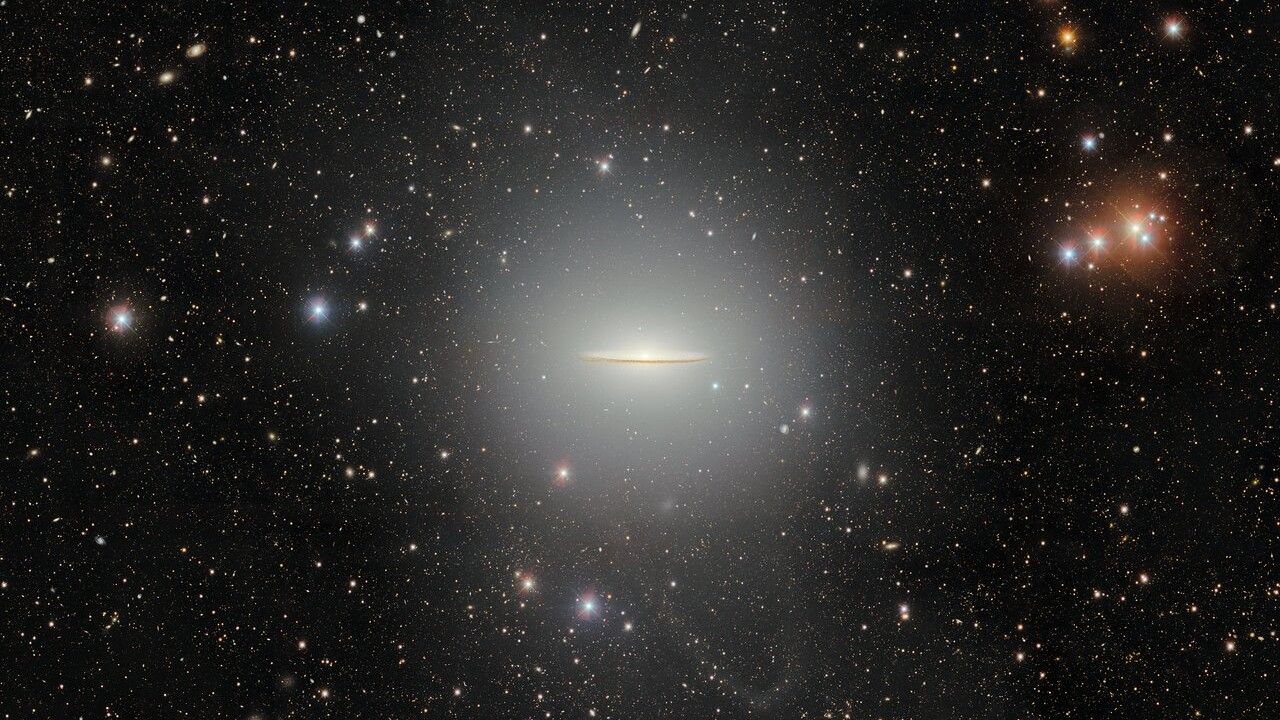
The Sombrero galaxy looks like a work of science fiction in a stunning new image showcasing its hat-shaped appearance in stunning detail.
What is it?
Messier 104, nicknamed the Sombrero galaxy, is a spiral galaxy located about 28 million light-years from Earth.
At an apparent magnitude of +8, it’s too dim to see with the naked eye. However, binoculars or a small telescope will reveal its distinctive, wide, sombrero shape, making it a favorite target for skywatchers.
Article continues below
If you’re looking for Messier 104 in the night sky, you can find it in the constellation Virgo.
This image of the far-off galaxy was captured using the Department of Energy-fabricated Dark Energy Camera (DECam), mounted on the U.S. National Science Foundation Victor M. Blanco 4-meter Telescope at Cerro Tololo Inter-American Observatory. The observatory is part of the National Science Foundations’ NOIRLab (formally the National Optical-Infrared Astronomy Research Laboratory), the U.S. center for ground-based nighttime optical astronomy.
Why is it incredible?
It’s no secret how the Sombrero galaxy got its nickname. With a very distinctive, wide and flat shape and it really does look like a cosmic sombrero.
The name itself has no scientific meaning — it’s simply a reflection of a very human habit of finding familiar shapes in the unfamiliar.
The Sombrero galaxy holds nearly 2,000 globular star clusters, nearly 10 times more than the number in our own Milky Way. But in looking at this galaxy like a big, cosmic hat, it becomes somehow more relatable. Humans have been doing this with galaxies, stars, constellations, and even cloud shapes for as long as we have existed, and it brings the cosmos close.
