


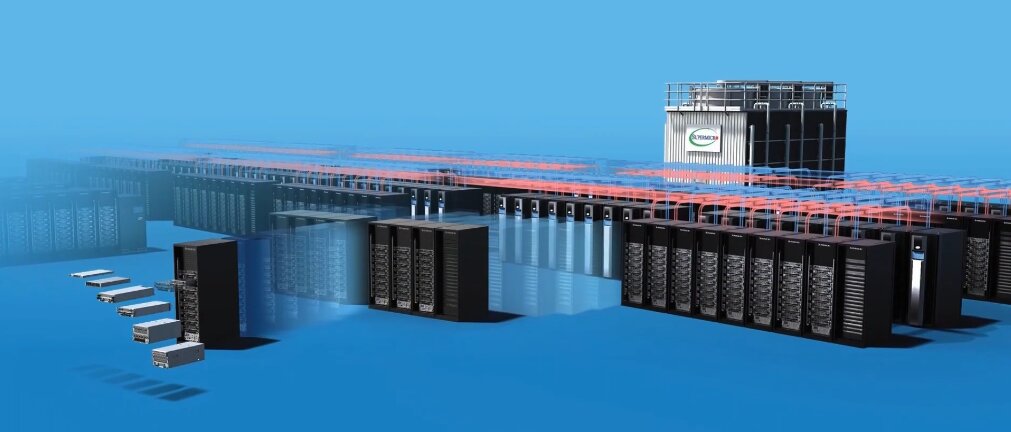
Super Micro Computer has a complete Data Center Building Block Solutions® (DCBBS). They have a comprehensive portfolio of racks engineered specifically for mission-critical, high-density AI data center deployments. The ORv3 standard allows Supermicro to offer customers a range of racks which simplify the integration of liquid cooling solutions for high compute-density systems, resulting in a reduction in the Total Cost of Ownership (TCO)
DCBBS technologies are high-density, liquid-cooling-optimized racks enable customers to deploy AI clusters faster, maximize compute density, improve reliability, and reduce total cost of ownership. Our manufacturing scale enables us to deliver up to 3,000 of these advanced racks per month, including 2,000 liquid-cooled racks from our facilities around the world for immediate deployment into existing and new data centers. The racks are Plug-and-Play ready for immediate installation in the customers data center.
3,000 per month would be enough for one 220K B300 400 Megawatt SpaceXAI minihard datacenter.
Backed by Supermicro Rack Integration Services and modular DCBBS portfolio Supermicro is capable of delivering complete, rack-scale data center infrastructure solutions at scale, streamlining deployment which gives customers a reduced Time-to-Online (TTO). Engineered entirely in-house by Supermicro, all racks feature a reinforced chassis with a certified static load capacity of up to 5500 lb/ 2,500 kg—significantly exceeding typical industry standards.
“Deploying as quickly as three months” — direct quote from CEO Charles Liang in a May 2025 press release introducing/expanding the DCBBS approach for AI/IT liquid-cooled data centers.
Company statements and investor materials target scaling to ~6,000 racks per month (including ~3,000 direct liquid-cooled) by the end of fiscal 2026.
What’s actually confirmed
Supermicro is genuinely working with SpaceXAI. Charles Liang posted on X in June 2026 that he was proud to co-build another new gigawatt AI datacenter for SpaceX and xAI within a year, calling it Supermicro’s fastest time-to-online yet. That was June 12, so “within a year” does land around mid-2027.
Supermicro then reported over $60 billion in new AI server orders in its fiscal Q4 with gross margins guided to 15–17%.
Liang confirmed Supermicro teamed with xAI to build the original Colossus in 122 days, with the 100,000-GPU cluster housed in Supermicro liquid-cooled racks at 64 GPUs per rack across roughly 1,500 racks.
Supermicro is a co-supplier, not the supplier. On Colossus 1, Dell assembled roughly half the racks on its PowerEdge XE9680 platform while Supermicro provided the other half. There’s no public evidence that split has changed for Macrohard/Macrohardrr/Minihard.
3,000 per month would be enough for one Minihard assumes SpaceXAI gets 100% of Supermicro’s global monthly output for a full month. Supermicro also serves Oracle, CoreWeave, sovereign deals, and enterprise. A single customer might get 30–50% of capacity, which stretches one 220K building to two or three months on the rack side alone.
Brian Wang is a Futurist Thought Leader and a popular Science blogger with 1 million readers per month. His blog Nextbigfuture.com is ranked #1 Science News Blog. It covers many disruptive technology and trends including Space, Robotics, Artificial Intelligence, Medicine, Anti-aging Biotechnology, and Nanotechnology.
Known for identifying cutting edge technologies, he is currently a Co-Founder of a startup and fundraiser for high potential early-stage companies. He is the Head of Research for Allocations for deep technology investments and an Angel Investor at Space Angels.
A frequent speaker at corporations, he has been a TEDx speaker, a Singularity University speaker and guest at numerous interviews for radio and podcasts. He is open to public speaking and advising engagements.
