


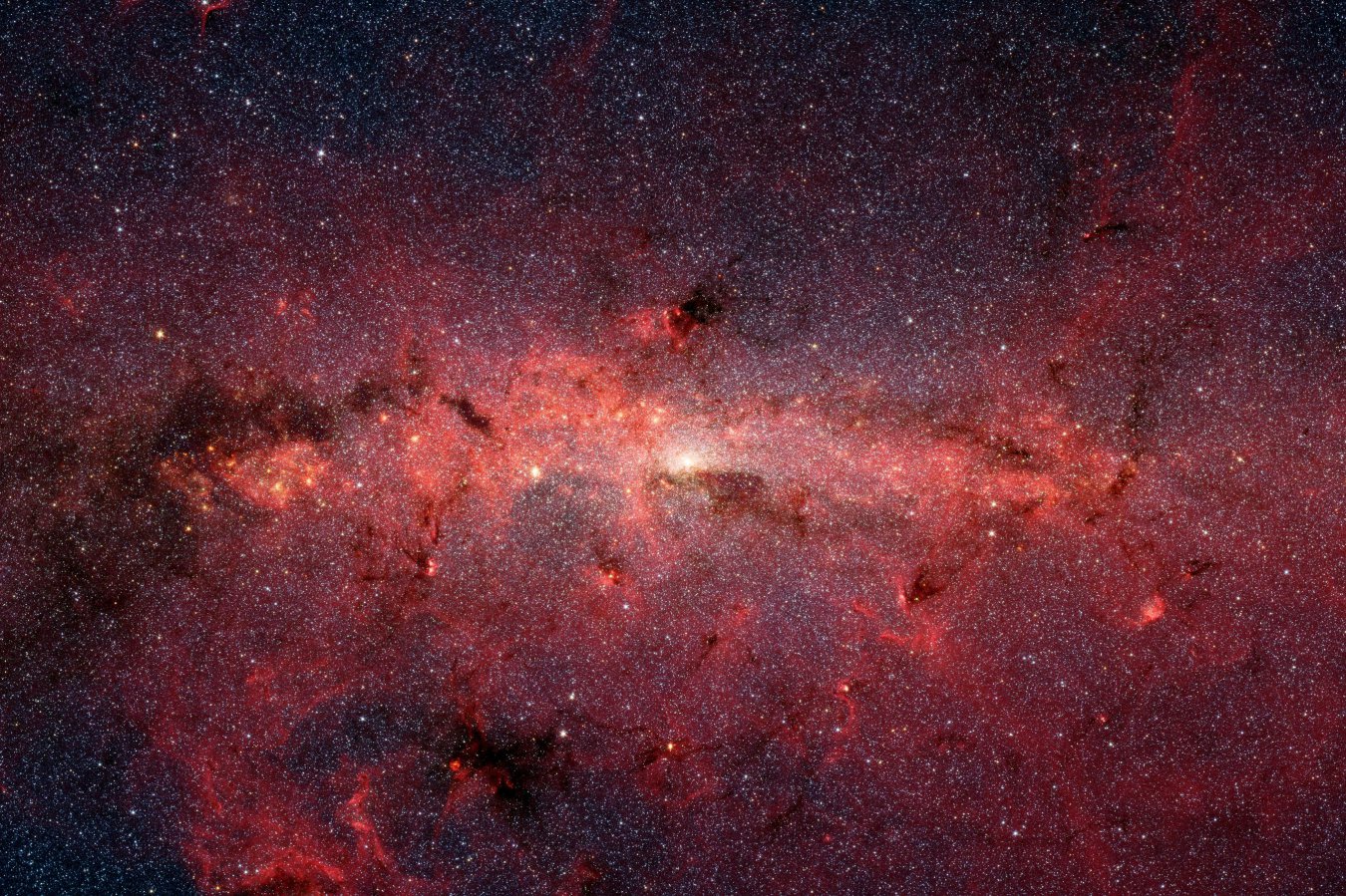

Is there any sugar out there?
NASA, JPL-Caltech, Susan Stolovy (SSC/Caltech) et al.
Sugar molecules have been found in interstellar space for the first time. The finding adds further evidence to the idea that early life on Earth may have benefited from complex sugar molecules arriving from elsewhere.
Sugars arise from chemical bonds among carbon, hydrogen and oxygen. Besides serving as an energy source, certain sugars are fundamental building blocks of RNA and DNA, the genetic material found in every living cell. However, there has long been a chicken-and-egg problem: living organisms make sugars with enzymes, but experiments recreating conditions on pre-life Earth have yielded relatively few.
Recent discoveries of sugars in meteorite and asteroid samples suggest that such bodies may have delivered them to the young Earth. Izaskun Jiménez-Serra at Centre for Astrobiology in Madrid, Spain, and her colleagues wondered if sugars might be present in interstellar space itself.
To find out, they aimed radio telescopes at G+0.693−0.027, a large molecular cloud 26,700 light years away already known to contain dozens of organic molecules, including glycolaldehyde, a compound involved in sugar formation but not considered a true sugar itself.
The team compared the cloud’s radio emissions with laboratory measurements of spectral fingerprints – distinctive patterns of radio frequencies that molecules absorb and emit – for the simplest sugars, glyceraldehyde and dihydroxyacetone.
When results came up empty for either of these three-carbon sugars, Jiménez-Serra says she decided to check for a more complex four-carbon sugar, erythrulose, one of the sugars found in raspberries. To her surprise, the team found an incredibly rich supply of the molecule.
“When I started looking at the signals, I was like, ‘I can’t believe this!’” she says. “This is really getting detected! And it’s a huge amount of sugar.”
The findings suggest that erythrulose may have formed before the solar system itself, become trapped inside asteroids and comets as they formed and finally reached the young Earth during the Late Heavy Bombardment about 4 billion years ago. This process could have delivered the equivalent of 500,000 to 50 million tonnes of erythrulose to the young Earth, says Jiménez-Serra.
“These molecular clouds are basically the birth sites of stars and planets,” she says. “So essentially, we’re finding that these complex organic compounds that are important for the origin of life can form already very early in the formation process of a planetary system.”
“This is a very exciting finding,” says Yoshihiro Furukawa at Tohoku University in Japan. “It points to an additional source of sugar distribution beyond asteroids. We have been waiting for an actual detection like this.”
Chemistry unlike anything naturally seen on Earth – playing out on icy dust grains chilled to around -250°C and bombarded by intense radiation – may have produced some of the molecular building blocks that ultimately gave rise to life, says Niels Ligterink at TU Delft in the Netherlands. “We can now say that the ingredients for biochemistry are likely spread throughout the galaxy,” he says.
