


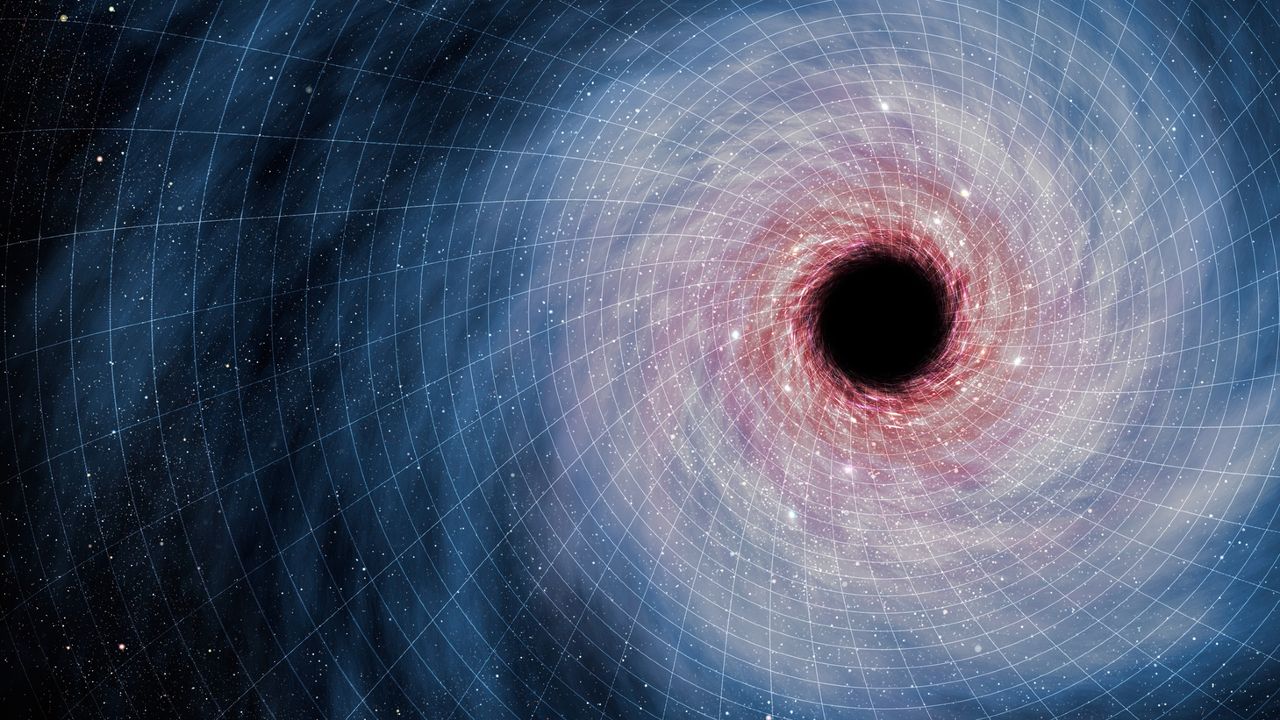
(Image credit: MARK GARLICK/SCIENCE PHOTO LIBRARY via Getty Images)
A new theoretical study suggests that black holes may never fully evaporate, which contradicts an infamous Stephen Hawking theory that seems to violate fundamental laws of quantum mechanics. Instead, black holes could leave behind tiny, stable remnants that store all the information they once consumed, the study suggests.
But there’s a twist — literally. For the theory to work, the universe must have three extra hidden dimensions that humans cannot perceive, making space-time seven-dimensional. As these hidden dimensions fold and twist, they create a repulsive force that prevents black holes from evaporating entirely.
A paradox that challenges the foundations of physics
Black holes are often thought of as cosmic traps from which nothing escapes. Yet, since the 1970s, physicists have known that these cosmic behemoths are not entirely black. Famed theoretical physicist Stephen Hawking proposed that black holes emit radiation and slowly evaporate over time, which leads to a troubling contradiction known as the information loss paradox.
“Imagine you throw a book into a fire,” study co-author Richard Pinčák, a senior researcher at the Slovak Academy of Sciences’ Institute of Experimental Physics, told Live Science via email. “The book is destroyed, but in principle you could reconstruct every word from the smoke, ash, and heat — the information is scrambled, not lost.”
But when a black hole evaporates completely, the information about everything that fell into it appears to vanish, violating a core principle of quantum mechanics.
For decades, physicists have struggled to resolve this paradox. Now, the new study, published March 19 in the journal General Relativity and Gravitation, suggests the answer may lie in the hidden structure of space-time itself.
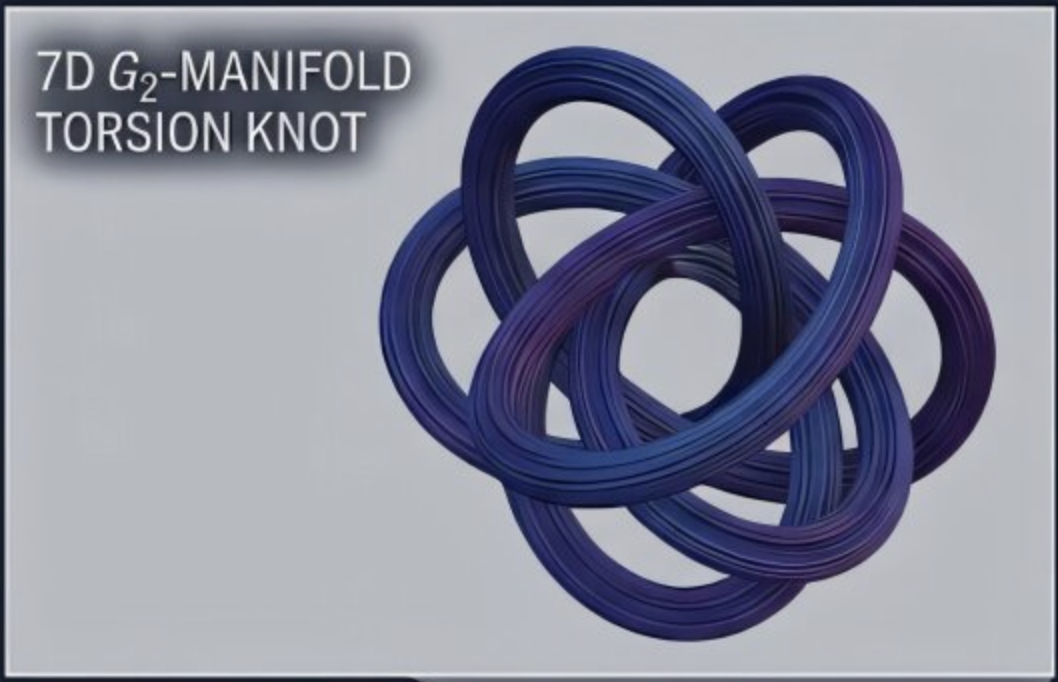
The new research explores a universe with more dimensions than the familiar four. In this framework, the cosmos contains seven dimensions, three of which are compact and invisible at everyday scales.
“We experience three dimensions of space and one of time — four dimensions in total,” Pinčák said. “Our model proposes that the universe actually has seven dimensions: the four we know, plus three tiny extra dimensions curled up so tightly that we cannot directly perceive them.”
These extra dimensions are arranged in a highly symmetrical structure known as a G₂ geometry. This mathematical framework, often explored in advanced theories such as a version of string theory known as M-theory, determines how the hidden dimensions are “folded.”
“Think of it like origami,” Pinčák said. “The way you fold the paper determines what the final shape can do.”
In the new model, this geometric structure produces a physical effect called torsion, which can be thought of as a twisting of space-time. This torsion field turns out to play a crucial role in black hole physics.
Torsion and the birth of stable black hole remnants
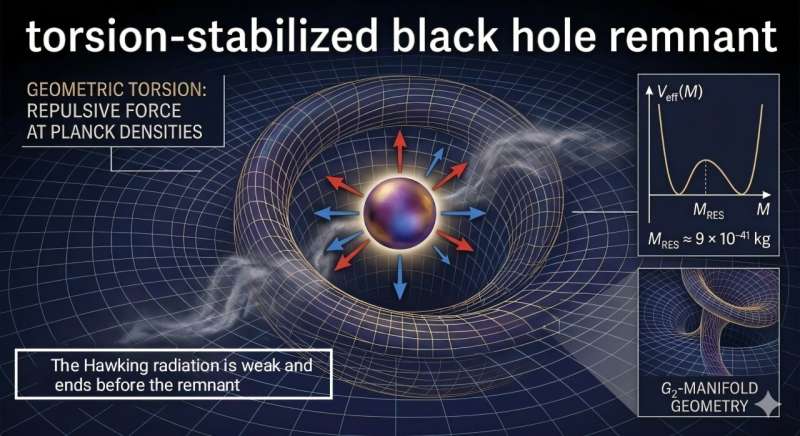
The study shows that torsion generates a repulsive force that becomes important at extremely small scales, near the end of a black hole’s life. As the black hole shrinks through Hawking radiation, this force eventually counteracts further collapse.
“This repulsive force acts as a brake, halting the evaporation before the black hole vanishes completely,” Pinčák said.
Instead of disappearing, the black hole stabilizes into a tiny remnant. According to the model, this leftover object has a mass of about 9 × 10⁻⁴¹ kilograms — some 10 billion times smaller than an electron.
Crucially, this remnant can store the information that fell into the black hole, avoiding any violation of quantum mechanics. The information is encoded in subtle oscillations known as quasinormal modes, which act as carriers of the lost data.
The model also reveals an unexpected connection to particle physics: The existence of three hidden dimensions, together with the presence of torsion, produces the pattern of particle interactions responsible for the Higgs mechanism, the phenomenon that gives mass to elementary particles like electrons and quarks.
“The same torsion field… generates a potential energy landscape that is identical in form to the one responsible for giving mass to the W and Z bosons — the carriers of the weak nuclear force,” Pinčák said.
This link ties the behavior of black holes to the electroweak scale, a well-known energy scale in particle physics.
Where the new theory reaches its limits
Despite its appeal, the model faces important challenges. The standard description of black hole evaporation relies on a semiclassical approximation, which is expected to break down at extremely small scales near the Planck mass — approximately 10-5 grams. This is the mass scale at which quantum gravitational effects become strong and impossible to ignore.
“As the black hole shrinks toward the Planck scale, all existing models — ours included — must eventually confront the transition into the deep quantum-gravity regime,” Pinčák noted.
In this regime, a full theory of quantum gravity is required, but such a theory remains incomplete. The new work does not claim to solve this problem entirely. Instead, it provides a concrete mechanism for how new physics could emerge at the final stage of evaporation.
“What distinguishes our approach is that we do not claim semiclassical evaporation operates all the way down to the remnant mass,” Pinčák said. “At that point, a new physical effect … takes over and stabilises the configuration.”
Testing the theory directly will be extremely difficult; the relevant energy scales are far beyond the reach of current particle accelerators. However, the model makes clear predictions that could, in principle, be tested.
For example, it predicts that hypothetical Kaluza-Klein particles associated with extra dimensions should have masses of around 10¹⁶ gigaelectronvolts — about 14 orders of magnitude heavier than the top quark, the most massive known elementary particle. Detecting lighter versions of these particles with current or future accelerators would rule out the model.
Another possibility involves observing the final stages of black hole evaporation, particularly for primordial black holes. Future gamma-ray telescopes or gravitational wave detectors could provide indirect evidence for stable remnants.
“The important point is that the predictions are concrete — the model can be wrong, which is what makes it scientific,” Pinčák said.
Looking ahead, the researchers aim to connect their framework more directly to fundamental theories such as M-theory and to better understand how information is stored in the remnants. If confirmed, the idea that black holes leave behind tiny, information-rich remnants could reshape our understanding of gravity, quantum mechanics and the fundamental structure of the universe.
Pinčák, R., Pigazzini, A., Pudlák, M., & Bartoš, E. (2026). Geometric origin of a stable black hole remnant from torsion in G$$_2$$-manifold geometry. General Relativity and Gravitation, 58(3). https://doi.org/10.1007/s10714-026-03528-z
How much do you know about black holes? Test your cosmic knowledge with our black hole quiz!
” data-join-the-conversation-text=”Join the Conversation”>
You must confirm your public display name before commenting
Please logout and then login again, you will then be prompted to enter your display name.
