


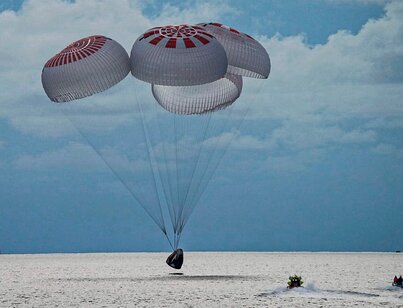
Starfall is SpaceX’s new uncrewed disk-shaped cargo return capsule (launched on its first demo flight today, June 23, 2026, aboard a Falcon 9). It is a flat, low-profile vehicle (~3.1 m diameter × 0.75 m tall) designed for rapid, high-volume return of up to ~1,000 kg of payload from orbit — especially for in-space manufacturing (pharma, materials, etc.). It has no main propulsion and cannot deorbit itself; the host vehicle (Falcon upper stage or Starship) performs the deorbit burn or places it on a re-entry trajectory.
It uses cold-gas (nitrogen) attitude control thrusters fed from composite overwrapped pressure vessels (COPVs) in the heat shield. These are classic low-thrust RCS thrusters — excellent for precise orientation but useless for meaningful delta-v or major trajectory changes.Future human-rated Starfall capsules are not yet announced, but the question assumes they will exist. The same control principles would apply and could be scaled up.
How cold-gas thrusters adjust the re-entry profile
Current thrusters do not provide significant propulsion or slow the vehicle.
They can enable precise attitude (orientation) control, which is one of the most important tools for shaping the aerodynamic re-entry profile.
Pre-entry orientation (vacuum/coast phase)
After separation from the deorbiting upper stage, the cold-gas thrusters rotate the capsule to the exact desired angle of attack and bank angle. This sets how much lift the capsule generates and in which direction the lift vector points.
Lift modulation for gentler deceleration
By flying at a controlled angle of attack, the capsule generates aerodynamic lift (typical L/D for capsules is ~0.2–0.3). Lift lets the vehicle “fly” through the upper atmosphere longer instead of plunging straight in. This spreads the velocity loss over more time and distance, dramatically lowering peak G-force.
A well-controlled lifting entry can keep peaks in the 3–5 G range (or lower with optimized design) instead of 8–10+ G for a ballistic fall.
Bank angle steering (cross-range & G-load control)
The thrusters allow the vehicle to roll (bank) and point the lift vector left/right or up/down. This lets the guidance system:Steer to a precise landing zone (important for point-to-point cargo or crew recovery).
Modulate how much lift is “used” vs. “wasted” to keep peak deceleration and heating within limits.
Perform minor trajectory corrections if the initial deorbit was slightly off.
Early atmospheric stabilization: Once thin air begins to bite, the thrusters can help maintain stable attitude against initial aerodynamic torques until aero surfaces (or the capsule’s inherent stability) take over.
The cold-gas thrusters give the vehicle closed-loop guidance and control authority during the critical seconds/minutes before and at the start of atmospheric interface. This turns a potentially violent ballistic plunge into a guided, lifting entry with lower peak loads, lower heating, and better targeting — exactly the kind of profile needed for human-rated vehicles where you want to keep accelerations comfortably below dangerous thresholds for as many people as possible.For a future human-rated Starfall, SpaceX could further improve this by Optimizing the disk shape + center-of-gravity for better inherent lift.
Adding more sophisticated guidance algorithms.
Possibly scaling up thruster authority or adding small aero surfaces.
Designing seats/crew orientation for the most tolerable G direction (+Gx, chest-to-back).
G-forces in current LEO returns (Soyuz & Crew Dragon)
Nominal re-entries from the ISS (low Earth orbit) produce peak accelerations of roughly 3.5–5 G for both vehicles:Soyuz: Typically ~4–4.5 G peak on a controlled (lifting) entry. In ballistic (uncontrolled/emergency) mode it rises to 6–8+ G.
Crew Dragon with nominal entries are often cited around 3–4 G (sometimes up to ~4.2 G depending on exact conditions and lift-to-drag). Contingency cases can go higher.
Risks for unfit/untrained tourists
There is a medical risk for some. At 4–6 G (especially if sustained or in certain directions):G-LOC (G-induced loss of consciousness) is possible.
Severe nausea, vomiting, and disorientation are common even in trained crews.
If someone vomits and becomes incapacitated while strapped in a helmet or with limited mobility, there is a real (though low-probability) choking/aspiration risk — and during the high-G plasma blackout phase, crewmates may have limited ability to assist immediately.
Space tourists on Dragon (Inspiration4, Axiom missions) have flown successfully after some training and medical screening, but they are not “completely untrained couch potatoes.” Completely unfit or untrained individuals would face meaningfully higher risk. Short-duration tourist flights already include basic G-tolerance training and medical vetting for this reason.
BTW: If you could not handle 3-4Gs then you are not flying up to space either.
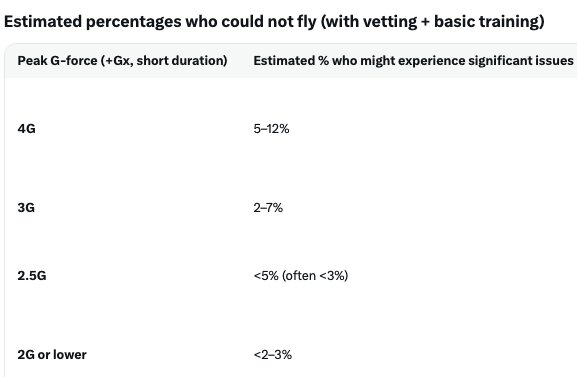
The peak G threshold where intolerance would also disqualify you from flying “up” (launch/ascent) is roughly the same as the ascent peak itself — about 3.5–4 G.Here’s why, based on real SpaceX Crew Dragon/Falcon 9 data and how missions are screened.
Current Dragon/Falcon 9 ascent G-forces build gradually. Typical peaks are 3–4 G (often cited as ~3.2 G on first stage, up to ~4.1 G on second stage). Astronauts describe it as building to around 3 G, then a brief drop at staging, then building again. The vehicle is designed/throttled to keep it in this comfortable range for crew.
Re-entry nominal peaks are also in the 3.5–4 G range (sometimes described as ~3–4 G or up to ~4.2 G depending on exact conditions and lift vector).
Both phases sit in essentially the same ballpark (~3–4 G peak, short duration, mostly tolerable +Gx direction after proper seating/orientation).
In an ascent or midair or midspace emergency, you will need to survive higher Gs. The emergency systems will ideally give a good chance versus no chance without emergency systems.
Brian Wang is a Futurist Thought Leader and a popular Science blogger with 1 million readers per month. His blog Nextbigfuture.com is ranked #1 Science News Blog. It covers many disruptive technology and trends including Space, Robotics, Artificial Intelligence, Medicine, Anti-aging Biotechnology, and Nanotechnology.
Known for identifying cutting edge technologies, he is currently a Co-Founder of a startup and fundraiser for high potential early-stage companies. He is the Head of Research for Allocations for deep technology investments and an Angel Investor at Space Angels.
A frequent speaker at corporations, he has been a TEDx speaker, a Singularity University speaker and guest at numerous interviews for radio and podcasts. He is open to public speaking and advising engagements.
