



The fight to save endangered species may have a new weapon: sex-changing mouse clones
For the first time, scientists managed to turn cloned male mouse embryos into females, giving life to healthy and fertile individuals
By Gennaro Tomma edited by Sarah Lewin Frasier
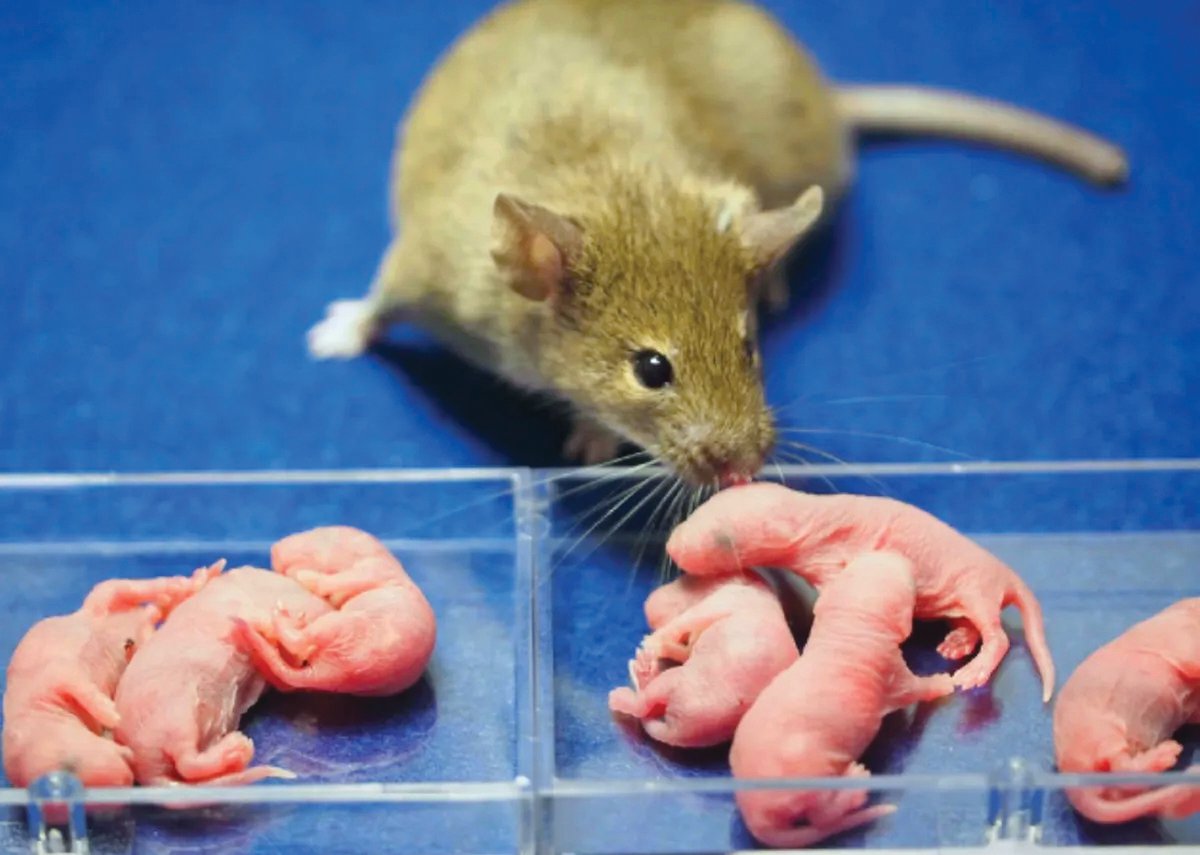
A male donor mouse meets its female (right) and male (left) clones.
Takashi Ichiushi and Shogo Matoba
Scientists racing to save critically endangered species may soon have a new tool at their disposal: sex-changing clones. For the first time, researchers managed to turn cloned male mouse embryos into females, giving life to healthy and fertile animals. The technique could one day help scientists rescue endangered species with only a few surviving individuals.
“I think it’s a really neat foundational breakthrough in reproductive science,” says Ben Novak, lead scientist at Revive and Restore, a nonprofit that promotes biotechnology for wildlife conservation. “Being able to manipulate chromosome counts and chromosome makeup will open up a new avenue of functional genomic science.” Novak wasn’t involved in the new study, which has not yet been peer-reviewed.
Inspired by the Okinawa rubble goby, a Japanese fish that can switch sex, researchers used a method based on the gene-editing tool CRISPR to eliminate the Y chromosome from male embryos, which typically carry both X and Y chromosomes. This process turned the embryos female with just a single X chromosome—typically notated as XO.
On supporting science journalism
If you’re enjoying this article, consider supporting our award-winning journalism by subscribing. By purchasing a subscription you are helping to ensure the future of impactful stories about the discoveries and ideas shaping our world today.
The scientists first successfully tested the tool, which they named Y-CUT, on male mouse embryos obtained through in vitro fertilization. Then they produced cloned male mouse embryos through a process called somatic cell nuclear transfer, in which a donor mouse’s cell nucleus was transferred into an egg cell with its own nucleus removed. The team applied Y-CUT to the cloned cells and transferred them to surrogate mothers, which gave birth to healthy, fertile female clones. In other words, the researchers were able to produce both male and female clones from the same donor male. The cloned females carried the exact same genome as the donor male (except for the Y chromosome).
In a surreal twist, the donor male mouse had the chance to meet its female clones. And it got weirder: The cloned females mated with male clones, producing offspring with regular XX or XY chromosomes. That’s why the researchers say the tool could be useful for rescuing endangered species with a few individuals left—scientists could create fertile breeding pairs using just one male donor.
“It certainly can have long-term future applications for extreme cases of species revival,” Novak says. Still, as tantalizing as the prospect of cloning a creature out of extinction may be, the method is limited—and not just because it requires at least one male. For example, female rodents carrying XO chromosomes may be fertile, but many other mammals, including horses and humans, can’t reproduce when they have this chromosome combination. It’s possible that supplementing the technique with other elements, such as future technologies that could add an X chromosome to XO embryos, might help overcome this problem.
Subscribe to Support Independent Journalism
Great science journalism requires human expertise, time, effort and creativity. And it costs money. That’s why I and the journalists here at Scientific American hope you’ll join our community.
When you subscribe, you are supporting staff and freelance journalists who are passionate about telling science stories that are true, important and compelling. Our editors and reporters are often experts in their fields, which means they understand the nuances of big discoveries and can untangle the breakthroughs from the hype. With a subscription, you are also supporting rigorous fact-checking to ensure the words we publish are precise and accurate. And you’re supporting original illustrations, graphics and photos that bring you closer to an advanced laboratory, an ice sheet in Antarctica or a space mission in orbit. You’re helping us craft other types of high-quality journalism as well: Our newsletters are carefully written, edited and curated by staffers you have or will come to know and love. Our Science Quickly podcast is based on original reporting, collaboration with editors and scientists and exacting production.
Subscriptions keep this engine running so we can continue to deliver thoughtful, rigorous and independent science journalism to you. In an era of viral misinformation, this work is crucial. If you value what we do, I hope you’ll consider joining us as a subscriber
