


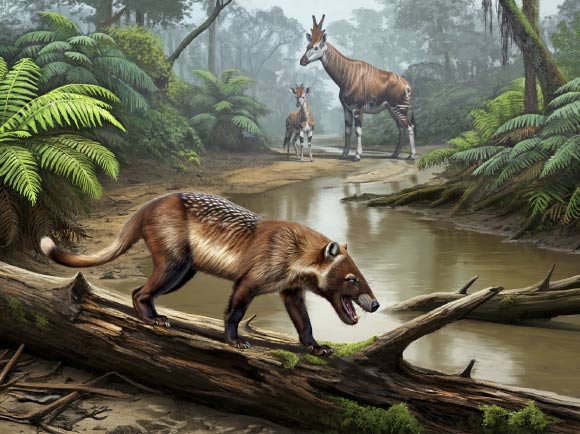
Paleontologists have recovered the fossilized remains of three hyaenodont species, including one previously unknown to science, from Miocene sediments in Pakistan.
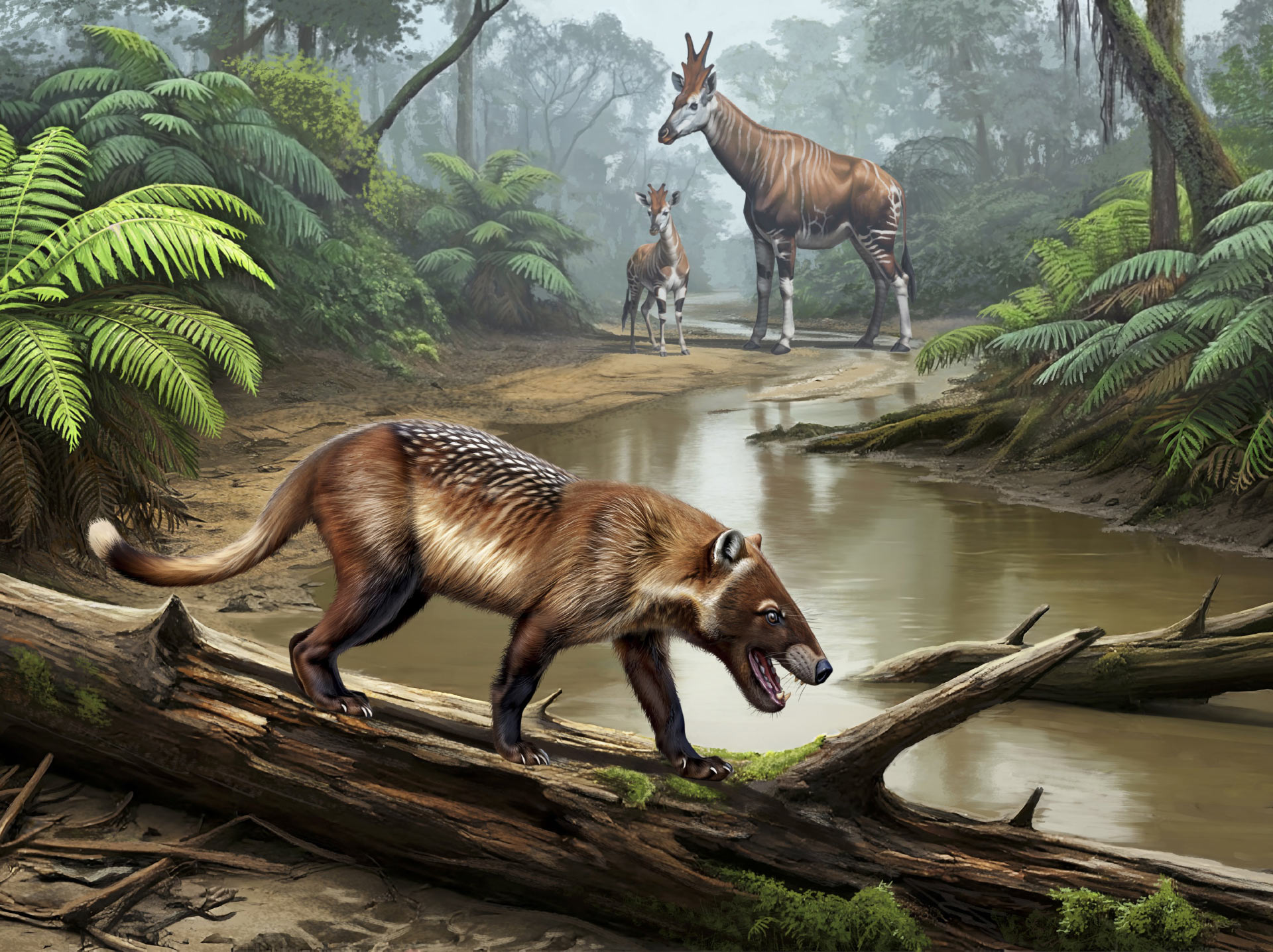
Metapterodon anari. Image credit: Steven Jasinski / SergeyAtrox1.
“Hyaenodonts were some of the most important mammalian carnivores before cats and dogs and the other mammalian predators we know today evolved and began to take over those niches, and some of them got to incredibly large sizes,” said Harrisburg University of Science and Technology’s Professor Steven Jasinski.
In a new study, Professor Jasinski and his colleagues examined fossils of three different hyaenodonts that lived between 14 and 9.5 million years ago.
The specimens came from the Chinji and Nagri formations of the Lower and Middle Siwaliks in Pakistan.
One of the hyaenodonts, tentatively identified as Megistotherium or Hyainailouros, was an incredibly large species that may have reached up to 500 kg — about the size of a polar bear.
The fossils were deciduous teeth from juvenile animals that had not yet developed permanent dentition, making firm identification difficult.
Other fossil teeth were identified as a member of the genus Hyaenodon.
While this wide-ranging genus is known from many northern continents, including North America, Europe, and Asia, these are the first specimens from this region.
They are also the youngest known occurrence of the genus and may represent a distinct species, though more material is needed to confirm this.
These creatures likely weighed around 30 kg, similar in size to a small gray wolf or leopard.
The paleontologists also identified a tooth belonging to a genus of relatively small hyaenodonts called Metapterodon.
Previously known only from African fossils, the genus is now confirmed to have traveled out of Africa during the Miocene.
Named Metapterodon anari, the new species may also be one of the youngest hyaenodont fossils published to date.
“Metapterodon anari is incredibly important both for its place among similar species, but also its placement in time,” Professor Jasinski said.
“It represents one of the last hyaenodonts and gives us potential insight into a time when there was likely competition between these mammalian predators and carnivorans, which were starting to overtake them as the main terrestrial carnivorous mammals.”
Metapterodon anari reached about 15 kg, similar in size to a large red fox or coyote.
“The significance of these fossils lies not only in their taxonomic identifications but also in their geographic implications,” the researchers said.
“They confirm important connections between Africa and Europe during the Miocene and suggest possible migration of hyaenodonts from neighboring regions such as China.”
“The Miocene Pakistan hyaenodonts are particularly interesting because they lived alongside carnivorans, providing data on how the two groups competed.”
“All show features of hypercarnivores, with meat dominating their diets: a specialization that may ultimately have left them vulnerable to competitive exclusion by carnivorans.”
The fossils also help scientists better understand South Asia during the Miocene, a time of cooling global temperatures and shifting animal communities that helped lay the foundation for the ecosystems we see in the region today.
“Fossils are not just an interesting anecdote about past animals and plants; they help us understand what changes have occurred and how living things dealt with those changes,” Professor Jasinski said.
“Studying them also can help give us clues for what changes may occur in our future, and ideas as to how to deal with those changes.”
The team’s results appear in the journal PalZ.
_____
K. Mahmood et al. Hyaenodonta from the Middle to Late Miocene deposits of the Siwaliks of Pakistan with a brief account of Indian subcontinent hyaenodonts. PalZ, published online April 16, 2026; doi: 10.1007/s12542-025-00766-5
