

• About
  • Advertise
  • Privacy Policy
  • Contact
Over View - Your Daily News Source
  • Home
  • News
    • Business
    • Politics
    • Science
  • Lifestyle
    • Food
    • Travel
    • Health
    • Fashion
  • Entertainment
    • Entertainment
    • Sports
  • Tech
No Result
View All Result
  • Home
  • News
    • Business
    • Politics
    • Science
  • Lifestyle
    • Food
    • Travel
    • Health
    • Fashion
  • Entertainment
    • Entertainment
    • Sports
  • Tech
No Result
View All Result
Over View - Your Daily News Source
No Result
View All Result
Home News Science

On this day in space! Nov. 12, 2014: European Philae probe lands on Comet 67P, bounced twice and then got lost for nearly 2 years

admin by admin
November 13, 2026
in Science
0
On this day in space! Nov. 12, 2014: European Philae probe lands on Comet 67P, bounced twice and then got lost for nearly 2 years
0
SHARES
1
VIEWS

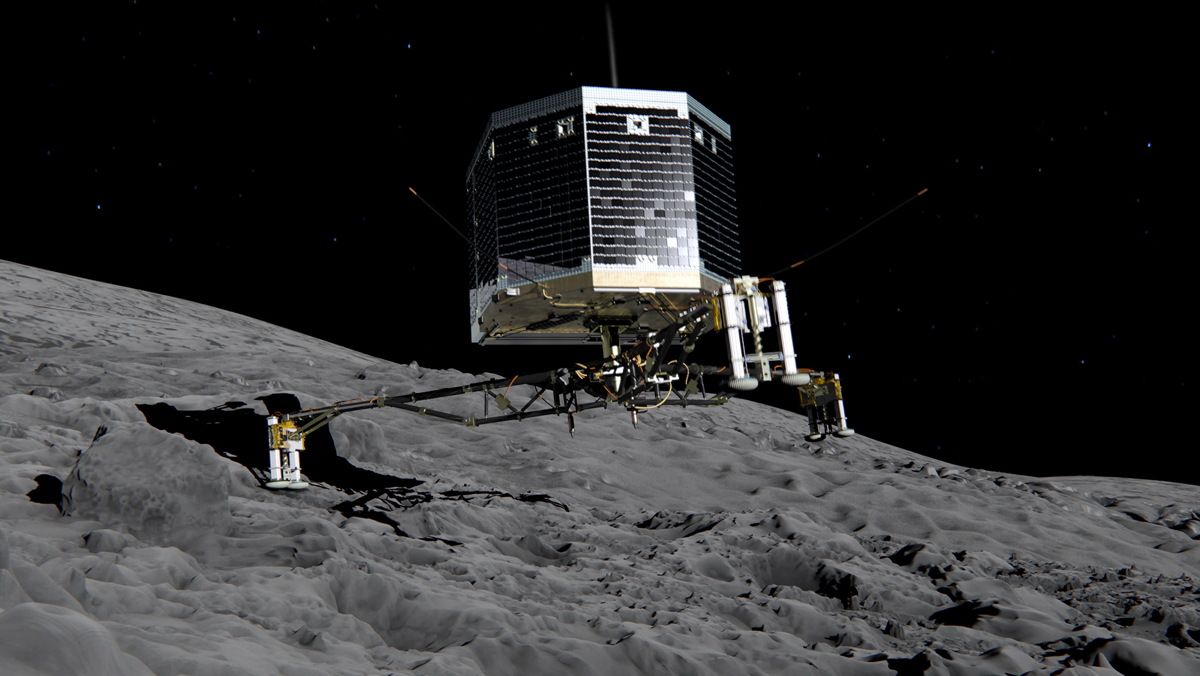
On Nov. 12, 2014, a European spacecraft named Philae landed on Comet 67P. To say it was a bumpy landing would be an understatement.

The European Space Agency’s Philae lander separated from an orbiter called Rosetta ahead of its historic landing in 2014. It was supposed to use harpoons to secure itself on to the surface of Comet 67P, but the harpoons never fired.

When it touched down, it immediately bounced back up into space. The first bounce brought Philae half a mile above the comet’s surface before gravity brought it back down.

Philae was missing for almost two years before scientists found it. Images from Rosetta showed Philae stuck in a dark crevice on top of the rubber duck-shaped comet.

The European Space Agency's Rosetta spacecraft captured these photos of the Philae lander descending on Nov. 12, 2014.

The European Space Agency’s Rosetta spacecraft captured these photos of the Philae lander descending toward, and then bouncing off, the surface of Comet 67P/Churyumov–Gerasimenko during its historic touchdown on Nov. 12, 2014. (Image credit: ESA/Rosetta/MPS for OSIRIS Team MPS/UPD/LAM/IAA/SSO/INTA/UPM/DASP/IDA)

Why it mattered

The European Space Agency‘s Rosetta and Philae expedition was a first-of-its-kind mission, an endeavour to not just rendezvous with a comet and watch it change over time as it approached the sun (that was Rosetta’s job), but also to soft-land a probe on its icy and rocky surface to see what a comet is truly made of.

The Rosetta and Philae mission succeeded on both counts, but Philae’s historic landing was marred by its turbulent touchdown. Philae actually landed three different times on Comet 67/P, all because the harpoons designed to secure it in place didn’t fire as planned.

After the first landing, Philae bounced up and drifted around the comet for two hours, making another bounce before Rosetta’s cameras lost track of it. Scientists figured it was stuck in a shady spot where sunlight couldn’t reach its solar panels. Because it was solar-powered, Philae needed to be facing the sun properly to generate enough power for sustained operation on the comet’s surface.

Still, Philae did have some power stored in batteries, which lasted for more than two days on the surface. That allowed Philae to perform some science with its 10 instruments in the time it had on Comet 67/P. Most notably, Philae found organic molecules that had never been detected on a comet before.

The Rosetta orbiter continued to orbit Comet 67P until September 2016, and it was in that month — just weeks before Rosetta itself landed on the comet on Sept. 30, 2016 — that the spacecraft rediscovered the Philae lander lying on its side in a rocky crevice.

Want more space history? Check out our full On This Day In Space Story archive and watch our On This Day In Space videos on YouTube.
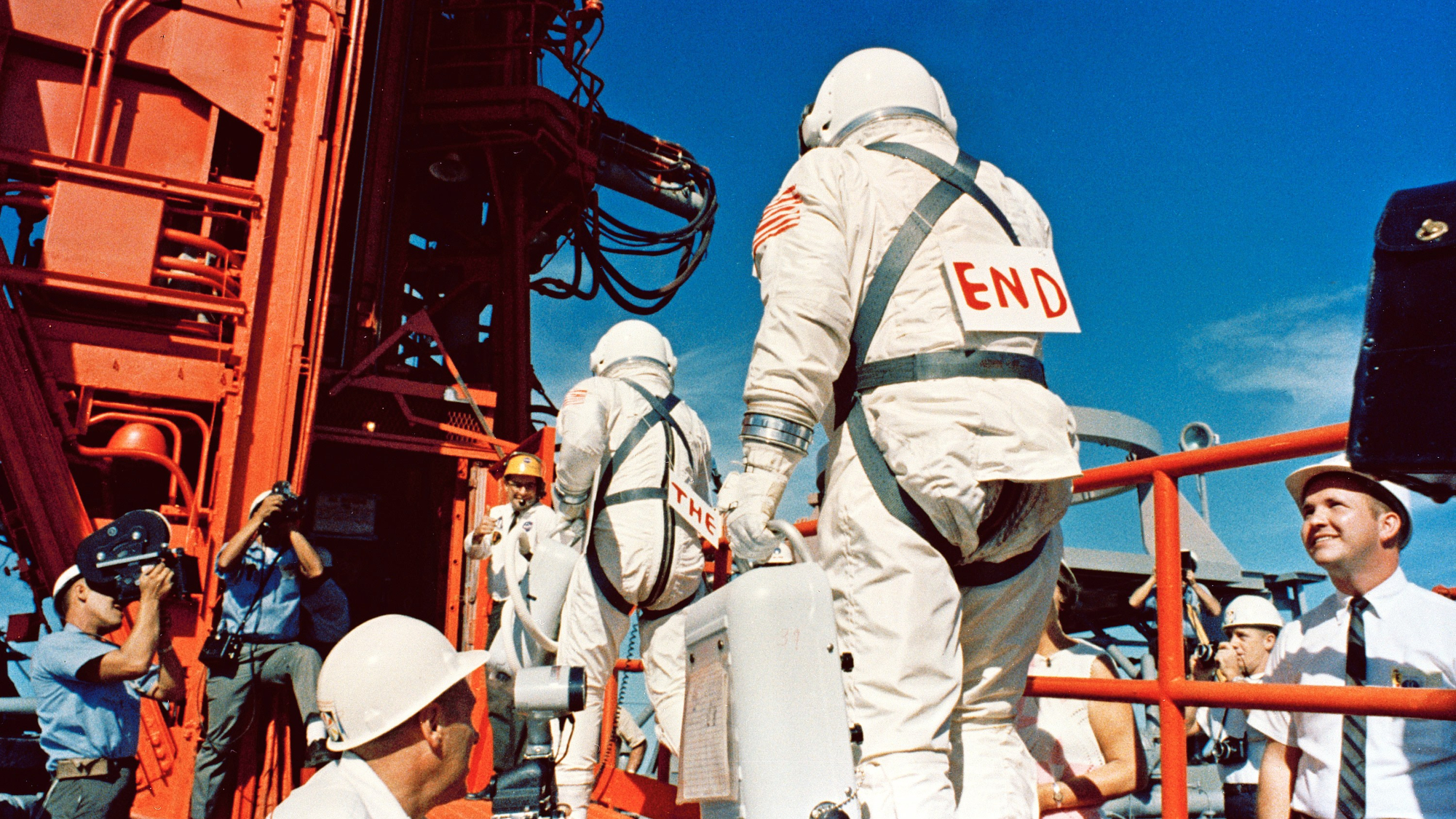
The Gemini 12 astronauts walk out to their launch pad with signs on their back denoting the end of the Gemini program.

Hanneke Weitering is a multimedia journalist in the Pacific Northwest reporting on the future of aviation at FutureFlight.aero and Aviation International News and was previously the Editor for Spaceflight and Astronomy news here at Space.com. As an editor with over 10 years of experience in science journalism she has previously written for Scholastic Classroom Magazines, MedPage Today and The Joint Institute for Computational Sciences at Oak Ridge National Laboratory. After studying physics at the University of Tennessee in her hometown of Knoxville, she earned her graduate degree in Science, Health and Environmental Reporting (SHERP) from New York University. Hanneke joined the Space.com team in 2016 as a staff writer and producer, covering topics including spaceflight and astronomy. She currently lives in Seattle, home of the Space Needle, with her cat and two snakes. In her spare time, Hanneke enjoys exploring the Rocky Mountains, basking in nature and looking for dark skies to gaze at the cosmos. 

Read More

Previous Post

Nithya Raman’s DSA Endorsement Could Be on the Chopping Block

Next Post

This supernova impostor baffled astronomers for 15 years — until they found a hidden black hole feeding on an unstable star

Next Post
This supernova impostor baffled astronomers for 15 years — until they found a hidden black hole feeding on an unstable star

This supernova impostor baffled astronomers for 15 years — until they found a hidden black hole feeding on an unstable star

  • About
  • Advertise
  • Privacy Policy
  • Contact

© 2026 JNews - Premium WordPress news & magazine theme by Jegtheme.

No Result
View All Result
  • Entertainment
    • Entertainment
    • Sports
  • Lifestyle
    • Fashion
    • Health
    • Travel
    • Food
  • News
    • Business
    • Politics
    • Science
  • Tech

© 2026 JNews - Premium WordPress news & magazine theme by Jegtheme.