



Paleontologists have identified a new genus and species of megaraptorid dinosaur from an incomplete skeleton unearthed in northern Patagonia, Argentina.
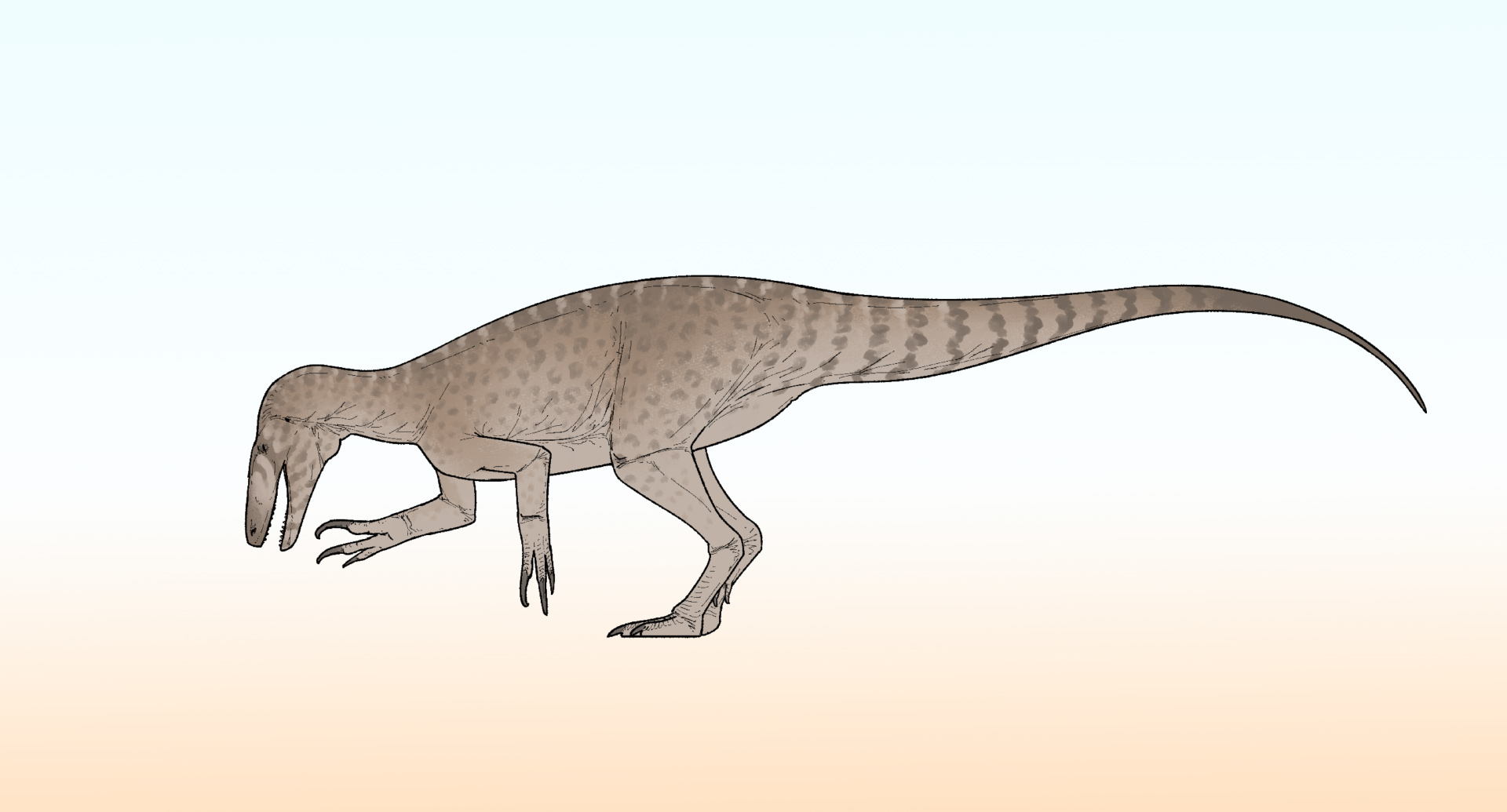
Life reconstruction of Rinconraptor pipoae. Image credit: Connor Ashbridge / CC BY 4.0.
The newly described species belongs to the Megaraptoridae, a group of medium- to large-sized theropods known for slender hind limbs, strongly curved teeth and large claws on their hands.
Dubbed Rinconraptor pipoae, the ancient predator roamed our planet during the Late Cretaceous epoch, some 83 million years ago.
“Megaraptoridae was recognized a decade ago and comprises medium- to large-sized theropods with several distinctive features, including strongly curved teeth with an 8-shaped outline, elongated and slender hindlimb bones, highly pneumatic cranial and vertebral elements, and large trenchant manual claws,” said CONICET paleontologist Ariel Hernán Méndez and his colleagues.
“Fossil remains of megaraptorans have been recorded not only in Argentina, but also in Brazil, Australia, Thailand, and Japan.”
“The megaraptorid fossil record remains scarce and fragmentary, so the phylogenetic affinities of this group have been the subject of debate among specialists.”
The fossilized remains of Rinconraptor pipoae were found at Cerro Overo, about 50 km (30 miles) southwest of the city of Rincón de los Sauces, in Patagonia, Argentina.
“The specimens come from the Bajo de la Carpa Formation, an integral unit of the Río Colorado Subgroup within the Neuquén Group, from the Upper Cretaceous of the Neuquén Basin,” the paleontologists said.
“Throughout the basin, this formation records a variety of paleoenvironments influenced by aeolian and fluvial depositional systems.”
The main specimen consists of 10 tail vertebrae, part of a bone from the underside of the tail, the lower end of a left upper-arm bone and the upper end of a right shinbone.
The tibia was still embedded in rock, while the other bones lay scattered on the surface within an area of about 4 square meters (roughly 43 square feet).
By comparing its vertebrae with those of better-known relatives, the researchers estimate that Rinconraptor pipoae was about 7 m (23 feet) long.
They also calculate that it had more than 40 to 45 tail segments, a pattern similar to that of Tyrannosaurus.
Dr. Méndez and co-authors also describe several other megaraptorid bones from the same area that they could not assign to a species. Their estimated body lengths range from about 6 to 8.5 meters (20 to 28 feet).
“The presence of medium- and large-sized megaraptorids in the Cerro Overo-La Invernada area during the Santonian coincides with the record of medium- and large-sized abelisaurids,” the scientists said.
“The presence of two groups of apex predators sharing time and space may have led to competition for resources.”
“However, the theropod fossil record in that area could indicate some partitioning of the ecological niche occupied by the representatives of both groups of carnivorous dinosaurs, to avoid direct competition for resources and allow coexistence.”
“It is particularly relevant in the Cerro Overo-La Invernada area, which represents an ecosystem with high faunal biodiversity, including titanosaur sauropods, as well as elasmarian and indeterminate ornithopods, among other species.”
The team’s paper was published online this month in the journal Palaeontologia Electronica.
_____
Ariel H. Méndez et al. 2026. Expanding the dinosaur diversity of the Cerro Overo-La Invernada area (Bajo de la Carpa Formation, Santonian), Northern Patagonia: Description of a new species and additional megaraptorid remains. Palaeontologia Electronica 29 (3): a41; doi: 10.26879/1738
