



Vera C. Rubin Observatory has spotted 2026 ED138 a large, bright trans-Neptunian object that scientists have identified as a dwarf planet candidate. The observations were announced today by the International Astronomical Union Minor Planet Center (MPC). If confirmed, ED138 would be among the largest dwarf planets ever discovered in this region of the Solar System.
The orbits of the five dwarf planets recognized by the International Astronomical Union (IAU): Pluto, Ceres, Eris, Haumea, and Makemake are in the image above.
ED138 is currently at a distance of about 46 astronomical units (au), where 1 au is the average distance between the Earth and the Sun. For reference, dwarf planet Pluto has an average distance of 40 au. This classifies ED138 as a trans-Neptunian object (TNO) — objects that orbit the Sun at a distance greater than Neptune’s.
ED138’s orbit is tilted almost 25 degrees off of the plane of the Solar System, classifying it as a hot-classical TNO and suggesting that it was disturbed from its original orbit through gravitational interactions with Neptune.
Not all TNOs are considered dwarf planet candidates, with the distinction being in the size and shape of the object. To be a dwarf planet an object needs to be massive enough for its own gravity to pull it into a round shape. Based on ED138’s distance, brightness and estimated surface reflectivity (albedo), the team estimates that its size is between 600 and 1500 kilometers, and icy bodies this large are expected to be round.
As of Sun Nov 22 2026 there are:
10 objects which are nearly certainly dwarf planets
19 objects which are highly likely to be dwarf planets
24 objects which are likely to be dwarf planets
74 objects which are probably dwarf planets
1306 objects which are possibly dwarf planets
The new object 2026 ED138
2026 ED138 was identified in early Vera C. Rubin Observatory data by Matthew Holman in October 2026 (announced 27 October). Precovery observations stretch back to a 1937 photographic plate; the object was missed for decades mainly because it lies far south and near the crowded Galactic plane.Wikipedia
Key facts:
Absolute magnitude HV≈3.19HV≈3.19 (one of the ten intrinsically brightest known TNOs; the brightest found since Chiminigagua in 2013).
Estimated diameter roughly 600–1,500 km depending on albedo (about 612 km at pV=0.25pV=0.25, ~970 km at 0.10, ~1,530 km at 0.04). Discoverers consider the 600–1,000 km range more probable.
Orbit: classical (hot) Kuiper-belt object with a≈43a≈43 AU, e≈0.14e≈0.14, i≈24.5∘i≈24.5∘, period ~282 years. Currently ~46–47 AU from the Sun.
Color is redder than the Haumea family, so it is not a family member.
Brown lists it among the “nearly certain” candidates (using an H estimate near 2.9 and a typical albedo ~0.14). It is still only a candidate. Its physical size and shape have not been measured. Thermal infrared observations, a stellar occultation, or detailed light-curve work would pin down the diameter and help settle the hydrostatic-equilibrium question. At its brightness it is accessible for spectroscopy and JWST follow-up.
A brighter (higher-albedo) surface makes a given observed brightness correspond to a smaller body. A darker surface implies a larger body. Many TNOs still lack direct size/albedo measurements. These usually come from thermal infrared observations (Spitzer, Herschel, ALMA, or JWST), stellar occultations, or (less precisely) light-curve constraints on shape. Those observations require scarce telescope time and are not always feasible, especially for objects that are faint, distant, or lie in crowded star fields.Wikipedia
Mike Brown’s running list ranks candidates by estimated diameter under reasonable albedo assumptions (using measured values when available, otherwise color- and population-based proxies). As of late November 2026
Nearly certain (over ~900 km) ~10 objects
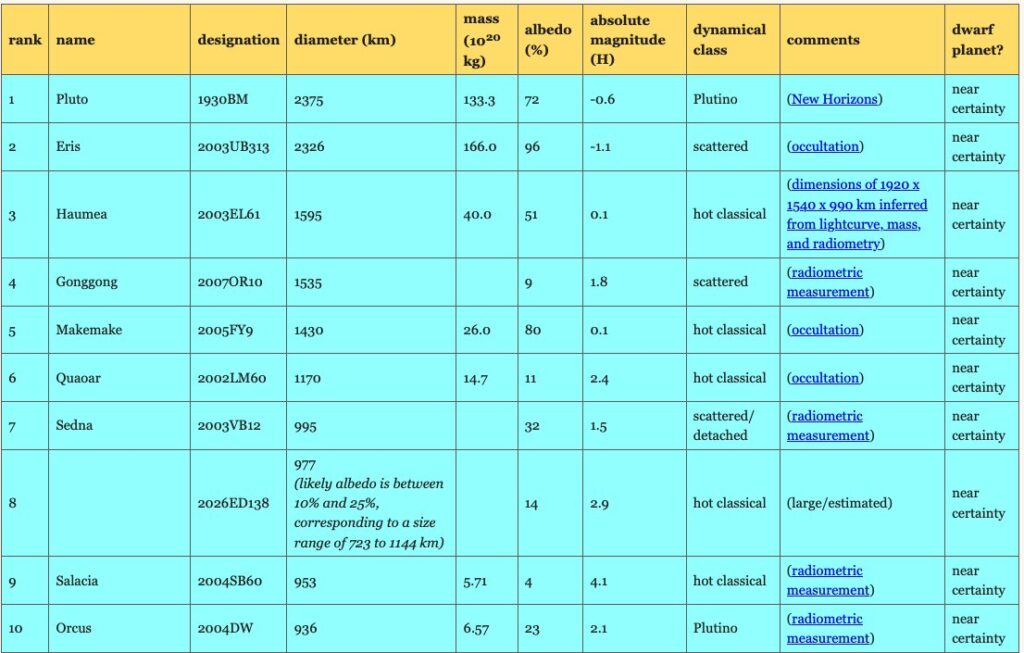
Highly likely (600–900 km) another ~19

Then dozens more in the “likely” / “probably” bins and over a thousand “possible”
Only five bodies are officially recognized by the IAU (Ceres, Pluto, Haumea, Makemake, Eris). The IAU has been conservative. Even high-probability objects such as Quaoar, Sedna, Gonggong, and Orcus remain unofficial. There is also ongoing scientific discussion about whether some mid-sized, low-density bodies retain significant porosity and never fully relaxed into solid spheres

Brian Wang is a Futurist Thought Leader and a popular Science blogger with 1 million readers per month. His blog Nextbigfuture.com is ranked #1 Science News Blog. It covers many disruptive technology and trends including Space, Robotics, Artificial Intelligence, Medicine, Anti-aging Biotechnology, and Nanotechnology.
Known for identifying cutting edge technologies, he is currently a Co-Founder of a startup and fundraiser for high potential early-stage companies. He is the Head of Research for Allocations for deep technology investments and an Angel Investor at Space Angels.
A frequent speaker at corporations, he has been a TEDx speaker, a Singularity University speaker and guest at numerous interviews for radio and podcasts. He is open to public speaking and advising engagements.
