


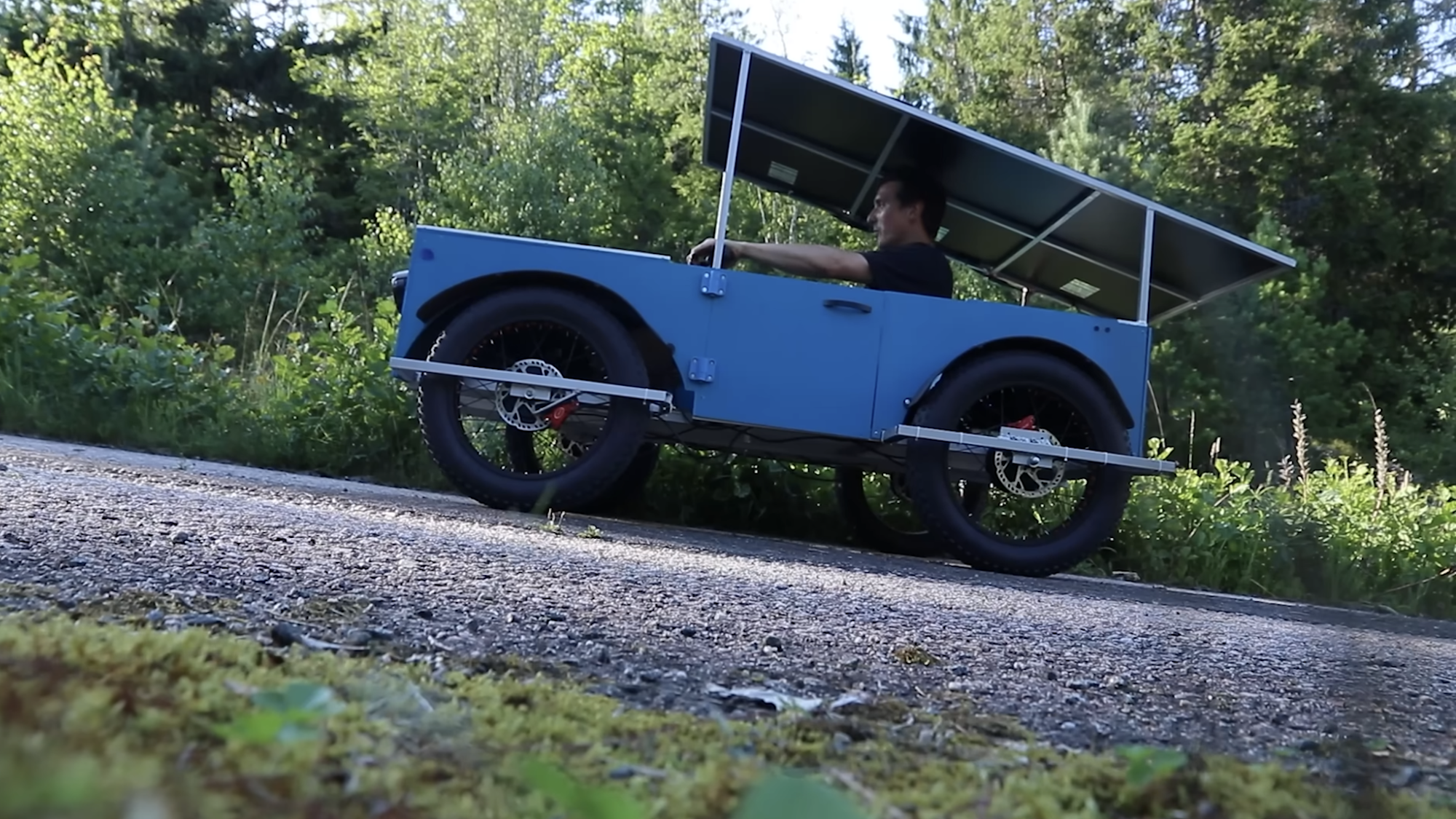
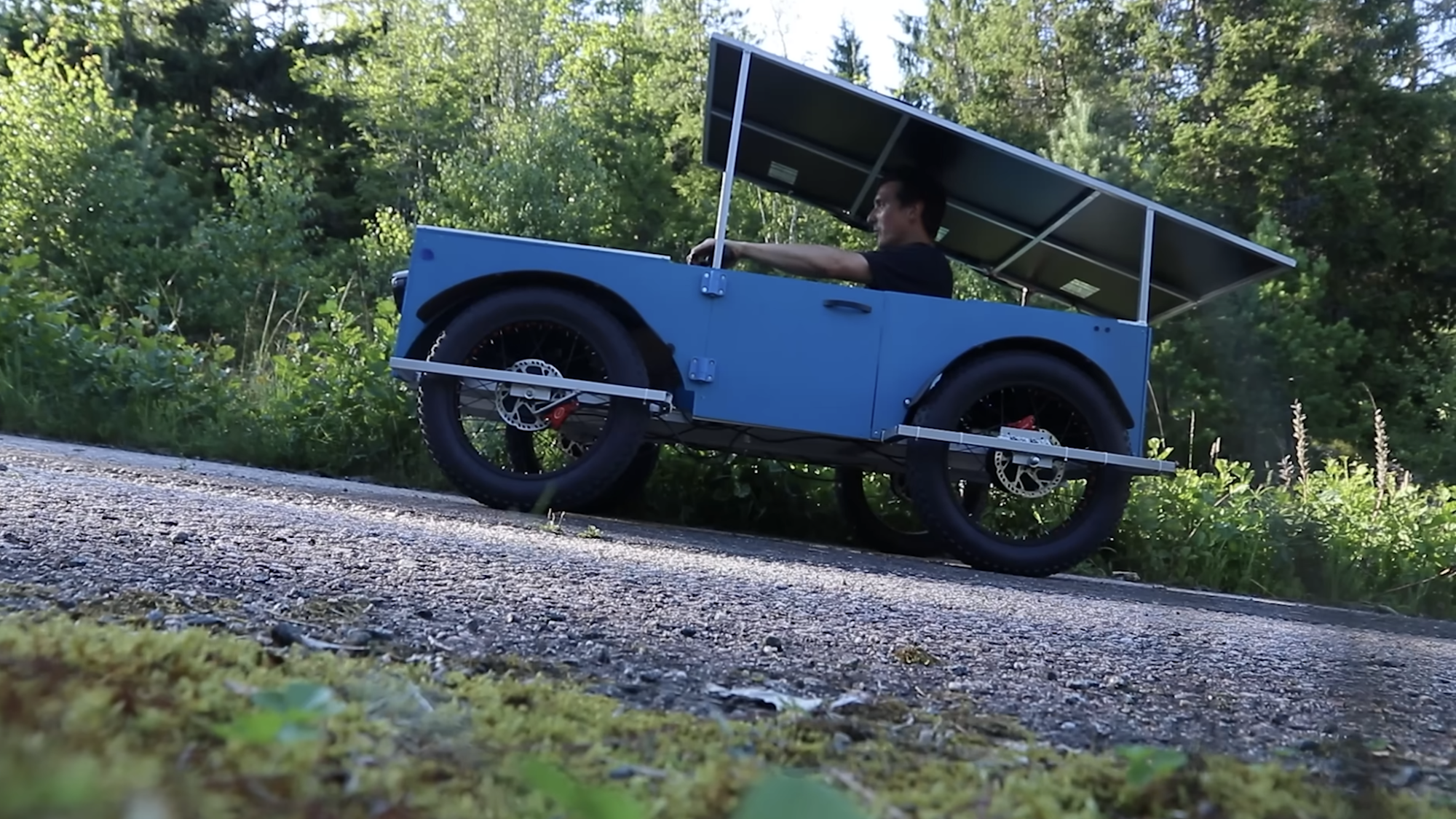
The vehicle is even capable of four-wheel drive.
Credit: YouTube
Get the Popular Science daily newsletter💡
Breakthroughs, discoveries, and DIY tips sent six days a week.
Engineering an efficient, affordable solar-power car has eluded automotive enthusiasts for decades. While the technology is increasingly becoming more cost-effective and integrated into global energy grids, using solar cells to reliably propel a standard-sized vehicle long distances simply isn’t quite there yet. But that doesn’t mean you can’t rig a smaller ride to ferry you on shorter trips.
As YouTuber Simon Sörensen demonstrated earlier this year, all you apparently need is a couple of e-bikes, some sustainable energy add-ons, and a little bit of soldering know-how to engineer an extremely enviable, two-person solar car. The diminutive vehicle isn’t a weakling, either. Thanks to his setup, Sörensen even managed to pack his project with four-wheel drive.
“What’s cool about this particular setup is that I have a 1000W hub motor in each wheel,” he explained in a recent profile from SupercarBlondie.

I Built a Solar-Powered Car – And It Works!
To create the car, Sörensen took apart two e-bikes for their powertrains—the components that generate and deliver power to a road surface—and integrated them into a steel-tubing chassis frame. The steering relies on Ackermann geometry, a system devised by German carriage builder Georg Lankensperger in 1816. Initially created for horse-drawn buggies, the arrangement is now most often seen in high speed vehicles like Formula 1 racers, which require extremely tight and precise turns. Sörensen even enabled the ride to swap between front-wheel, rear-wheel, and four-wheel drive.
The car is topped with a trio of lightweight solar panels that collect 300 watts of power that funnels into a 48-volt battery—but you don’t necessarily need the backup energy immediately after leaving the driveway. In good weather conditions, Sörensen can drive the vehicle almost 20 miles on solar power alone before using the battery.
“The range, by the way, is about 50km [31 miles], but on a sunny day you can probably go upwards to 100km [62 miles],” he added.
Of course, a solar powered car isn’t much good if it moves at snail’s pace. That doesn’t seem to be an issue in Sörensen’s case. In his highlight video, the inventor ultimately cruises at a top speed of nearly 30 miles per hour. Not bad for a backyard project.

2025 PopSci Best of What’s New
The 50 most important innovations of the year
