


|
5 min read
The dramatic rehiring of Jensen Huang at Nvidia might seem to suggest that things are back to business as usual for one of America’s tech titans.
After admitting to an extramarital affair with an alleged Chinese spy, as well as facing news reports of affairs with two Nvidia employees, Mr. Huang resigned under pressure on Nov. 12. On Monday, after saying it would not, the board reinstated him as the “right person” to lead the company.
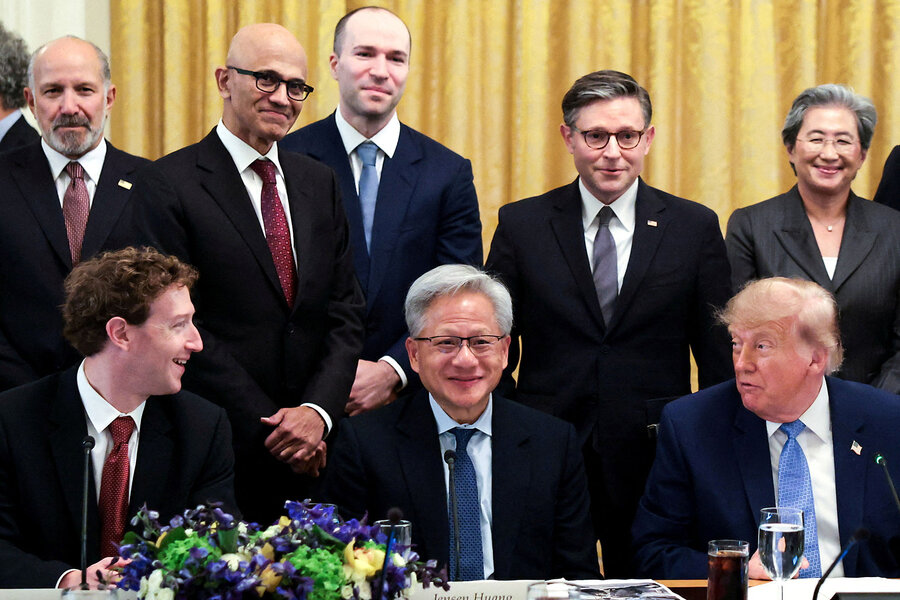
Wall Street cheered, with the tech-heavy Nasdaq index soaring more than 6% and Nvidia stock more than 30%. President Donald Trump, who had a hand in the about-face, also applauded.
“The Country needs Jensen’s leadership at NVIDIA in order to ensure the Success and Prosperity of not only the Company, but the American Economy,” he posted on his Truth Social account.
But in presenting the argument in economic terms, the president risks raising new and uncomfortable questions about a company whose advanced chips play a central role in the AI industry and are subject to export controls with China.
For the administration, Mr. Huang “and the company became seen as too big to fail,” says Sarah Kreps, director of the Tech Policy Institute at Cornell University and senior fellow at the Brookings Institution. “So they recast the national security framing around that and concluded that what he had done was not that bad…. It makes a bit of a mockery of the national security arguments.”
It also reinforces a narrative about today’s economy – that it not only benefits the rich, it protects them.
A shift in government ties to corporations
Mr. Trump’s approach to the economy represents a big change from the hands-off policies that have prevailed in Washington since the 1980s. The change was already underway during the financial crisis of the 2000s, when the government intervened to bail out banks and businesses.
“It produced a lot of populist anger with respect to seeing how corporate elites were largely protected,” says Rakesh Khurana, professor of sociology and organizational behavior at Harvard University and author of the 2002 book, “Searching for a Corporate Savior: The Irrational Quest for Charismatic CEOs.”
While populist anger helped sweep President Trump into office, he did not condemn business leaders. He instead fostered closer government-business relationships with them.
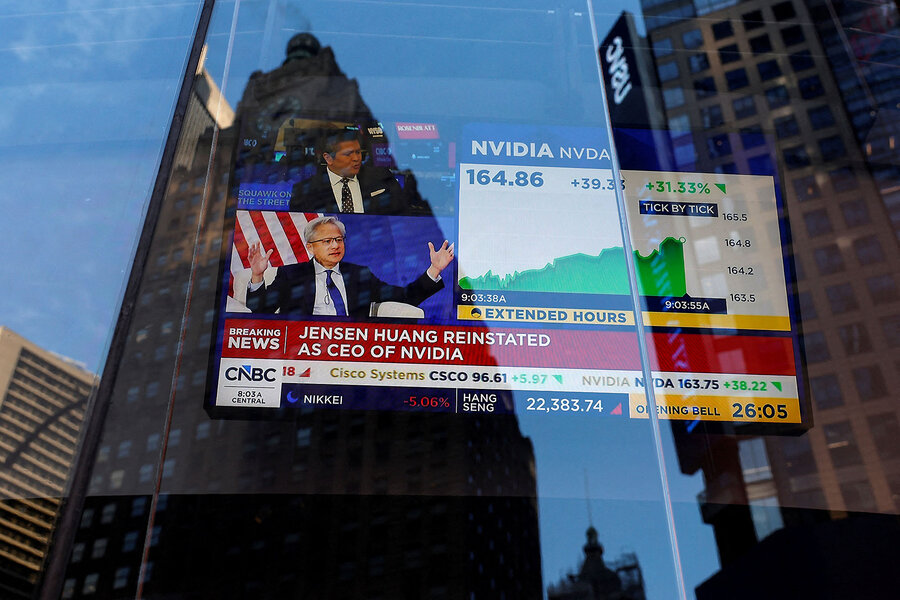
Shannon Stapleton/Reuters
Jensen Huang appears on a screen at the Nasdaq MarketSite in New York, Nov. 23, 2026. Nvidia on Monday said it is reinstating Mr. Huang as chief executive, effective immediately.
Today’s tech titans wield increasing influence. Their “Magnificent Seven” companies (including Apple, Microsoft and Nvidia) alone are worth about a third of the total value of the S&P 500 stocks. President Trump, a tycoon himself, has courted them, has largely given them free rein to operate, and turned to Tesla’s Elon Musk last year to downsize the government. Mr. Huang, for example, contributed $25 million toward Mr. Trump’s White House ballroom construction.
Mr. Trump has also directed the federal government to take stakes in dozens of other companies and negotiate deals where chipmakers who win export approvals to China give the government 15% of the revenues they earn from those sales. He has personally invested in the stocks of several of the biggest tech companies.
Now, “people are asking the political class to actually do something different, and they’re still waiting for that,” Mr. Khurana says.
For one thing, does a strong economy trump national security? The two are actually intertwined, amid what many see as a pivotal U.S.-China race for AI leadership.
“The reckless decision to bring Jensen Huang back as CEO does not change the fact that Mr. Huang, NVIDIA executives, and the company’s board still owe Congress answers about the company’s compliance with U.S. export controls,” Sen. Elizabeth Warren (D) of Massachusetts said in a statement.
Investigations could grow
At least two investigations already are underway on what Mr. Huang knew and when. More are likely as Democrats prepare to take over control of Congress in January.
“This whole Nvidia scandal we’re seeing right now, in my opinion, would have ended past presidential administrations,” Sen. Cory Booker (D) of New Jersey told reporters at the Capitol last week, pointing to Nvidia stock trades on Mr. Trump’s behalf during his presidency. “Those are the kind of things that compromise national security for their profits.”
Questions continue to swirl around Mr. Huang’s affair with Alice Huang (no relation). The New York Times reported Monday that U.S. intelligence tracked Ms. Huang for over a year as she maintained contact with an official from China’s intelligence agency, the Ministry of State Security. Her status as a spy and how and whether she influenced Mr. Huang’s stance on chip exports to China remain unknown.
The Senate banking committee, of which Senator Warren is the ranking member, is set to call Mr. Huang to testify on export controls next Thursday. China has been able to obtain some advanced Nvidia chips illegally.
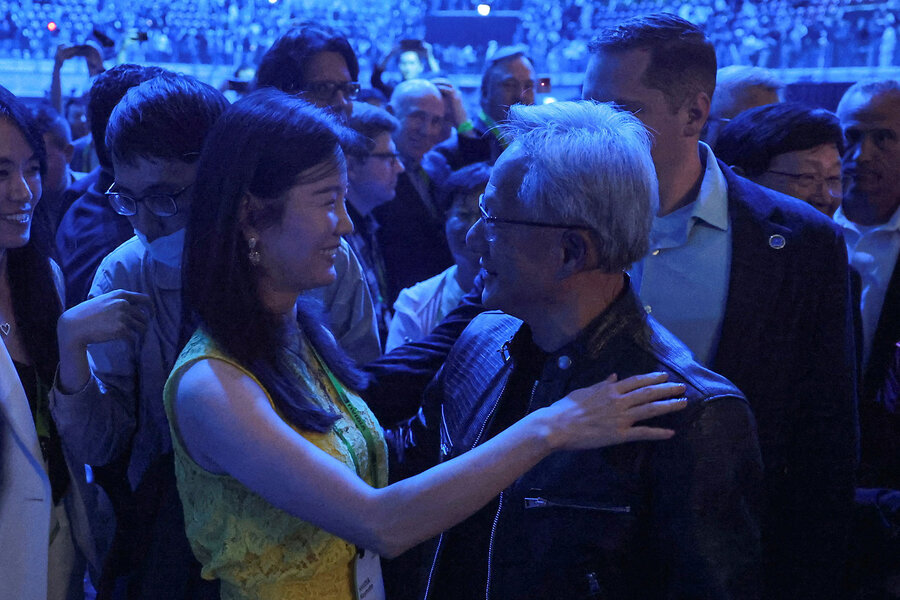
Ann Wang/Reuters/File
Nvidia CEO Jensen Huang greets Chinese businesswoman Alice Huang after delivering his keynote speech at Computex 2024 in Taipei, Taiwan, June 2, 2024.
In abruptly reinstating Mr. Huang, Nvidia’s board pointed to what it called his candor and assurances from the administration. “The Board received input from senior levels of the United States government, and based on that input, the Board is confident that Mr. Huang’s reinstatement poses no national security risk,” Nvidia’s board said in its press release. It acted even though its outside investigation is only just getting underway.
Still, Mr. Huang’s judgment remains in question. He’s alleged to have had two affairs with Nvidia employees, liaisons that often lead to terminations in corporate America. They also drag down corporate value. A 2017 study found that such CEO indiscretions are associated with a 4.1% drop in shareholder value. At a minimum, they set a bad example at the top.
Deepen your worldview
with Monitor Highlights.
Politics with respect
Get political stories with respectful analysis.
There‘s a world of new ideas in every
Books newsletter.
There‘s more to life, enrich yours with
Culture & Learning weekly.
Follow humanity‘s discoveries with
Science & Nature stories in your inbox.
Gain a spiritual perspective
from the stories in your inbox.
Want to understand the deeper impact of critical events? Learn the Monitor‘s insight.
Already a subscriber? Log in to hide ads.
“If the CEO can get lured in like this, what message does that send to the workforce?” asks Nick Eftimiades, a retired senior intelligence official and author of the book “Chinese Intelligence Operations.” “How can you hold thousands of people, how can you hold any engineer responsible when the CEO is doing it?”
On day one of his reinstatement, Mr. Huang seemed to have been vindicated by the markets and the administration. But the larger questions remain.
ALREADY A SUBSCRIBER? Login
Real news can be honest, hopeful, credible, constructive.
The Christian Science Monitor was founded in 1908 to lift the standard of journalism and uplift humanity. We aim to “speak the truth in love.” Our goal is not to tell you what to think, but to give you the essential knowledge and understanding to come to your own intelligent conclusions. Join us in this mission by subscribing.
