




Ke Zhu/Getty Images
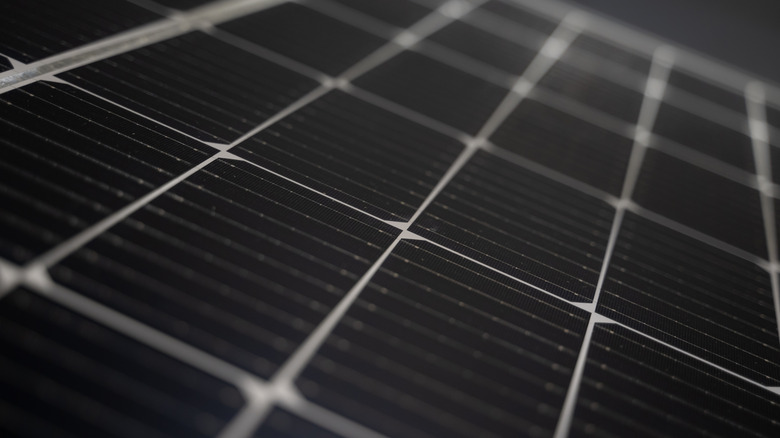
If you’ve ever looked at the wings of a black butterfly and thought that the color is due to some sort of natural pigment, well, the reality is far more interesting. Those wings are made up of tiny scales that form one large surface area, which absorbs 99.94% of the light that hits it, according to ScienceAlert. The scales are capable of letting in more light than they reflect since their surface is “kind of spongy or mesh-like, with ridges and holes.” Since the wings reflect so little light, they appear black. This is similar to the difference between black and blue solar panels. Black solar panels are black as a result of each cell being a single silicon crystal that absorbs almost all light. This improved light absorption is why black solar panels are more efficient than blue panels.
In a study published in Solar Energy (via Science Direct), scientists ran a numerical simulation in which silicon slabs, the light-absorbing material of photovoltaic cells used on solar panels, were structured similarly to wings of nine different species of black butterflies with the aim of reducing the amount of surface reflection and increasing light input. According to the results, the amount of light they reflected was reduced from more than 35% to 10%. With less light being reflected, the silicon slabs effectively absorbed more light, increasing the short-circuit current or absolute maximum current produced by the slabs by up to 66%.
Will solar panels ever be 100% efficient?
dotshock/Shutterstock
Efficiency is one of the many things one considers before installing solar panels. With 66% efficiency being a possibility, it’s exciting to think that, with the right structure and materials, we might one day be able to go all the way to 100%. However, there are several issues that make 100% solar efficiency unlikely. For instance, shadows and bad angles can reduce the amount of direct sunlight that a solar panel can get. Debris like dirt, dust, snow, and water can block sunlight, reducing the amount of light that the PV cells can convert into usable electricity. Heat is another issue, with the efficiency of the PV cells dropping by 0.3% to 0.5% with each degree when the temperature rises above 25 degrees Celsius.
But suppose everything is right, down to the 33% rule for panels; the universe still won’t allow solar efficiency to reach 100%. This is due to the second law of thermodynamics, which tells us that everything that happens in the universe is wasteful. This is a law of the universe, meaning it cannot be transcended by any technological advancements. So, when the light is converted to usable electricity, some of that energy will be lost. This brings us to the first law of thermodynamics, which tells us that energy cannot be created or destroyed. It can only become something else — in this case, it becomes heat.
