



Anthropic became one of the most valuable companies on the planet on Wednesday, valued at $1.5 trillion after its IPO. Known as one of the “good guys” of AI, Anthropic was founded by employees who left OpenAI over disagreements about ethics and safety. But despite the company’s emphasis on responsibility and preventing AI from killing everybody, one thing you don’t hear Anthropic talking about much is its contribution to climate change.
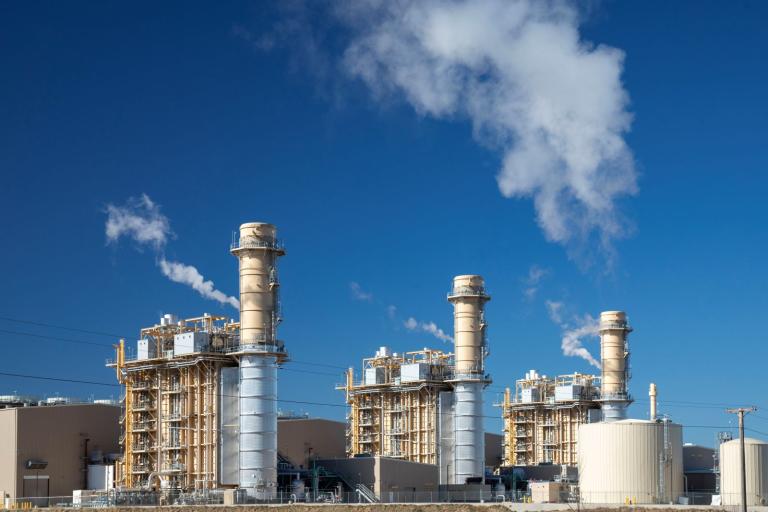
Ahead of the initial public offering this week, Greenpeace accused the company of “asking average investors to join them in throwing the planet into the climate furnace.” AI data centers are causing electricity demand to soar and fueling a surge in natural gas plants. A recent report found that the biggest data centers in the United States emit about as much carbon dioxide as entire countries like Bolivia or Denmark. Anthropic is contributing to that: It reportedly signed a $3.4 billion deal with the Texas-based company OnePWR Solutions in September to power data centers with gas-fired engines — the largest known single purchase of its kind by an AI lab.
“It signals what direction they’re taking very clearly,” said Charlie Cray, a senior strategist at Greenpeace USA. The company is locking in fossil fuels at a time when scientists say the world is certain to overshoot the goal of limiting global warming to 1.5 degrees C. Anthropic’s reputation for being the most responsible of the AI giants means it should be minimizing its climate impact, Cray argued: “Show the world that you can do it better.”
The company has been lauded for focusing on safety and “alignment,” trying to ensure that AI acts in accordance with human values — or as its website puts it, “training Claude to be helpful, harmless, and honest.” Earlier this year, Anthropic got into a dispute with the Pentagon when it refused to give the Department of War unrestricted use of AI for autonomous weapons and mass domestic surveillance. This summer, Dario Amodei, its CEO, called for the government to regulate the industry and for AI development to slow down. But Anthropic’s actions are decidedly less “aligned” with efforts to preserve the stable climate that allowed complex human civilizations to grow and flourish.
In the hundreds of pages of its IPO filings, the maker of Claude mentioned climate change sparingly, laying out a number of ways that the warming planet could threaten its business. One risk is higher operating costs: Anthropic said that higher temperatures “can increase the power consumption and water usage required to cool equipment at the facilities on which we depend.” In addition, fires, hurricanes, and floods amped up by climate change could disrupt its operations, it noted.
Environmental policies pose another set of risks to the company’s resource-intensive business. Anthropic acknowledged that some investors may choose not to invest in the company if its sustainability measures are seen as inadequate. On the other hand, implementing such goals “could be difficult to achieve or costly to implement,” it wrote in the filings, adding that navigating various climate and sustainability disclosure laws in California, the European Union, and the United Kingdom could require “significant time and resources.”
That good-guy reputation might also take a hit. The filings suggest that AI’s environmental harms could hurt Anthropic’s image, as its brand is “subject to heightened scrutiny with respect to perceived societal, environmental, labor, health, and safety-related impacts.”
“At least they admit that climate change is a threat when they say it’s a risk to their own operations,” Cray said, “but they’re not taking responsibility for their own contribution.”
In the broader public discussion about AI, concerns about global warming have been drowned out by a more immediate existential threat. One of Anthropic’s researchers, Jacob Coxon, accused the company of “racing straight to self-improving superintelligence and gambling with our lives” when he resigned in September; then the lead of its alignment division, Evan Hubinger, said he thought there was a greater than 10 percent chance that “AI could kill all humans” within the next decade.
Assuming humans avert an AI apocalypse, we’ll have to contend with the reality of living on a rapidly warming planet. Some experts are trying to bring sustainability into the conversation about how to use AI responsibly. “The entire sector needs to be scrutinized closely as to what choices they make and how much transparency is in their reporting — which in this case, is not a lot,” Cray said. A recent analysis from the firm Integrum ESG compared Anthropic to 14 peer companies across the AI supply chain and found that all of them except Anthropic and SpaceX reported their direct greenhouse gas emissions and the indirect emissions from the energy they purchase (called Scope 1 and 2 emissions in energy wonk-speak).
Anthropic has pledged to cover the electricity price increases from its data centers so the public wouldn’t have to pay those costs and committed to “being a responsible neighbor” and addressing its environmental impacts, such as by deploying “water-efficient cooling technologies.” In June, it joined other major corporations in backing the carbon removal industry. (Anthropic did not respond to a request to comment.)
Cray has ideas for how Anthropic could apply its ethical standards to the problem of climate change. In addition to greater transparency, the company could commit to a timeline for powering its data centers with only renewable power and set firm climate targets. “They shouldn’t be building data centers that are powered by natural gas without a timeline for phasing that out and replacing it,” he said.
