


Christian de Looper/BGR
Robot vacuums have become commonplace, now available at a range of price ranges and with excellent high-end features. It makes sense that the tech could be put to use elsewhere though. The likes of Ecovacs, for example, are turning to new appliances — the latest of which is the new Ecovacs GOAT A3000 LiDAR Pro.
I’ve actually been using the last-generation model, the standard GOAT A3000, for around a year now. It’s performed pretty well, but it has one big missing feature — the ability to get all the way to the edge of the grass. The result is that while it dramatically cuts down on mowing time, it doesn’t handle everything. That’s what the new Pro model aims to solve — with a new rotor on its side that spins to trim the edge of your grass, all the way to any walls or sidewalks that border the grass.
That said, there are trade-offs. The price is steep at $2,500. The trimmer is loud. And in yards with complex layouts or tall weeds, the mapping and obstacle detection can trip up in ways that require manual intervention. So, is the Ecovacs GOAT A3000 LiDAR Pro worth that high price?
Design
Christian de Looper/BGR
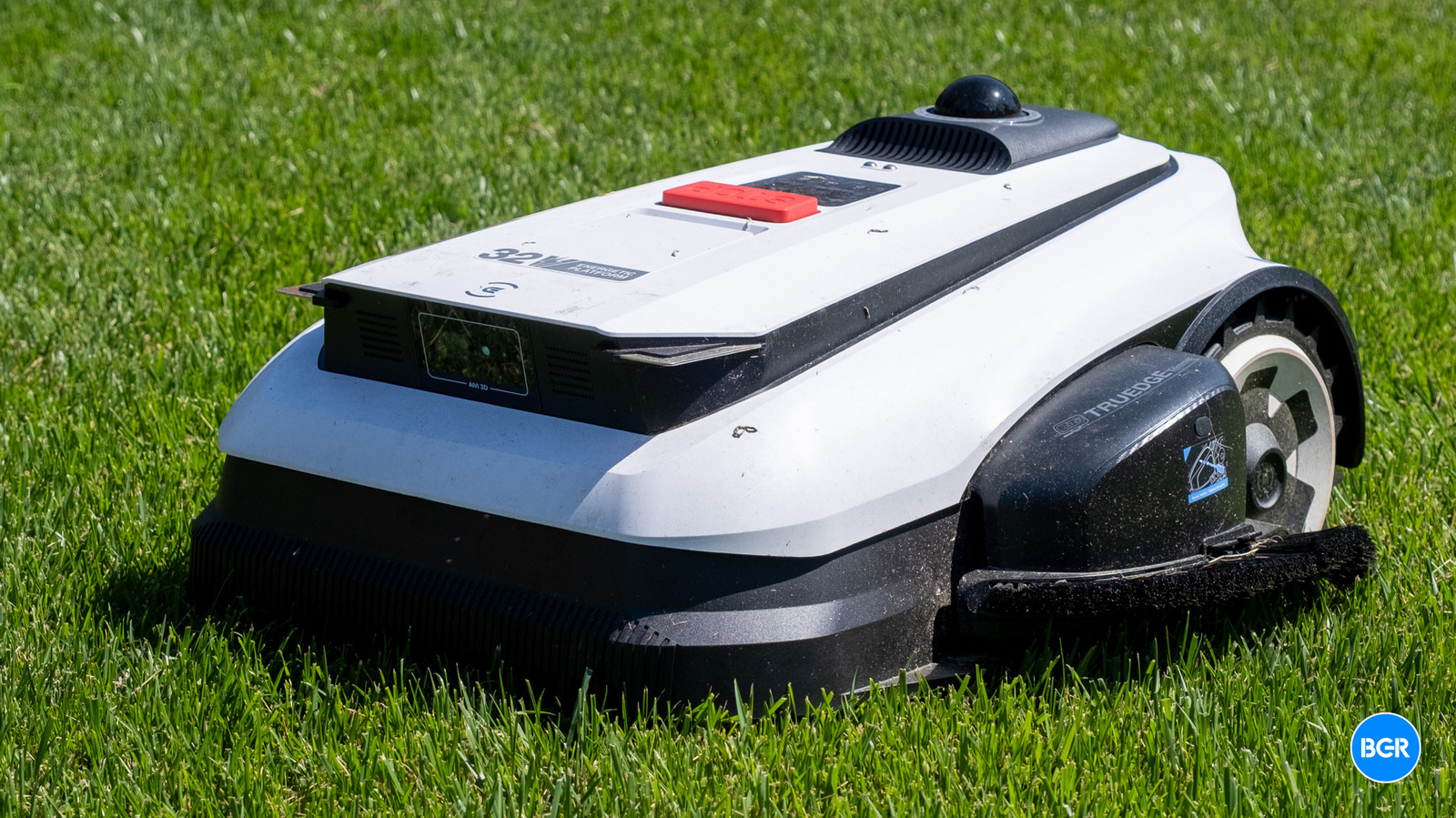
The Ecovacs GOAT A3000 LiDAR Pro is, as you might assume, built to be in the same family as the standard A3000 — and it looks like it. In fact, the new model looks more or less exactly the same as the old one, except for one thing — it has rotor on its side that uses nylon string to cut the edges of your lawn. It measures 27.8 x 23 x 12.2 inches and weighs roughly 40 pounds, so it’s not small, and it’s not light. It’s built with handles, so you can lift it if you need, but it’s certainly awkward to carry given its size and weight.
The chassis is heavy-duty, injection-molded polymer, and it feels built for years of outdoor abuse. Ecovacs gave it an IPX6 waterproof rating, which means you can hose the whole thing down like you’re washing a car when grass and dirt inevitably build up underneath. That’s exactly what I did after a few weeks of testing, and it held up fine.
The wheel setup is smart. Smooth front casters handle steering and precision, while tread-patterned rear drive wheels do the actual work. The combination gets the mower up inclines as steep as 27 degrees, or a 50% grade. My yard is pretty flat, so this isn’t something that I really needed, but it never struggled to get across my yard. There’s also a carry handle on the back, which can come in handy if the unit gets stuck — sometimes you just need to pick the thing up and move it.
On top of the mower sits a 360-degree rotating LiDAR sensor. Next to it are the physical controls, including a large, prominent emergency stop button that’s easy to hit if anything goes sideways. The other controls can do things like return the mower back to the station and control other aspects as needed, as well as when guided by the app.
The charging dock is included in the box with a base plate and dock structure that you set up in a flat, open area. There’s no separate RTK antenna to position, no wire to bury, and no complicated alignment to fuss over. Just find a flat spot near a power outlet and you’re done. The mower also comes with anchor screws to install the station in grass or soil. I set mine up on concrete, so I didn’t use these.
Features
Christian de Looper/BGR
Navigation is the headline here, and it works the way you wish all robot mowers worked. The 360-degree rotating LiDAR on top pairs with the 3D Time-of-Flight (ToF) sensor on the front to map and navigate without needing a GPS signal. That’s a big deal. If you have big trees, covered patios, or narrow passages between structures, GPS and RTK systems can get lost easily. LiDAR doesn’t care. It just reads the environment.
The AIVI 3D system layers AI object recognition on top of that, using a fisheye camera to identify more than 200 different object types. Honestly, I wasn’t really able to verify this — my lawn is pretty well separated from anything I’d need the mower to avoid, and our cat stays indoors. According to Ecovacs, for static objects like trees, planters, or garden edging, it’ll navigate as close as possible. For unpredictable obstacles like pets or humans, it stops completely. That’s what you’d want, especially if it’s using the more accident-prone edge trimmer.
Where the system stumbles is in distinguishing tall grass from actual obstacles. More than once, I watched the mower treat a patch of taller grass or a weed stem as something it needed to avoid, leaving a small, uncut area behind. I had to manually direct the mower to go back and trim it, which is easy enough to do using the app.
Rain sensing is built in, and it’s effective. If it starts raining, the mower heads back to the dock and waits. It won’t resume until roughly three hours of dry conditions have passed.
For maintenance, the package includes backup multi-blade sets, which is a nice touch. You’ll need to swap blades roughly every four to six weeks depending on how much you’re running it and what you’re cutting. The trimmer line needs replacing on a similar schedule. None of this requires special tools or expertise — it’s a few-minute job.
App and setup
Christian de Looper/BGR
Setup happens entirely through the Ecovacs Home app, available on iOS and Android. It’s as easy as downloading the app, scanning a QR code on the mower, and following the prompts. This is easily the best setup experience I’ve had with a robotic mower.
The auto-mapping is the part that actually impressed me most. You initiate the mapping, and the mower does a perimeter trek of your property on its own, generating a fully interactive 3D holographic map in about five minutes. The result is super cool to look at — you can see trees, boundary features, structures, and even neighboring properties rendered in the visualization. It’s more detail than you strictly need, but it gives you real confidence that the mower actually understands the yard.
From there, the app handles everything else. You can set up schedules, define multiple zones with different parameters, and drop no-go areas right onto the map. There are “mark flush” and “not flush” boundary options that tell the trimmer whether the grass ends exactly at the mapped line or extends beyond it, which controls how aggressively the edge trimmer engages. It’s a smart system once you understand it, but the distinction isn’t obvious at first and took me a minute to wrap my head around.
One annoyance is that you have to schedule mowing and edge trimming as separate tasks. I’d much rather set one schedule and have the mower handle both. Instead, you’re managing two sets of schedules. There’s also a live touchscreen joystick for manual control, which is handy for pushing the mower into tight spots it doesn’t want to tackle on its own.
Mowing performance
Christian de Looper/BGR
The cutting hardware is a dual-disc setup with six independent blades across a 13-inch cutting width. That’s wider than most competing robotic mowers and it shows up in coverage speed. The 32-volt power platform is the other half of the equation — it maintains blade RPMs through dense grass without any issue. Cuts are clean and tear-free, which is the kind of thing you care about if you’ve spent weeks landscaping.
Cutting heights adjust electronically from 1.2 inches up to 3.5 inches, and you can change them remotely from the app. This also means you can set different heights for different zones, which is useful if your front and back yards have different needs.
The TrueEdge side trimmer is the main feature that sets this model apart from its predecessor and, for the most part, it delivers. In my testing, it replaced about 75-90% of the manual trimming I’d otherwise do. That’s significant. But it’s not perfect — I still had to touch up certain spots after the mower was done, particularly around corners. If your yard has a lot of steep vertical edging, you’ll still be spending some quality time with a weed whacker.
At top speed, the mower moves at 0.7 meters per second and processes up to 4,305 square feet of grass per hour. The so-called pathing algorithm tries to emulate how a human would mow, laying down overlapping, systematic stripe patterns. The result looks clean. You can also tell the app to change direction each week, which varies the pattern and is better for the grass.
The limits show up with tall weeds or heavy thatch. The mower can misread those conditions as obstacles and either slow down significantly or leave uncut patches. If you’re using this as your sole mowing solution on a lawn that occasionally gets out of control, you’ll want to plan for a manual pass before the first mow, or expect a second manual cycle to clean things up.
Battery and charging
Christian de Looper/BGR
The battery is a 32-volt, 7,500 mAh lithium-ion pack, which is a meaningful upgrade over the 5 Ah unit in the previous generation. Rated runtime is up to 160 minutes per charge, and I never got close to hitting the limit. To be fair, my yard is relatively small, so it was more than enough battery to mow and edge-trim both the back and front yards without needing a charge. That said, different terrains and denser grass can impact battery life.
Charging is fast. The included 189-watt system takes the mower from empty to full in roughly 70 minutes, which is quick enough that even on larger properties, you can expect complete coverage within a day without any manual intervention.
Conclusions
The Ecovacs GOAT A3000 LiDAR Pro is easily one of the best robotic lawn mowers out there. The LiDAR navigation is better than the GPS and RTK alternatives in complex yards. The cut quality is very good. The edge trimmer eliminates much of the manual edging that used to be the dealbreaker for robotic mowers. Taken together, this thing eliminates the vast majority of mowing work for most residential properties.
It’s expensive, though. At $2,499, this is a serious investment. But if you’re paying for professional lawn service, it might pay for itself in a few years. If you’re doing the work yourself, the calculation is about how much you value your weekends.
The competition
It outperforms basically every other robot mower I’ve used, and for anything other than edge trimming, it performs identically to the non-Pro A3000 — so if edging isn’t a priority for your yard, you can save some money by going with the standard model.
There are cheaper alternatives worth considering too, especially if you don’t need edge trimming. Where the A3000 Pro is less sensible is on massive, wide-open acreage without meaningful border features. For that kind of property, you’re better off with a less expensive unit or a GPS-focused system designed for open expanses.
Should I buy the Ecovacs GOAT A3000 LiDAR Pro?
Yes, if you want a high-end robotic mower and don’t mind paying a lot for it.
