


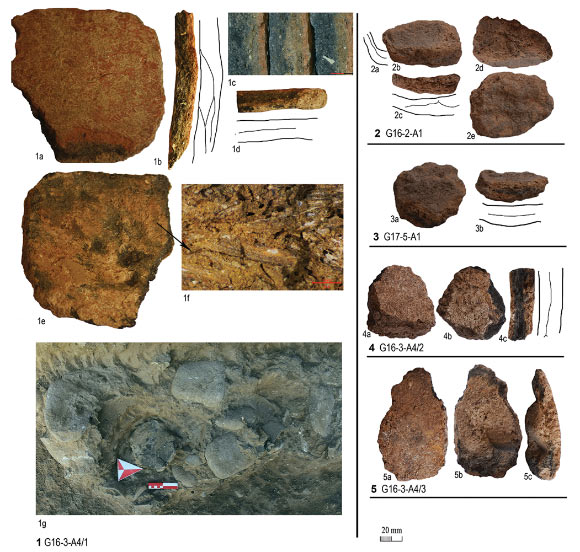
Archaeologists say 46 low-fired shards from Çemka Höyük, a Neolithic site in Türkiye, suggest people were testing clay’s possibilities long before pottery became common.
Fragments of clay vessels from Çemka Höyük, Türkiye. Image credit: N. Petrova / E. Kodaş.
“Adoption of a new object, style or technology requires its integration within wider cultural, social and temporal spheres,” said Dr. Ergül Kodaş of Mardin Artuklu University and colleagues.
“Early ceramics were no exception; substantial social changes accompanied the development of ceramics during the Pottery Neolithic in South-west Asia which begins around the turn of the seventh millennium BCE.”
The archaeologists examined 46 fragments of fired clay from Çemka Höyük, a Pre-Pottery Neolithic settlement in Mardin province, Türkiye.
The pieces were recovered from the floors of several round and oval dwellings, partly sunk into the ground.
They belong to at least nine different objects and date to around 9350 BCE, making them some of the earliest known fired-clay containers in South-west Asia.
The researchers examined the fragments under microscopes and used X-ray diffraction to assess how they were made.
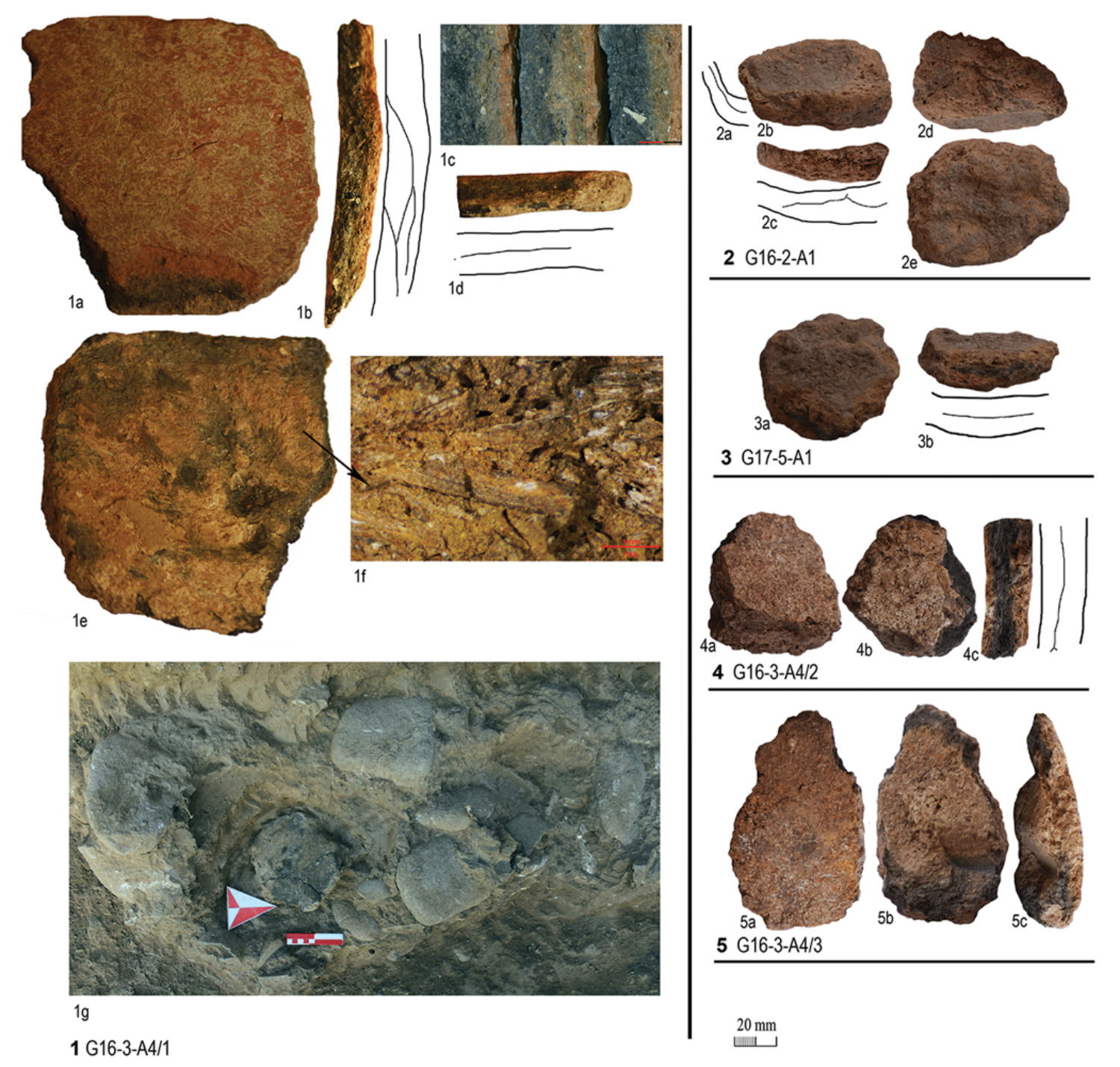
Compared with unfired clay found elsewhere at the site, the fragments showed irreversible changes to their minerals, which the authors interpret as evidence of deliberate firing, probably at roughly 600 to 700 degrees Celsius in a bonfire, rather than accidental exposure to heat.
Some fragments appear to be clay coatings that once covered oval organic objects, with the outer surfaces heavily fired and the interiors unburnt, possibly pointing to cooking-related use.
One piece may be a clay extension designed to enlarge a stone vessel, pierced with two holes that may have held a cord, perhaps to tie on a lid.
The remaining fragments look like thick-walled containers built from layered clay slabs and mixed with crushed plant matter. Two of them contained dung, identified by microscopic spherulites.
“This diversity suggests that the manipulation of clay was already embedded in daily life and local practices nearly 12,000 years ago,” the scientists said.
They caution that the residents were not yet reliant on ceramics for storage or cooking.
They characterize the assemblage as an experimental phase in which the community explored the material’s properties.
“By situating Çemka within the broader context of the Pre-Pottery and early Pottery Neolithic of South-west Asia, this study enables insights into the diverse pathways through which ceramic technology must have emerged,” the authors concluded.
“The Çemka finds reveal a pivotal stage in South-west Asian innovation: the translation of constructional knowledge into container production, contributing to our understanding of early pottery development as neither uniform nor linear but rather regionally variable and dynamic.”
“Thus, early pottery can be seen as a mosaic of regional experiments, each negotiating functional demands and social acceptance.”
“At present, Çemka stands as a key example of how early Neolithic communities explored the possibilities of clay, setting the stage for the fully developed ceramic traditions of the seventh millennium BCE.”
The study was published June 15, 2026 in the journal Antiquity.
_____
Ergül Kodaş et al. 2026. Understanding a first attempt at pottery: early fired containers at Çemka Höyük. Antiquity 100 (412): 904-922; doi: 10.15184/aqy.2026.10371
