


Two AI stories matter more than anything else right now, and most coverage is missing both. The first is a compute efficiency shock: useful AI inference per watt is on track to improve 10x by late 2027, 100x by 2029 and about 1,000x by 2031. The second is a pretraining avalanche: OpenAI’s own chart shows pretraining loss falling about 7 times faster in 2026 than it did from 2022 to 2025.
Put those together with the build-out already under way and the result is not an AI bubble or an AI plateau. It is an acceleration. The video version of this analysis is on the NextBigFuture YouTube channel.
Shock one: AI gets 10x, 100x, then 1,000x cheaper
The base case is 10x cheaper inference per watt by late 2027, 100x by mid-2029 and 1,000x around mid-2031. The gains come from six layers that multiply rather than add –
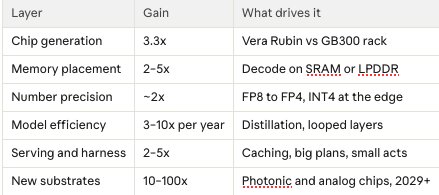
The first 10x needs nothing new.
3.3x from the chip, 1.5x from memory and 2x from model and serving lands on hardware shipping in 2027. 100x needs 2028 chips plus two more years of software. Only the last step to 1,000x might need some new technology of photonic or analog chips in production.
The world is adding roughly 40 GW of AI data centers per year. SpaceX alone guides to about 13 GW by the end of 2027, with power and cooling built for 20 GW. That takes about 15 new Vera Rubin halls and $300–350 billion of capital. SpaceX builds a data center in about four months, versus about two years for most others.
Then there is space. The FCC has approved SpaceX’s plan for up to 1 million AI compute satellites, the Starmind constellation. At 250 kW per satellite, 1 million satellites is 250 GW. At 500 kW each, it is 500 GW. SpaceX plans to put AI into orbit at scale around 2029 and is spinning up factories aimed at hundreds of gigawatts of space solar per year.
Multiply gigawatts by efficiency and you get roughly 2,600 times more AI capacity than today.
Shock two AI Pretraining Avalanche
OpenAI chief scientist Jakub Pachocki shared a chart of raw pretraining loss, the measure of how well a base model predicts text. From 2022 to 2025, loss fell about 0.026 per year. Over the last 11 months it fell about 0.17 per year, and over the last seven months about 0.20 per year. That is roughly 7 times the old pace.
The curve of progress went faster instead of going slower. Progress is supposed to slow as models approach the floor, but 2026 sped up instead. By scaling-law math, a 0.15 drop in one year is like having about 100,000 times more compute to brute force the progress.
Six forces landed in 2026:
1. Frontier-size base models came back after a run of smaller ones.
2. GB200 and GB300 clusters made training runs of about 1e27 FLOP possible.
3. 288 GB of memory per GPU allowed larger mixture-of-experts models and longer pretraining context.
4. Inference now makes training data: reasoning traces and verified code are fed back into pretraining.
5. Research got faster as AI writes kernels and runs experiments; Anthropic says about 90% of its code is written by Claude.
6. Long-term research bets paid off.
OpenAI’s internal model is at a loss of about 0.732. My base case is about 0.66 by the end of 2027 and about 0.57 by 2030. Each step down unlocks more. Below 0.80 brought transformative cybersecurity and math; around 0.76 brought groundbreaking open math results. Around 0.60, my estimate is autonomous senior engineers and researchers working for weeks, in about Q3 2029. More compute alone gets 2027 only to about 0.68–0.71. The rest depends on whether the 2026 gains from better methods keep coming. I expect 2027 to bring an avalanche of new AI research.
Why GPU price dips are a sideshowB
Anthropic is not renewing a lease on 50,000 H200s, and SpaceX is offering that capacity for early 2027 at about $5 per GPU-hour, versus the $5.27 Anthropic paid before. SemiAnalysis shows some softening in AI leasing after a year of rising rates. Gas prices also never went straight up; a dip to $3 does not mean prices stay there.
These wiggles are small next to 4x, 10x and 100x multipliers. What matters is Rubin rental rates at million-chip volumes, how much hyperscaler money goes to capex, whether SpaceX can build 10–20 GW, and how fast AI capability improves. The loop is simple: spend more, make more, buy more compute. A cluster that pays for itself in 6–12 months is hard to strand.
Memory is the same story. More memory per GPU has about twice the effect of more compute. Efficiency gains will not crash memory demand, because cheaper AI gets used far more. That is my view, not financial advice.
The biggest wild card is training without backpropagation. Normal training stores every intermediate result and then works backward, which can take up to 12 times the memory of running the model. Backprop-free methods nudge the weights, score the result and keep the good nudges, using forward passes only. Q Labs cut the time to pretrain a 37.7-million-parameter model from 1 hour 46 minutes to 1.6 seconds in 10 days of speedrun records. The caveat: it has only been shown on small models so far. I put the odds that it strands 2027 Vera Rubin clusters at under 10%.
🎁 Get a $50 sign-up bonus on Kalshi: https://kalshi.com/r/nextbigfuture
Kalshi now has perpetuals on stocks like NVIDIA, plus indices and crypto.
In this video:
• Why GPU rental price wiggles are a sideshow
• OpenAI’s pretraining loss falling 7x faster than its 2022–25 pace
• Six forces that landed in 2026
• Memory per GPU and what efficiency means for memory demand
• Backprop-free training: 1 h 46 min → 1.6 seconds (37M-parameter model so far)
• SpaceX build-out: ~13 GW base case vs 20 GW
• Who wins: Anthropic, SpaceX, Google, Nvidia, OpenAI
Chapters
0:00 Two AI shocks most people are missing
2:33 FCC approves 1M SpaceX satellites
3:00 GPU rental price “fluctuations”
6:48 What actually matters
9:18 OpenAI’s 7x faster pretraining loss drop
12:34 Six forces that landed in 2026
14:13 Memory per GPU and memory stocks
15:00 Kalshi
15:13 Chips show up in models 11–19 months later
17:02 Training runs 15x bigger by late 2027
18:21 The capability ladder
19:32 Memory and continual learning
21:30 Signposts: bull vs base case
23:19 Backprop-free training
26:35 Inference per watt across six layers
28:19 Who wins
Brian Wang is a Futurist Thought Leader and a popular Science blogger with 1 million readers per month. His blog Nextbigfuture.com is ranked #1 Science News Blog. It covers many disruptive technology and trends including Space, Robotics, Artificial Intelligence, Medicine, Anti-aging Biotechnology, and Nanotechnology.
Known for identifying cutting edge technologies, he is currently a Co-Founder of a startup and fundraiser for high potential early-stage companies. He is the Head of Research for Allocations for deep technology investments and an Angel Investor at Space Angels.
A frequent speaker at corporations, he has been a TEDx speaker, a Singularity University speaker and guest at numerous interviews for radio and podcasts. He is open to public speaking and advising engagements.
