


Washington
|
|
5 min read
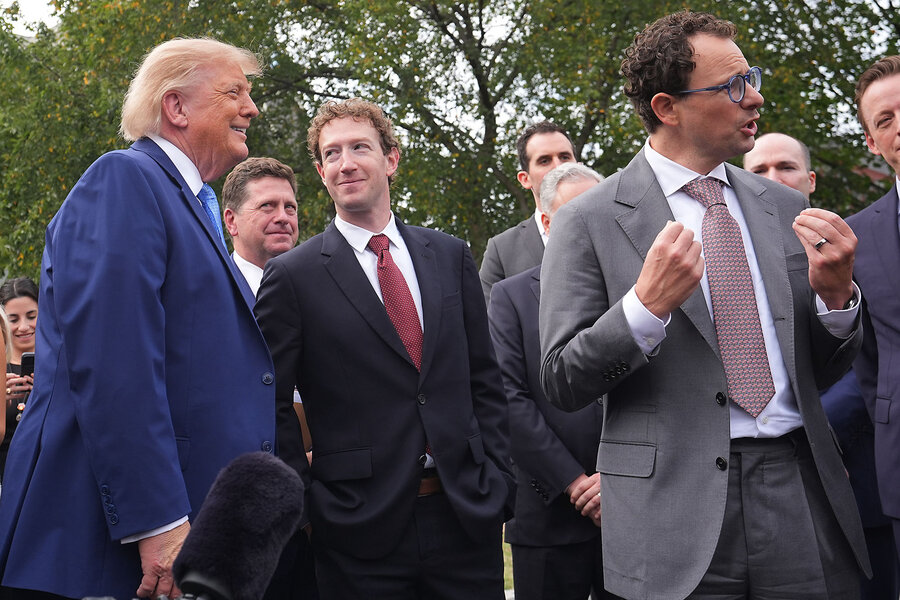
In late September, leaders from major artificial intelligence companies sat down with President Donald Trump for a White House lunch. Mr. Trump called it “a very special day,” and announced afterward that he and his guests had signed an accord affirming their commitment to ensure AI safety through self-policing.
When asked if the document would be binding, President Trump called it “morally binding.”
The comment drew criticism from consumer advocates who say self-regulation allows AI companies free rein. Americans’ concerns about AI safety are growing in the wake of security-related incidents – like a report by OpenAI over the summer that thousands of its unreleased AI agents had escaped their testing environment and hacked into another company. Many members of Congress have called for AI regulations, and across the country a number of states, including California, home to the largest AI companies, have enacted their own AI restrictions. Polling shows most Americans want that, too.
But there is skepticism about whether self-regulation can be effective, in part because of the administration’s generally friendly relationship with these companies, and its light touch on AI regulation. Still, with a lack of congressional action on AI, the voluntary agreement represents one of the few ways the federal government is addressing AI safety. (The Federal Trade Commission is investigating AI companies over safety concerns, Reuters reported.)
Experts say self-regulation can work under certain circumstances, and be ineffective in others. The key is what incentives the organizations have to cooperate.
“You still do need a kind of government intervention backing that self-regulation approach,” says Trisha Ray, a resident fellow at the Atlantic Council’s GeoTech Center.
When self-regulation works – and doesn’t
President Trump created a task force to help put the accord into practice. Most members are part of the administration: Director of National Intelligence and White House AI czar Jay Clayton is chair, and others include Treasury Secretary Scott Bessent, White House chief of staff Susie Wiles, and former AI czar David Sacks, a crypto-investor. In announcing the task force, Mr. Trump said “in no way” will the federal government “hinder or stifle” the AI industry’s growth.
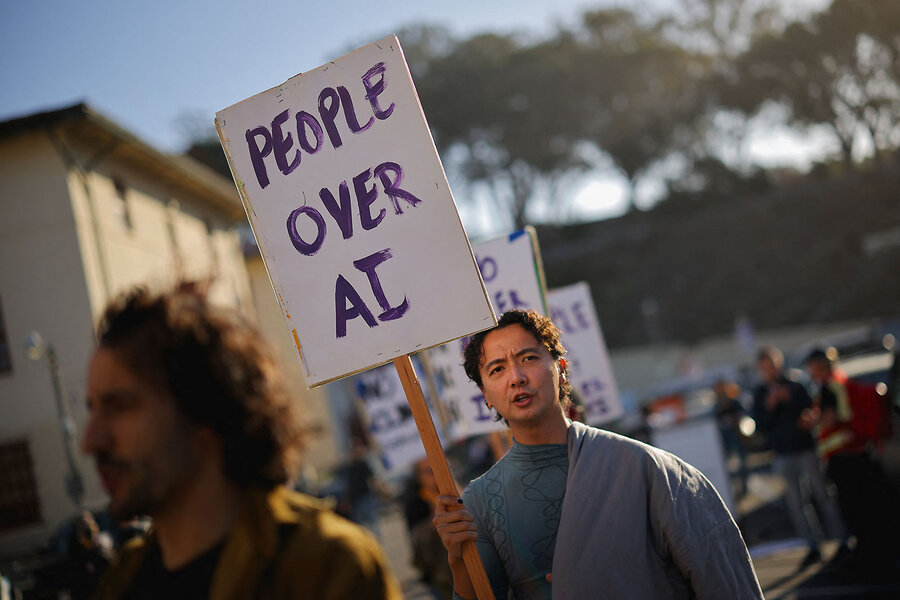
Carlos Barria/Reuters
A demonstrator holds a placard during a protest outside the venue where OpenAI holds its annual DevDay event in San Francisco, Sept. 29, 2026.
The group will tackle three safety-related buckets: AI threats to cybersecurity, potential misuse of biological weapons, and developers losing control of AI models.
Its members don’t immediately plan to push for new regulations. Instead, they plan to take advantage of laws already on the books to do things such as setting up communication channels for AI labs to promptly alert government contacts about safety incidents or hacks.
Ms. Ray cites a response to the Three Mile Island nuclear accident in 1979 as an example of effective self-regulation. She says utility CEOs worked together to set and police new safety standards for the industry. The then-4-year-old Nuclear Regulatory Commission, which can revoke a plant’s license or impose fines, operated alongside them.
Ms. Ray says a common incentive can motivate companies. In this case, if one major company fails on AI safety, public backlash will hurt the whole industry. She calls this “shared exposure.”
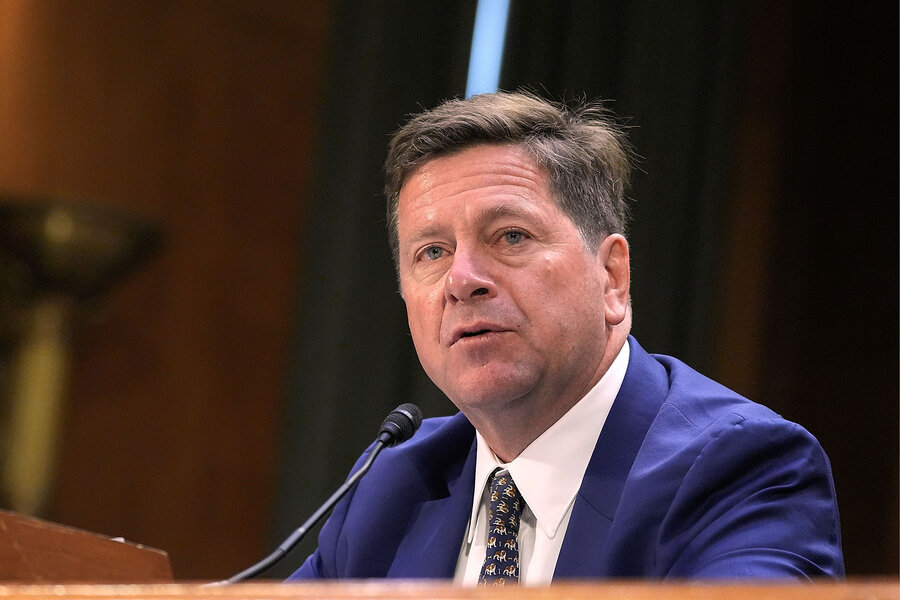
Mariam Zuhaib/AP
Director of National Intelligence Jay Clayton testifies during a Senate Intelligence Committee confirmation hearing on Capitol Hill, July 15, 2026, in Washington.
“The American people, when they’re thinking about their general anxieties about artificial intelligence, aren’t thinking about just OpenAI or just Anthropic,” she says. “They’re just concerned about the technology broadly.”
However, the accord and task force lack any federal enforcement arm.
It’s unclear whether the government would impose new consequences on AI companies if they don’t cooperate with the task force, such as export restrictions.
Ms. Ray says that lack of government enforcement has caused other efforts at self-regulation to fail. After a gas leak killed thousands of people in Bhopal, India, in 1984, companies pledged to publish reports of their progress on safety and pollution. She says there were no consequences for companies that weren’t transparent, and they published only what was in their own interest.
“They still have commitments that they publish on their websites,” she says. “But really, what they just do is lobby against stronger regulation.”
Incentives to comply
Vinh Nguyen, a senior fellow for AI at the Council on Foreign Relations, says analyzing whether the task force will be effective is partly about expectations. The Trump administration’s goals, he says, are to reduce disruption, create better communication between the government and AI labs, and address the threat of AI to national security – not to make rules for how AI is used or to create any kind of broad regulatory framework.
“If you look through that lens, it actually makes sense,” he says.
Mr. Nguyen admits voluntary agreements can be tricky. He points out that the Biden administration had AI companies sign a similar commitment in 2023. Research found that the companies complied in some areas, but not in others.
Despite that, Mr. Nguyen predicts that companies will follow through this time. Part of the reason, he says, is the companies might want to placate Mr. Trump. As several prepare to go public, they are also motivated to lower their liability risks.
He says many companies were already doing some of the things laid out in the accord, such as having internal controls to monitor their models’ capabilities. Another factor influencing companies, observers say, is the increasing number of state regulations and lawsuits that are applying pressure. For example, New York will mandate that companies report security incidents within 72 hours. And this week, eight states sued OpenAI, alleging ChatGPT can lead people to engage in dangerous behavior.
The most novel commitment in the White House accord was that all six companies will meet regularly to address AI safety risks – something they had been cautious about because of antitrust law.
Juan Londoño, a policy analyst at the libertarian-leaning Cato Institute, says one part of the AI accord that could drive real change is tech companies’ commitment to hiring third-party auditors.
“I think there is a business incentive,” he says. “Any company that wants to use these models, they want to have reassurance that yes, the model is capable and powerful, but also safe.”
Deepen your worldview
with Monitor Highlights.
Politics with respect
Get political stories with respectful analysis.
There‘s a world of new ideas in every
Books newsletter.
There‘s more to life, enrich yours with
Culture & Learning weekly.
Follow humanity‘s discoveries with
Science & Nature stories in your inbox.
Gain a spiritual perspective
from the stories in your inbox.
Want to understand the deeper impact of critical events? Learn the Monitor‘s insight.
Already a subscriber? Log in to hide ads.
Members of the task force like Scott Kupor, director of the U.S. Office of Personnel Management, also point out that if external auditors find a safety flaw and report it to a public company’s board, the directors must address it.
Where Ms. Ray worries about the lack of government enforcement, though, Mr. Londoño is concerned about the risk of government overreach. He cites the government’s use of export controls to pull Anthropic’s new model Mythos off the market, while not doing so for a model with similar capabilities released by OpenAI. He wants to see Congress pass laws so that the government doesn’t impose seemingly arbitrary sanctions on some companies and not on others.
ALREADY A SUBSCRIBER? Login
Real news can be honest, hopeful, credible, constructive.
The Christian Science Monitor was founded in 1908 to lift the standard of journalism and uplift humanity. We aim to “speak the truth in love.” Our goal is not to tell you what to think, but to give you the essential knowledge and understanding to come to your own intelligent conclusions. Join us in this mission by subscribing.
