


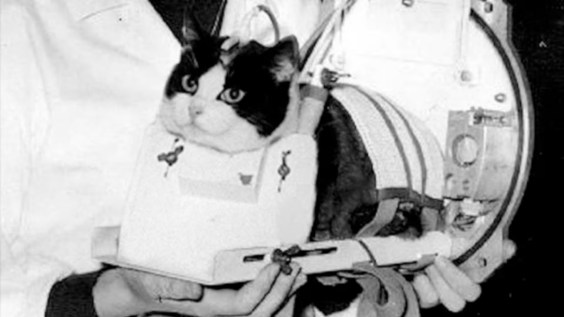
On October 18, 1963, French feline Félicette became the first “catstronaut” to head to space, landing safely by parachute after a trip of under 20 minutes.
In that time, Félicette climbed to an altitude of more than 150 kilometers (93 miles) and experienced five minutes of weightlessness. It wasn’t enough to get into orbit, but it was comfortably higher than Blue Origin’s New Shepard went with Jeff Bezos on board, and about 40 percent of the way to the International Space Station.
After months of training, Félicette was chosen from a group of 14 cats, apparently for her relaxed temperament. Ahead of the launch, the catstronauts in training were put into special harnesses for up to two hours a day to get used to the movement of spaceflight, while listening to sounds matching what researchers thought they would experience on the trip.
Brain-scanning electrodes were used to monitor Félicette’s neuron activity during the brief space jaunt, giving us some representation of what this adventurous feline made of everything that happened while being blasted skyward on a Véronique rocket. According to French archives, Félicette stayed calm and composed throughout, which the mission scientists chalked up to her extensive training.
After landing, the catstronaut designated as C341 and her capsule were recovered by helicopter, and Félicette’s expedition was commemorated with postcards, stamps, and a statue that now stands at the International Space University in Strasbourg.
Félicette didn’t show any adverse reactions to the spaceflight and was reported to be eating and behaving as normal after touching back down on Earth. The story, however, doesn’t have an entirely happy ending. Two months later, researchers euthanized Félicette to study her brain.
Félicette wasn’t the first nor the last animal to be sent to space to test how the environment might impact human astronauts. It began with fruit flies in 1947, ultimately progressing to monkeys, mice, dogs, rabbits, guinea pigs, rats, wasps, tortoises, frogs, spiders, jellyfish, and geckos (not all of whom, sadly, survived their missions).
Read more: “What Do You Get When You Cross a Tardigrade with a Space Pioneer?”
Scientists now know much more about how spaceflight affects our biology than they did in 1963. Although we can survive many months of space travel at a time, there are issues around muscle atrophy and the slowing down of cardiovascular systems that will need to be addressed for longer trips. In fact, researchers are currently studying the best ways to strengthen the heart for a potential Mars mission.
That said, animal experiments are still useful for understanding how we might eventually develop larger space stations and colonies on other planets—which will need their own collections of flora and fauna. So here’s a toast to Félicette, the French catstronaut who helped lead the way. 
Enjoying Nautilus? Subscribe to our free newsletter.
Lead Image: Wikimedia Commons
