


Hollywood has always had a complicated relationship with the truth. Most people understand that historical films take liberties—characters get composited, timelines get compressed, and battles get tidied up for a two-hour runtime. The problem isn’t creative license. The problem is when a film actively markets itself as authentic, earns a reputation for rigorous accuracy, wins awards partly on the back of that reputation, and then turns out to have been feeding audiences something considerably more fictional than advertised.
These are the films that didn’t just bend history—they convinced critics, audiences, and sometimes even historians that they hadn’t. That’s a different kind of dishonesty, and it matters, because for most people, the movie version is the only version they’ll ever encounter. When a film gets it wrong in spectacular fashion while everyone applauds its realism, history loses. What follows are ten films that pulled off that particular trick with remarkable success.
Related: 10 Movies That Get Elite Jobs Right, According to Experts
10 Bohemian Rhapsody (2018)
Everything ‘Bohemian Rhapsody’ Gets Completely Wrong About Queen
When a film is produced by two of the surviving band members, you’d expect it to at least get the band’s own timeline right. It didn’t.
Bohemian Rhapsody grossed nearly a billion dollars and won four Oscars, along with the Golden Globe for Best Motion Picture – Drama, largely on the strength of its crowd-pleasing authenticity. Except the Live Aid concert—the film’s emotional centerpiece—is presented as a reunion after a bitter breakup, when Queen never actually split. Freddie Mercury’s HIV diagnosis is depicted years before it actually occurred, presumably for dramatic symmetry. “We Will Rock You” is placed in the wrong era entirely.
Brian May and Roger Taylor served as producers throughout, which makes the distortions harder to explain away as ignorance. Journalist and Queen historian Matt Richards documented the chronological chaos in extensive detail. The film isn’t really a biopic so much as a tribute act performing a greatest hits version of a story that didn’t quite happen that way.[1]
9 A Beautiful Mind (2001)
A Beautiful Mind: How TRUE Is The Movie To The Real Story?
A Beautiful Mind won four Academy Awards including Best Picture and Best Director, and was widely praised for humanizing schizophrenia in a way mainstream cinema rarely attempted. Mental health advocates applauded it. Mathematicians appreciated the attention paid to Nash’s work. The public embraced it as an honest portrait of a difficult life.
It wasn’t, really. The film’s most fundamental distortion is that John Nash’s hallucinations were exclusively auditory—he heard voices. The film gave him vivid, fully realized imaginary people, including his college roommate Charles and a shadowy government operative named Parcher, because visual hallucinations translated more easily to film. Princeton’s own website confirmed that the famous pen ceremony, in which colleagues honor Nash by placing their pens before him, was completely fabricated.
The film also erased Nash’s illegitimate son, his 1954 arrest for indecent exposure in a Santa Monica bathroom sting targeting gay men—which cost him his security clearance and his position at RAND Corporation—and his long estrangement from his wife Alicia. Nash himself noted that the film inaccurately implied he was taking antipsychotics; in reality he stopped all medication in 1970 and never resumed. The movie that humanized him also quietly edited him into someone easier to root for.[2]
8 JFK (1991)
JFK: Does Oliver Stone’s Conspiracy Classic Hold Up?
Oliver Stone’s film about the Kennedy assassination used real archival footage, documentary-style cinematography, and the weight of Kevin Costner’s everyman gravitas to give it the texture of genuine investigation. It worked almost too well.
The film was so persuasive that it directly pressured the U.S. government into passing the President John F. Kennedy Assassination Records Collection Act of 1992, forcing the release of classified documents. That’s either a testament to its power or a warning about its dangers, depending on your view. Historians were considerably less impressed. David Ferrie, played by Joe Pesci, confesses the entire conspiracy to Jim Garrison on screen. The real Ferrie never did any such thing—the confession is invented wholesale.
Key witness Willie O’Keefe doesn’t exist. Garrison’s actual star witness, Perry Russo, was subjected to sodium pentothal and hypnosis before testifying, a detail the film tactfully omits. Historian Robert Rosenstone called it “a brilliant but irresponsible misuse of film.” Stone shot back that he was presenting a “counter-myth” to the Warren Commission, which critics argued blurred fact and invention.[3]
7 Schindler’s List (1993)
How Accurate Is Schindler’s List
Steven Spielberg’s Holocaust masterpiece won seven Academy Awards and is rightly considered one of cinema’s great moral achievements. The care and seriousness with which Spielberg approached the subject is not in question. The historical precision is another matter.
The famous scene in which Schindler breaks down outside his factory, lamenting that he didn’t sell his car and save two more people, never happened. It was invented for the film. Holocaust scholar and Emory University professor Deborah Lipstadt, while praising the film’s artistry, raised serious concerns that it reframed the Holocaust as a story of a German’s moral awakening rather than Jewish survival—a distinction she felt carried real consequences for how audiences processed what they’d seen.
The real Schindler’s role in composing “the list” was partly mythologized, including by Schindler himself during postwar reparations proceedings. Amon Göth’s sadism, disturbing as it is onscreen, was toned down from the historical record. The film is based on Thomas Keneally’s novel Schindler’s Ark, which Keneally himself described not as strict biography but as “faction.” Spielberg’s film is extraordinary. It is also, in places, a dramatization of a dramatization.[4]
6 Dunkirk (2017)
Christopher Nolan’s Dunkirk was praised almost universally as a model of historical restraint—a war film disciplined enough to trust the facts. Most critics didn’t push back. WWII historian James Holland, author of Duty Calls: Dunkirk, did.
Holland called the film “historically all over the place” while freely admitting it worked brilliantly as spectacle. The “little ships”—the civilian boats that became the film’s emotional backbone—rescued approximately five percent of the soldiers evacuated from Dunkirk. The Royal Navy handled the rest. The film inverts that ratio almost completely. The Spitfires are depicted carrying around 75 seconds of ammunition; in reality, they had roughly 14 seconds of continuous firing time.
The weather is shown as rough and dramatic, when in reality the evacuation took place under unusually calm, flat conditions beneath heavy cloud cover. Most significantly, of the 338,000 soldiers evacuated, some 123,000 were French—yet French and colonial troops are effectively invisible in a film set on French beaches. Nolan never explicitly claimed documentary accuracy, but critics happily awarded him that reputation anyway.[5]
5 The Imitation Game (2014)
How The Imitation Game Got Alan Turing Wrong…
The Imitation Game earned eight Oscar nominations, a 90% approval rating on Rotten Tomatoes, and introduced Alan Turing to a generation that might otherwise have known nothing about him. It is also, according to scholars who actually know Turing’s story, one of the most misleading biopics in recent memory.
Slate’s thorough fact-check, cross-referenced against Andrew Hodges’s authoritative biography Alan Turing: The Enigma—the very book the screenplay claimed to be based on—found fabricated conflict at nearly every turn. Turing never met Soviet spy John Cairncross. The film’s suggestion that he covered for Cairncross to protect his own secret is pure invention and, critics noted, perpetuates the ugly Cold War insinuation that gay men were inherently security risks. Commander Denniston, painted as an obstructive bureaucrat throughout, was in reality a consistent supporter of Turing’s work.
Most significantly, the film implies Turing cracked Enigma largely alone, which erases the foundational contributions of Polish mathematicians Marian Rejewski, Jerzy Różycki, and Henryk Zygalski, who broke earlier versions of the cipher and handed the British their starting point years before Turing arrived at Bletchley Park.[6]
4 Argo (2012)
What’s the real history behind… ARGO (2012)
Argo opened with the words “Based on a True Story” and closed with a postscript acknowledging Canada’s role in the rescue it had just spent two hours minimizing. It won Best Picture at the Oscars, the Golden Globes, and the BAFTAs. The tagline was: “The movie was fake. The story is completely true.” Neither part of that sentence held up to scrutiny.
Former President Jimmy Carter appeared on CNN and stated that roughly ninety percent of the operation was Canadian, not American. Canadian Ambassador Ken Taylor—whose government planned, funded, and largely executed the extraction—called the film’s portrayal “disgraceful and insulting.” The British and New Zealand embassies, which initially sheltered the Americans before the Canadians took over, were erased from the story entirely. Canadian diplomat John Sheardown, who housed several of the diplomats at personal risk, doesn’t appear in the film at all.
The airport chase sequence that provides the film’s climax is complete fiction—the real departure was uneventful. Ben Affleck later conceded the film had downplayed Canada’s role, which is a polite way of saying the hero of the story wasn’t American.[7]
3 Zero Dark Thirty (2012)
Separating Facts from Fiction In Zero Dark Thirty
Kathryn Bigelow’s film about the hunt for Osama bin Laden opened with the declaration that it was “Based on firsthand accounts of actual events.” Screenwriter Mark Boal had embedded with CIA officers and military units. The film presented itself as the closest a narrative feature could get to journalism, and critics largely accepted that framing.
Three sitting U.S. Senators didn’t. Dianne Feinstein, John McCain, and Carl Levin wrote jointly to Sony Pictures calling the film “grossly inaccurate and misleading,” specifically in its central claim that torture produced the intelligence that led to bin Laden’s location. The Senate Intelligence Committee’s 6,000-page report—later partially declassified—confirmed that the key information came from a detainee named Hassan Ghul, who provided it before he was subjected to enhanced interrogation. After the torture began, he gave nothing further of use.
The film’s foundational premise—that brutal interrogation appeared to work and was worth it—was directly contradicted by the government’s own classified findings. A film marketed as journalism turned out to be, on its most important point, precisely the opposite of what the evidence showed.[8]
2 The Hurt Locker (2009)
US Army bomb techs give their verdict on The Hurt Locker
The Hurt Locker won six Academy Awards including Best Picture and Best Director, and director Kathryn Bigelow was explicit and consistent about the film’s authenticity. Screenwriter Mark Boal had embedded with a bomb disposal unit in Iraq, and Bigelow repeatedly described her goal as keeping the film “reportorial,” “raw,” and “as accurate as possible.”
Iraq and Afghanistan Veterans of America founder Paul Rieckhoff read that and wrote a piece for Newsweek calling the film “riddled with inaccuracies,” awarding it “nine more Oscar nominations than it deserves.” NBC anchor Brian Williams published a piece titled “The Hurt Locker: Hurting for a Fact-Checker.” The Pentagon withdrew its support over the inaccuracies. EOD technicians pointed out that real bomb disposal teams use robots and controlled detonations—not the wire-cutter heroics the film made its visual signature.
The main character’s habit of going rogue, wandering alone, and removing his protective gear mid-operation was described by one actual EOD technician as equivalent to a firefighter walking into a burning building with a squirt bottle. The gap between what Bigelow claimed she’d made and what veterans said they watched was, in the words of one embedded journalist, “so disconnected from reality as to be almost parody.” [9]
1 Saving Private Ryan (1998)
WWII Historian Rates ‘Saving Private Ryan’ For Realism | How Real Is It? | Insider
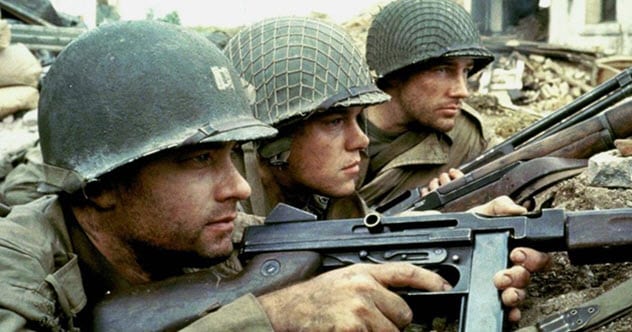
It seems almost heretical to put Saving Private Ryan at the top of this list. The D-Day sequence is so visceral that the Department of Veterans Affairs set up a dedicated phone hotline for WWII veterans experiencing PTSD after seeing it. The National WWII Museum held a formal symposium in the film’s honor. Spielberg won both the Oscar and the Golden Globe for Best Director. The film is preserved in the U.S. National Film Registry as “culturally, historically, or aesthetically significant.”
And yet. Historian and battlefield guide Mat McLachlan documented the inaccuracies methodically: the German bunkers shown are Hollywood inventions many times larger than the real concrete emplacements. The film’s dialogue incorrectly states that no Allied armor made it ashore at Omaha Beach, when armor actually did land. The P-51 Mustang in the climax bears the wrong squadron markings. The cast’s average age was roughly fifteen years older than the soldiers who actually stormed the beaches—every lead actor was pushing thirty or beyond; the real Rangers were mostly nineteen and twenty.
Most fundamentally, the entire premise is historically implausible. No squad was ever dispatched behind enemy lines purely to retrieve a single enlisted man. The real-life Niland brother who inspired Private Ryan was pulled from combat through routine administrative channels, not a combat mission. The D-Day sequence is genuinely magnificent. What follows it is a gripping war film wearing historical accuracy as a costume it never quite earned.[10]
fact checked by
Darci Heikkinen
