


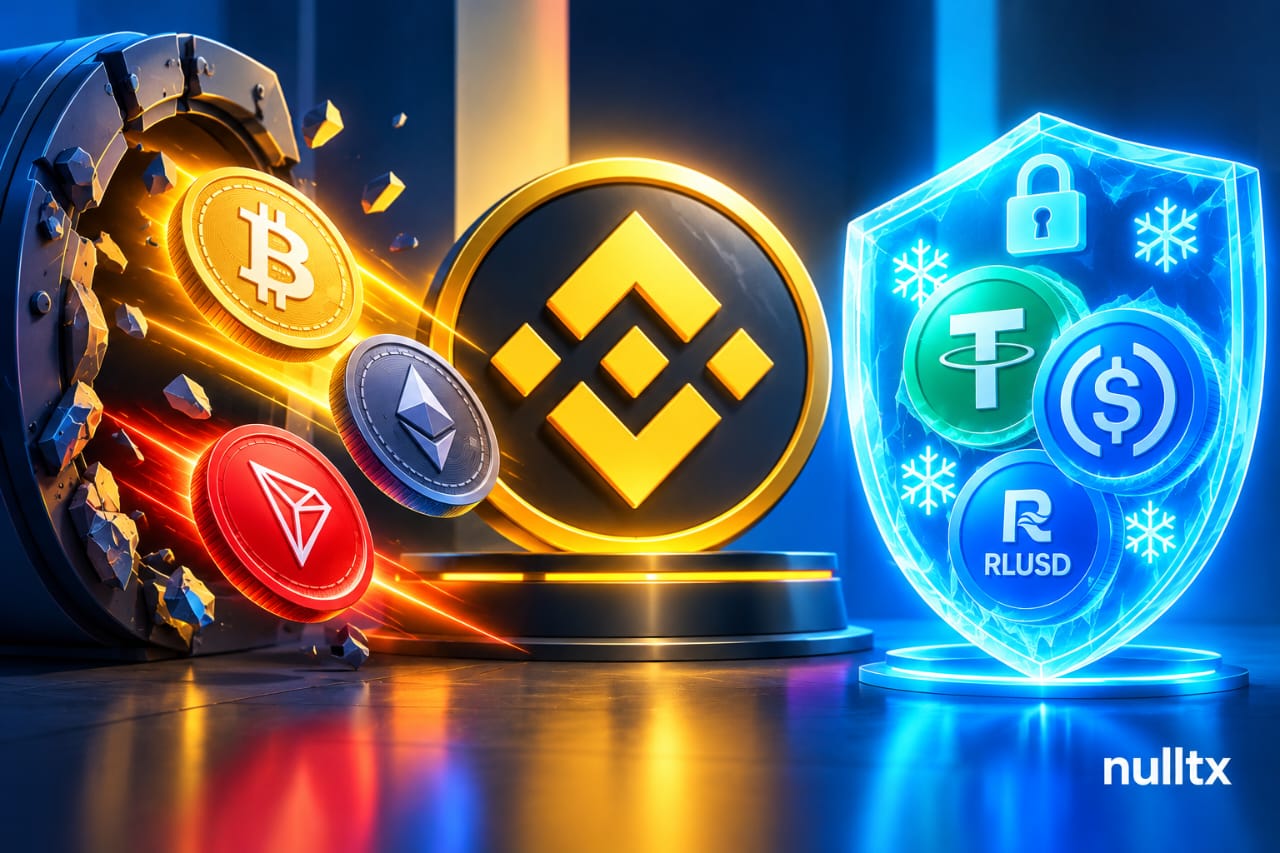
Tether, Circle and Ripple could freeze their tokens within hours of the Binance theft, and they did.
There is no one to call for the stolen bitcoin, ether and TRX, which makes up most of the money Binance is unlikely to get back.
In most hacks, the stolen total is the headline. In the Binance breach, the more useful number is how much of the stolen money could be stopped.
 On-chain trackers estimate the stolen basket at more than $5.6 billion. Binance itself has put the estimated impact at $6.3 billion and says nearly $3 billion is frozen. That freeze was possible only because of how the stolen money was made up.
Almost half of it was in tokens whose issuers can freeze them. The rest was in assets that no company, foundation or council can stop on their main blockchains.
That second half explains why recovery stalled at about $3 billion despite a fast industry response. It is also the part Binance will most likely have to pay for itself.
A $5.6 Billion Basket Split Almost Down The Middle
The per-asset breakdown from on-chain trackers is:
 Sorting by whether the issuer can freeze the token gives a near-even split:
- Tokens with a freeze button: USDT, USDC, RLUSD, WBETH and XAUT add up to about $2.61 billion, or roughly 46% of the $5.6 billion total.
- Assets with no freeze button: BTC, ETH and TRX add up to about $2.56 billion, or roughly 46%.
- The remaining $447.5 million is a mix of the two kinds, from stablecoins to ordinary DeFi tokens.
That one division shaped everything that happened after the theft.
The Issuers Who Could Hit Pause
The response on the freezable side was unusually fast:
- Tether: CEO Paolo Ardoino said the company froze more than 1.567 billion USDT “related to a potential Binance exchange hack.” That is close to the full $1.57 billion of USDT in the trackers’ estimate.
- Circle: CEO Jeremy Allaire said that, “in coordination with law enforcement,” Circle had frozen more than 800M USDC associated with the incident.
- Ripple: Jack McDonald, who leads Ripple’s stablecoin business, said the company was “actively freezing affected funds” in RLUSD tied to the attackers.
- World Liberty Financial: CEO Zach Witkoff said USD1 had moved to freeze the $27 million in USD1 linked to the hack. Binance co-CEO Yi He said a further $2 million in WLFI was also frozen.
- First Digital: CEO Vincent Chok said the company had frozen the FDUSD involved and was working with Binance to stop the stolen funds from being moved.
- WBETH and XAUT also appeared among the frozen assets. WBETH is Binance’s own wrapped staked ether, and XAUT is Tether’s gold-backed token.
The pattern is the same in every case. A company that issues a token on a public blockchain usually keeps a way to block specific addresses from moving it. Critics see that power as a central point of control, but in this theft it worked. Within hours, the largest dollar-value block of the stolen money could not be moved.
 There was one notable intervention outside the token issuers. On Arbitrum, the Arbitrum Security Council took emergency action and moved 74,559,805 ARB and 8,425 ETH, about $30.5 million, out of an address connected to the exploit.
It shows that some layer-2 networks keep emergency powers their base layers lack. The amount was small next to the size of the theft.
The Assets Nobody Can Freeze
The other half is a different story. Bitcoin has no issuer. Ether on Ethereum’s main network has no admin key. TRX is Tron’s native coin, and no token issuer sits between the holder and the blockchain. Once these assets reached the attacker’s wallets, stopping them depended on exchanges refusing deposits and investigators tracking the funds, not on any freeze function.
Together, the $1.45 billion in BTC, $875 million in ETH and $234 million in TRX make about $2.56 billion. That is close to Binance’s own numbers: about $3 billion frozen out of a $6.3 billion estimated impact leaves roughly $3.3 billion still in play, and most of it is in assets nobody can freeze.
The bitcoin figure is the most contested part of the basket. Some BTC moving out of Binance-linked wallets during the incident may have been Binance moving its own reserves to safety rather than attacker withdrawals. So the true unfreezable total could be lower than $2.56 billion, but the split between the two groups is unlikely to change much.
The Attacker Raced To Swap Freezable For Unfreezable
The attacker appeared to understand this difference and acted on it right away.
On-chain records show the main sweep on Ethereum used an EIP-7702 delegation. This feature lets a regular wallet hand control to a smart contract. Within minutes, the drained hot wallet’s contents, including more than 1.6 billion USDT, had moved to attacker-controlled addresses.
The clearest example of the next step is on Aave. According to Aave’s governance forum update from risk manager LlamaRisk, one wallet in the exploiter’s cluster acted between 20:58 and 21:01 UTC:
- It supplied 60 million USDT to Aave V3 on Ethereum.
- It borrowed 19,762 WETH, about $44.6 million.
That trade left freezable USDT locked inside Aave as collateral and gave the attacker wrapped ether, which no issuer can freeze. The position stays over-collateralized, and LlamaRisk said it “does not put Aave suppliers at risk.” The ETH, however, was already gone.
Aave responded on a large scale. Between 21:42 and 23:04 UTC, its guardian multisigs froze:
- Aave V3: 175 reserves across 16 networks.
- Aave V4: 117 reserves across four networks.
The freezes blocked new deposits and borrowing. Reports also describe stablecoins being swapped for ETH on Uniswap.
 The race was easy to see in the timeline. Each hour before an issuer froze its token was another hour to swap that token for ether. Tether and Circle reacted within the first hour, so most of the stablecoin stash was frozen before it could be converted.
Why Frozen Is Not The Same As Recovered
A freeze stops the attacker, but it does not put money back in Binance’s accounts. Frozen tokens stay locked at the attacker’s addresses until the issuer decides what to do with them. In past cases, issuers have destroyed frozen tokens and reissued the same amount to the rightful owner, usually after legal or law-enforcement checks. That process takes time, and each issuer has its own procedure.
Binance has said that its initial investigation points to a compromised DevOps engineer’s laptop. According to the company, that laptop let the attacker reach a service container and submit unauthorized withdrawal transactions. Binance said it found no evidence that wallet private keys were leaked, and that it has revoked the affected address authorization and is working with law enforcement and blockchain intelligence firms.
Deposits and withdrawals were suspended while security checks continue. Binance has not yet given a date for reopening them.
What The Split Means For Binance’s Bill
Binance has said it will cover all losses using its SAFU fund and its own money. Grouping the stolen basket by freezability gives a rough picture of what that bill could be.
The roughly $3 billion that is frozen should eventually be recovered, depending on how and when each issuer releases or reissues the tokens. The bitcoin, ether and TRX are another matter. Unless exchanges block deposits and investigators recover funds as they are laundered, that part is effectively gone. It accounts for most of the money Binance will have to cover from its own reserves.
The theft also raises a question for the whole industry. The assets that limited the damage were the issuer-controlled tokens that crypto purists often criticize. The assets that caused the real loss were the ones built so that no one can stop them. Exchanges have long decided hot-wallet sizes by liquidity needs. After this theft, they may also consider which assets in those wallets can still be stopped once they leave.
Disclosure: This is not trading or investment advice. Always do your research before buying any cryptocurrency or investing in any services. Follow us on X @nulltxnews
