



Cybersecurity worries and shifting regulations are reshaping the derivatives world right now, and Hyperliquid is coming out ahead. After a major exchange security incident led to a lot of scrutiny, regulators are signaling they’d rather see perpetual futures run through onshore, compliant channels. That leaves room for infrastructure that meets institutional standards and still keeps execution onchain.
What Happened and Who Is Driving the Shift
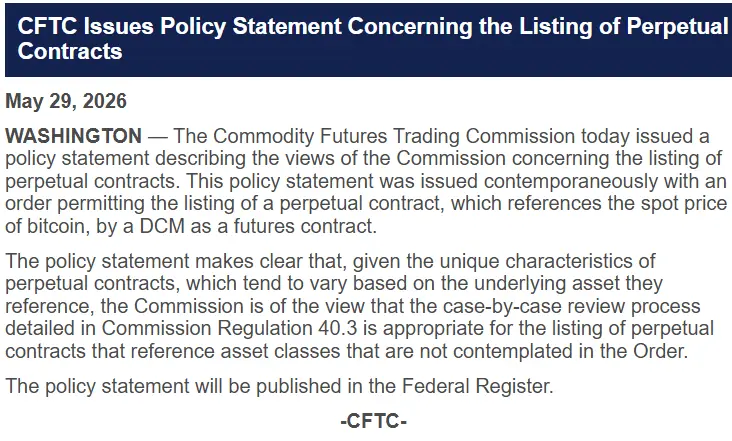
The CFTC has spelled out how perpetual contracts can work under US oversight. Chair Michael Selig is pushing for a federal registration pathway for platforms that meet US requirements. It builds on a May 2026 CFTC staff advisory and no-action relief, which opened the door to regulated perpetual futures.
Source: CFTC
Two things put Hyperliquid at the center of this. September remarks suggested the CFTC was working to bring Hyperliquid to the US in a fully compliant, legal way. Then Intercontinental Exchange, NYSE’s parent, announced on October 29 a definitive agreement with Trade[XYZ] to bring Hyperliquid-based perpetual markets onshore. Under the arrangement, ICE runs the exchange and clearing, Trade[XYZ] designs the markets, and Hyperliquid’s HIP-3 supplies the technology.

Source: Medium
ICE also disclosed a strategic minority stake in Trade[XYZ], with the venue to be offered through brokers pending CFTC approval. No launch date has been set, and Hyperliquid’s current platform stays geofenced for US users.
Also Read: Hyperliquid Generates $105M in September Revenue as HYPE Price Eyes Rally
Why ICE, HIP-3, and Regulated Perps Actually Matter
With HIP-3, which stands for Builder-Deployed Perpetuals, outside teams can spin up their own perp markets right on Hyperliquid while still sitting on top of its matching engine and deep liquidity. Trade[XYZ] got there first in October 2025, and in a bit over a year it’s already cleared more than $650 billion in cumulative volume. For ICE, the crypto angle is only part of it.
Hyperliquid Is Benefiting From the U.S. Regulatory Shift
The Binance hack has strengthened the U.S. government’s push for stricter oversight and cybersecurity standards across crypto exchanges.
CFTC Chair Michael Selig is advocating a federal registration pathway for platforms… pic.twitter.com/nmk3yYtpnK
— Hyperliquid Daily (@HYPERDailyTK) November 3, 2026
CEO Jeffrey Sprecher is pointing at a bigger shift in who’s doing the trading. Retail is global now, and those traders want short-dated, leveraged exposure that never sleeps. The new venue is built for exactly that: crypto, equities, indices, commodities, forex, all of it available 24/7. And to make it work for institutions, ICE is setting up a separate clearing structure so its traditional futures clients don’t end up carrying retail counterparty risk.

Source: Zach Rynes
Early in 2026, ICE and CME were reportedly pushing regulators to take a harder look at offshore perp venues over manipulation and sanctions worries. Five months later, ICE is building a regulated version of the same thing on Hyperliquid’s tech stack. That tells you where Wall Street is heading. Launching Bitcoin ETFs isn’t the whole story anymore. It’s starting to use onchain infrastructure to build products.
To be clear, this isn’t the US government putting its stamp on HYPE. But it does move Hyperliquid into a different lane, as the plumbing for regulated onchain derivatives, set apart from offshore giants like Binance, Bybit and OKX that still dominate volumes.
Also Read: Hyperliquid Burns $6.75M as HYPE Price Outlook Strengthens Sentiment
What It Means and What to Watch
If the CFTC greenlights an onshore perp venue, it becomes a compliant benchmark for the whole space. That changes how brokers, market makers, and custodians think about margin, liquidations, and risk.For builders, it matters too. When a group like ICE validates HIP-3, it makes the builder-deployed model look far more credible than the old, monolithic exchange model.
Regulators will dig into surveillance, margin rules, custody, and how retail is protected. And competition is heating up: Kraken’s parent Payward has already been disclosed as the first CFTC-regulated HIP-3 deployer.
The next steps to watch: what the CFTC does with the ICE-Trade[XYZ] filing, the details on products and clearing, and whether more builders jump in. If it clears, the real test is simple: can on-chain matching paired with traditional clearing actually pull retail flow back onshore and meet US cybersecurity standards? That question will define the next chapter of market structure.
Also Read: Hyperliquid’s ICE Deal Expands RWA Futures as HYPE Price Faces Key Levels

Ananthyka J
Ananthyka J is a market reporter at Tronweekly, reporting on cryptocurrency news. She covers cryptocurrency markets, blockchain technology, and digital asset regulation, focusing on Bitcoin, Ethereum, DeFi, altcoins, and crypto policy. Her reporting emphasizes clear and accurate market coverage, including crypto market movements, regulatory developments, and blockchain adoption. She holds a BA in Journalism and Mass Communication and an MA in Communication and Media Studies. She has also completed multiple media internships, follows strict editorial and fact-checking standards, and discloses potential conflicts of interest when reporting.
