


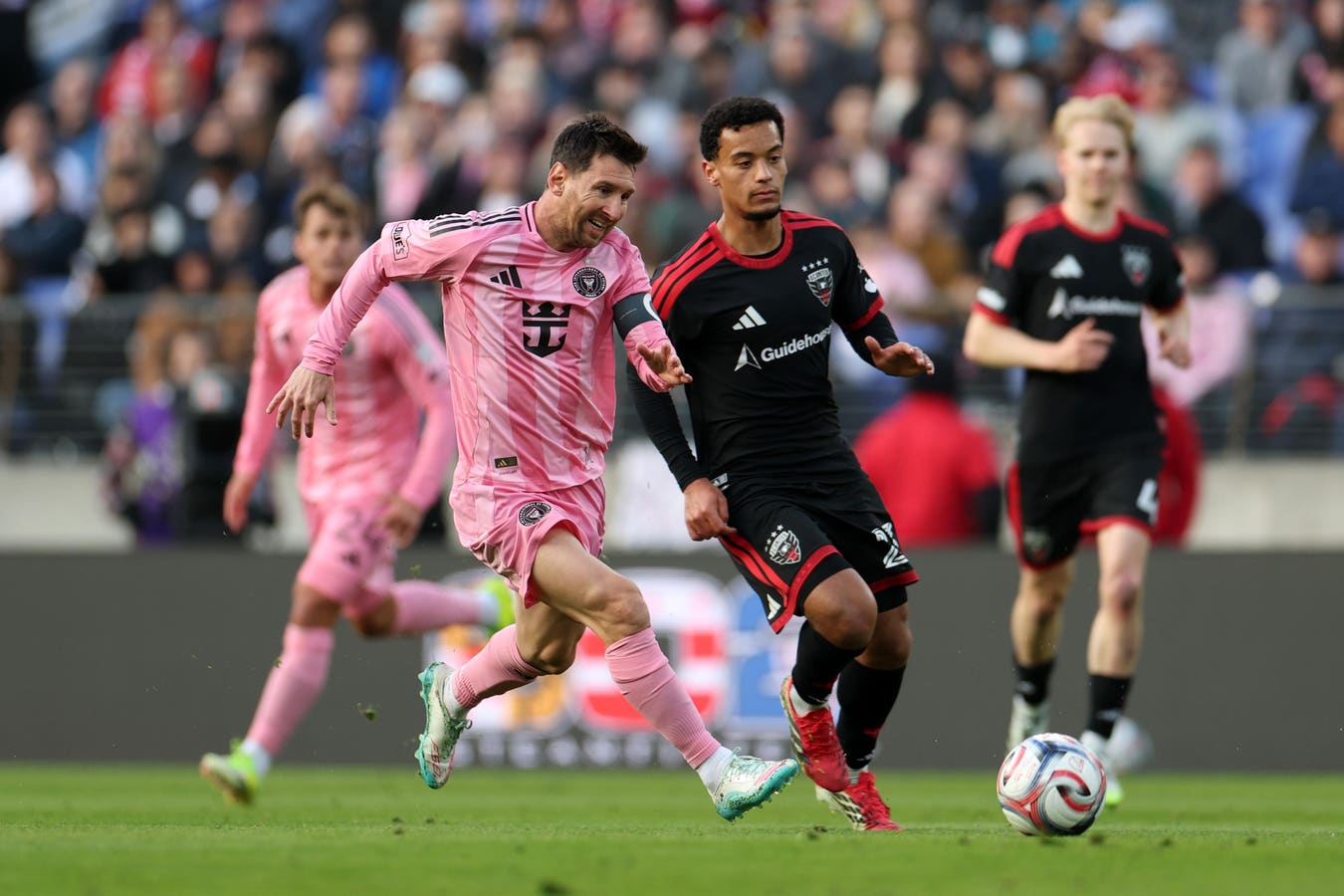

Lionel Messi of Inter Miami CF and Brandon Servania of D.C. United compete for the ball during an MLS match at M&T Bank Stadium on Saturday.
Getty Images
For every Major League Soccer team that plays in an intimate, soccer-specific stadium, hosting a home match against eight-time Ballon d’Or winner Lionel Messi and Inter Miami serves up the tricky question of whether to move the fixture to a larger venue.
And on Saturday, D.C. United coach Rene Weiler seemed to suggest his club’s decision to play Saturday’s contest up the road at an NFL facilty in Baltimore may have prevented his side from earning a result.
“It was nice to have a game in front of so many spectators, and it is a beautiful stadium,” Weiler said after his club’s 2-1 defeat. “But as a coach and as players we prefer to have a good result at the end. But yeah, it was a nice atmosphere.”
Asked to assess his side’s first-half performance, in which they conceded two relatively soft goals, Weiler followed with this:
“I was a little surprised, because the start was very nervous. We lost easily our balls with simple passes. We didn’t give them a chance to score (with those), but at the end it was a gift, the first goal. It was not expected like this. But maybe a little bit nervous because of the atmosphere. the spectators in the stadium, and of course the opponent, Miami.”
Before the announced crowd of 72,026, United made an admirable effort to rescue a result, and cut the deficit in half through Tai Baribo’s second goal of the season. But Weiler’s comments reflect a clear truth, that when teams make the decision D.C. made, they create an atmosphere Miami is far more familiar with than the home side will be.
Matches Played Before Large Crowds Since 2025
Above 30,000
Inter Miami: 15
D.C. United: 3
Above 40,000
Inter Miami: 11
D.C. United: 2
Above 50,000
Inter Miami: 8
D.C. United: 1
Above 60,000
Inter Miami: 8
D.C. United: 1
Above 70,000
Inter Miami: 2
D.C. United: 1
To be fair, it doesn’t always mean defeat. On Matchday 1 of the MLS season, LAFC rampaged past Miami 3-0 before 75,673 at LA Memorial Coliseum. But LAFC was already more comfortable than most other MLS clubs in such environments, having twice played in front of more than 50.000 since the arrival of South Korean star Son Heung-min last summer transfer. They also played an El Trafico fixture against the LA Galaxy before 70,076 at the Rose Bowl on July 4, 2024.
That’s not the case for a D.C. side that has struggled in recent seasons to fill its own 20,000-seat Audi Field. Contrast that with the Herons, who played nine times in front of 40,00 or more in 2025 across all competitions.
So while it’s not fair to solely blame the venue for the result, it’s hard to ignore the likelihood that it removed some of the mathematical home-field advantage that is statistically significant across every MLS season.
The Black-and-Red are the fourth team to relocate a game to enable larger crowds to watch Messi and Miami since the 2024 campaign, with LAFC the only side to earn a positive result.
But other teams that play their regular season matches in larger venues have been able to open portions of the stadium that typically go unticketed for normal MLS fixtures. That means Miami are regularly drawing the kinds of crowds typically reserved for American football.
Inter Miami in relocated matches
Inter Miami 3, Sporting Kansas City 2
April 13, 2024
GEHA Field at Arrowhead Stadium
Kansas City, Mo.
Att: 72,610
Inter Miami 1, Columbus Crew 0
April 19, 2025
Huntingdon Bank Field
Cleveland, Ohio
Att: 60,614
LAFC 3, Inter Miami 0
February 21, 2026
LA Memorial Coliseum
Los Angeles, Calif.
Att: 75,673
Inter Miami 2, D.C. United 1
March 7, 2026
M&T Bank Stadium
Baltimore, Md.
Att: 72,026
You can certainly understand why D.C. – a club trying to climb out of a five-year postseason drought with a new sporting director and new manager – would believe moving the game is worth it.
It’s not just about boosting ticket sales. It’s about increasing exposure in a region where they’ve struggled to maintain the local relevance they once had when they won four of the first nine MLS Cups played between 1996 and 2004.
Yes, the crowd that turned up Saturday came primarily to see the world’s greatest living player in person. But they were also exposed to a D.C. side with some interesting new faces that is trying to regain relevance.
A narrow defeat that included a strong second-half performance may have made convinced some in attendance to attend another D.C. match in the future. And in a year where the club is unlikely to be a serious MLS Cup contender, there’s a credible argument that the publicity is worth more in the long run than the best possible chance to earn a good result.
