




 8 min read
Forty years ago, Kevin Eastman and Peter Laird published the first issue of a wild, wacky, and shockingly violent comic book you may have heard about: Teenage Mutant Ninja Turtles. In the decades since, the four ectothermic ninjutsu masters with bottomless pizza cravings have been mascots to a franchise that spans generations and prints more money for its current owner, mass-media conglomerate Paramount, than any person can count. But its newest writer, Gene Luen Yang, sees them in a different light.
“What I appreciate about the IDW run is that they are reincarnations,” the 52-year-old comics writer and illustrator (he prefers the term “cartoonist”) tells me. In the current Ninja Turtles comics published by IDW, a reboot effort that began in 2012, the Turtles and their father figure Splinter “are reincarnations of a family from feudal Japan.” They might not look it, but to their Chinese American scribe, “that makes them quintessentially Asian American.
“They sit between two cultures, between American culture centered around New York City and Japanese culture,” Yang says. “I feel a lot of resonance with them as an Asian American. We’re playing with that a bit. The connection between Japan and America is in every iteration of the Turtles, but there’s a little extra oomph in the IDW version.”
When the Ninja Turtles first broke out from New York’s sewers, among their fans was a young Gene Luen Yang. “I remember watching the show with my little brother. I remember coming across those old Mirage Studios comics at a friends’ house and being stunned by the art,” he says. “It was Frank Miller–esque, channeled in this unexpected way.”
Today, the second-generation Chinese immigrant is a celebrated industry figure whose books like American Born Chinese, Boxers & Saints, and Superman Smashes the Klan have earned him numerous publishing accolades. Among his honors are several Eisner Awards (basically the Oscars for comics), a National Book Award, and the John Steinbeck Award in 2024. In 2016, Yang became the third comics pro to receive a “genius grant” from the MacArthur Foundation. Also that year, he wrote one of the most compelling titles for DC Comics in its storied history: New Super-Man. The series followed a bullish Shanghai teenager who obtains Superman’s powers and is recruited into the “Justice League of China.” When Warner Bros. sought a box-office foothold in China through the DC Extended Universe, Yang explored themes like democracy and censorship in that same IP sandbox.
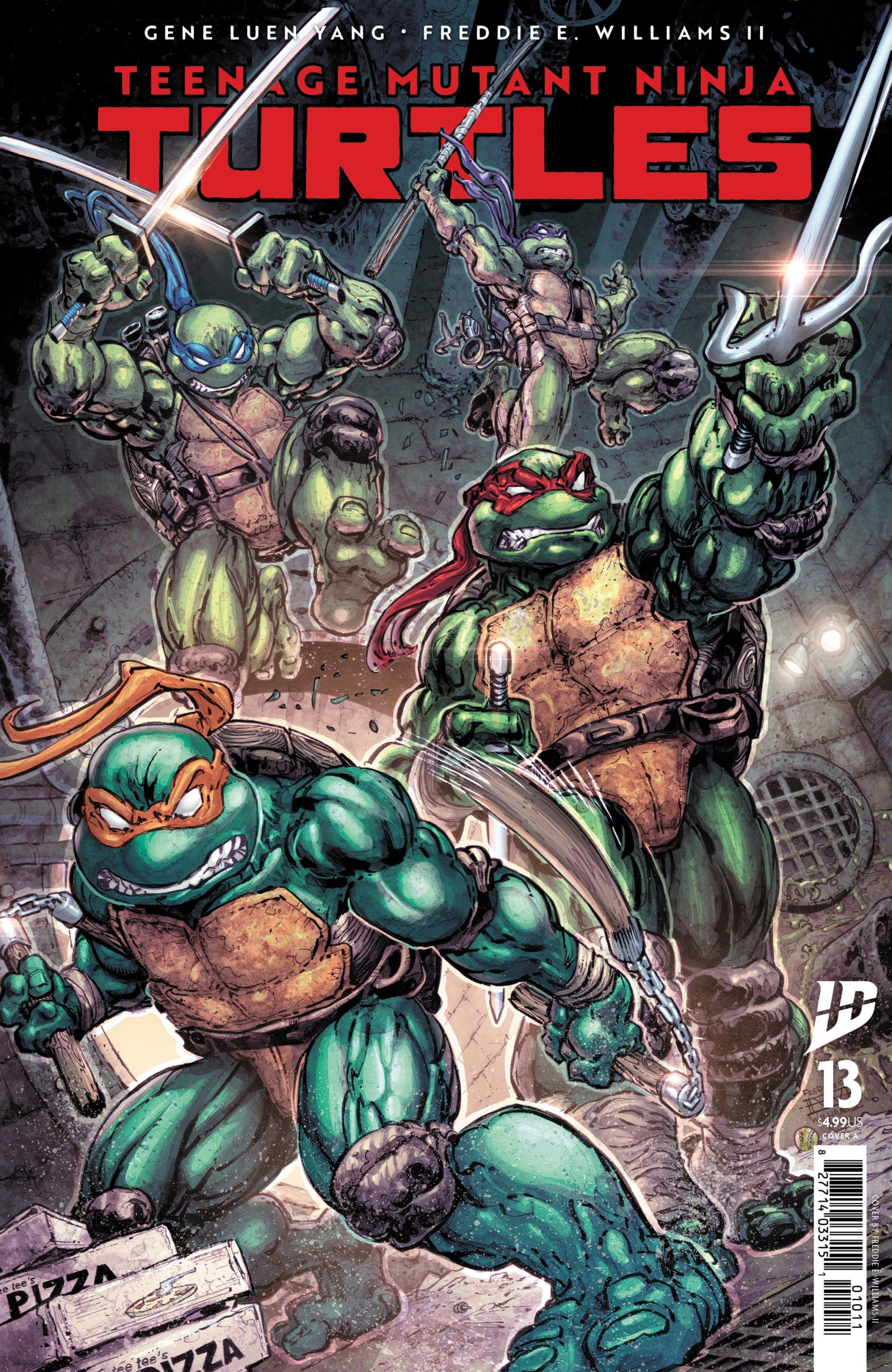
Last July, IDW announced Yang and artist Freddie E. Williams II as the new team for Teenage Mutant Ninja Turtles, taking over for the previous duo of Jason Aaron and Juan Ferreyra. Their first issue hit shelves in December, and their third (issue #16) published on March 11. The moment made Yang the first Asian American writer to pen a flagship Ninja Turtles comic, a milestone in a 40-year-old franchise marinated in East Asian mysticism.

Gene Luen Yang’s award-winning comics like American Born Chinese and Boxers & Saints have earned him prestige in the industry. Since December, he’s helmed IDW’s Teenage Mutant Ninja Turtles as the first Asian American writer on the series.
“There’s this grittiness to what they did, a heavy emphasis on action,” Yang observes of his predecessors. By contrast, Yang strives to crank up the “weirdness” in homage to what Eastman and Laird did after the initial success of their OG Turtles. “If you read those original Mirage Studios [issues], it moves from fighting Shredder in the streets of New York City to going to outer space meeting triceratops aliens. I want to follow that same pattern. Jason and Juan captured the grittiness of early Turtles, and I wanna move into weirdness.”
In an interview conducted at New York Comic Con in October, Yang explored his career in comics and taking over Ninja Turtles. He grappled with his approach to the legendary series, the history of comic books for marginalized artists, and what you’re actually allowed to do when you get a “genius grant.”
This interview has been edited for clarity.
ESQUIRE: Why do you call yourself a cartoonist and not a “comic-book writer”?
GENE LUEN YANG: We call ourselves cartoonists. When we talk to the wider world, we’ll say “graphic novelists” or “comic-book writer.” But deep down most of us consider ourselves cartoonists. Charles Schulz called himself a cartoonist. It’s part of the tradition. When we’re trying to sell something, we might call ourselves something else.
What made you fall in love with comics?
I grew up with stories. My parents are immigrants; they told me lots of stories from Chinese culture. It was their way of maintaining connection between the culture they left and the culture they were raising me in. My mom loves stories about the Monkey King. I also grew up drawing, and animation and comics seemed natural.
I was obsessed with Disney. I remember figuring out at a young age that the cartoons were drawings somebody made. But after I got [my first comic], DC Comics Presents #57, I realized that this was another form of drawn storytelling, and it was more accessible. I had a best friend in fifth grade, we started making comics together. That’s how it started.
What do you remember about getting the MacArthur Fellowship in 2016?
I remember the day. It was in the morning. At the time I did all my writing, all my art, in a Panera. I was driving when I get a call from from a number I did not recognize in Chicago. It was the MacArthur folks telling me I got the grant. It was stunning. I had to pull over to the side and call my wife. I did not do any work that day. [Laughs.]
What does it entail?
It is a no-strings-attached grant. You can do anything [with the money]. I have four kids, and it ended up going into their college funds. I was a high school teacher and cartoonist—I had no idea how I was going to pay for college. That solved that issue. It also allowed me to rent a workspace. I’m no longer going to Panera.

Interiors from Teenage Mutant Ninja Turtles #13, which marked the debut of Yang and Williams as its creative team.
Did getting a certified “genius grant” influence your confidence or ego?
It didn’t get me out of dishes at home. [Laughs.] Most of us do this very introverted art form because we struggle with self-confidence. Those cracks, the insecurities, they become a source of storytelling. Some of the best stories are pulled from that feeling. When I was teaching, I would tell my students the best place to look for ideas are the parts of your life that create negative emotions. Anything that makes you feel angry, sad, annoyed. Look there. Stories are about conflict. Even when you’re working on IP characters, there will be this personal connection between you and your writing.
What do you think makes the Ninja Turtles evergreen after 40 years?
The Turtles are archetypes. I used to teach writing at Hamlin University in Minnesota. [The Ninja Turtles] map onto the four humors from Greek philosophy, which is sort of a basis for so much fiction. The cast of Seinfeld, the core Avengers, Mickey Mouse and his friends all map onto the four humors. Of those, the Turtles kind of do it the best. Also, the Turtles are multi-genre. You can throw the four in a serious martial-arts epic, throw them in sci-fi, horror, it’ll work. Those things combined give the Turtles this lasting power.
You’re the first Asian American writer to pen the Ninja Turtles in comics. It’s frankly a miracle the franchise hasn’t ever been insensitive. How are you approaching the Ninja Turtles given their strange history of exploring Asian culture the way they do?
One of the reasons why the Turtles never cross the line is that they’re so weird. Their weirdness works in their favor. [As a writer] I want to lean on Japanese mythology and philosophy. The first villain in our story arc is Ujigami. In Shinto mythology, Ujigami is a protector spirit in charge of protecting family. We want to play with having a protector spirit for New York City, and the Turtles come into conflict with that spirit.
This isn’t the first time you’ve done a comic about green turtles. In 2014 you wrote The Shadow Hero starring the obscure Golden Age character Green Turtle, who might be the first Asian American superhero. In an interview we did in 2017, you said the comic instilled a “feeling of affirmation that we might have always been there.”
I’ve always thought American comics were a place where people who couldn’t find their voices could find their voices. A lot of the greats, Jack Kirby, Stan Lee, Bill Finger, were poor Jewish immigrants who escaped Europe in a time when America was not friendly to Jewish people. They were able to find a place for themselves in this medium. Comics has continued that tradition. It’s the same reason I was drawn to it when I was in fifth grade.
Ten years ago you wrote New Super-Man for DC Comics. A decade later, how do you feel about that book in retrospect?
I loved my time on that book. I was resistant to doing it in the beginning. I thought doing a Chinese Superman was a bad idea. Then I found out it was Jim Lee’s idea to bring an Asian member into the Superman family, and I had to say yes ’cause I’m a huge fan of Jim Lee. But it felt like they had carved out a corner of the DC Universe that I got to play in. It’s gratifying to see the characters we created for that show up in other DC stories today.
Do you think a book like New Super-Man could have happened today?
I’m not sure if it could. At the time we thought of New Super-Man as a commentary of how American culture interacts with Chinese culture. How these cultures interact with each other, as opposed to how two political entities interact.
Take Chinese rap, for example. Chinese rap began as this poor carbon copy of American rap. It didn’t have identity. Over time, the Chinese find their voice. Now you have Higher Brothers, who pull from American rap, but they’re distinctively Chinese. We wanted to do that with superheroes. The Justice League of China began as this imitation of the Justice League of America, and the hope was that as the book developed, they would come into their own. Now, even though there are political tensions, those connections are still there.
One of your most celebrated books, American Born Chinese, was adapted into a Disney+ show in 2023. The show was very different from your comic. How do you feel about the series and the changes it made in hindsight?
I was hoping the show would capture the emotional heart of the book. The feeling of being an outsider, taking that discomfort, dealing with that discomfort by taking it out on somebody who’s supposed to be your friend—all that. I was hoping the underlying emotions would be the same. I think [producer] Kelvin [Yu] and his team did that.
Across all of culture, we’ve seen rollbacks of inclusion and diversity. Besides the obvious political forces at play, why do you think we’ve regressed so much after years of progress? Why haven’t we learned anything from superheroes?
I have a friend, Melvin Barr, he was a producer on Fresh off the Boat. He says progress is always two steps forward, one step back. We might be in “one step back.” But there’s still opportunities for the stories of marginalized people to get out [there]. Human beings are good but flawed. It’s difficult to get away from our flawed nature. But stories at their best can be healing. Stories can help us deal with that intrinsic flaw in our species. Unfortunately, I don’t think we’ll ever be in a place where we don’t need heroes.
