


The men’s bathroom at the Naval Air Station North Island Visitor Center was closed Wednesday because someone smoked a cigarette inside. It was a completely understandable transgression—the anxiety among those waiting for the USS Abraham Lincoln to return was high enough to make a nicotine virgin turn to Zyns, or even unfiltered Camels.
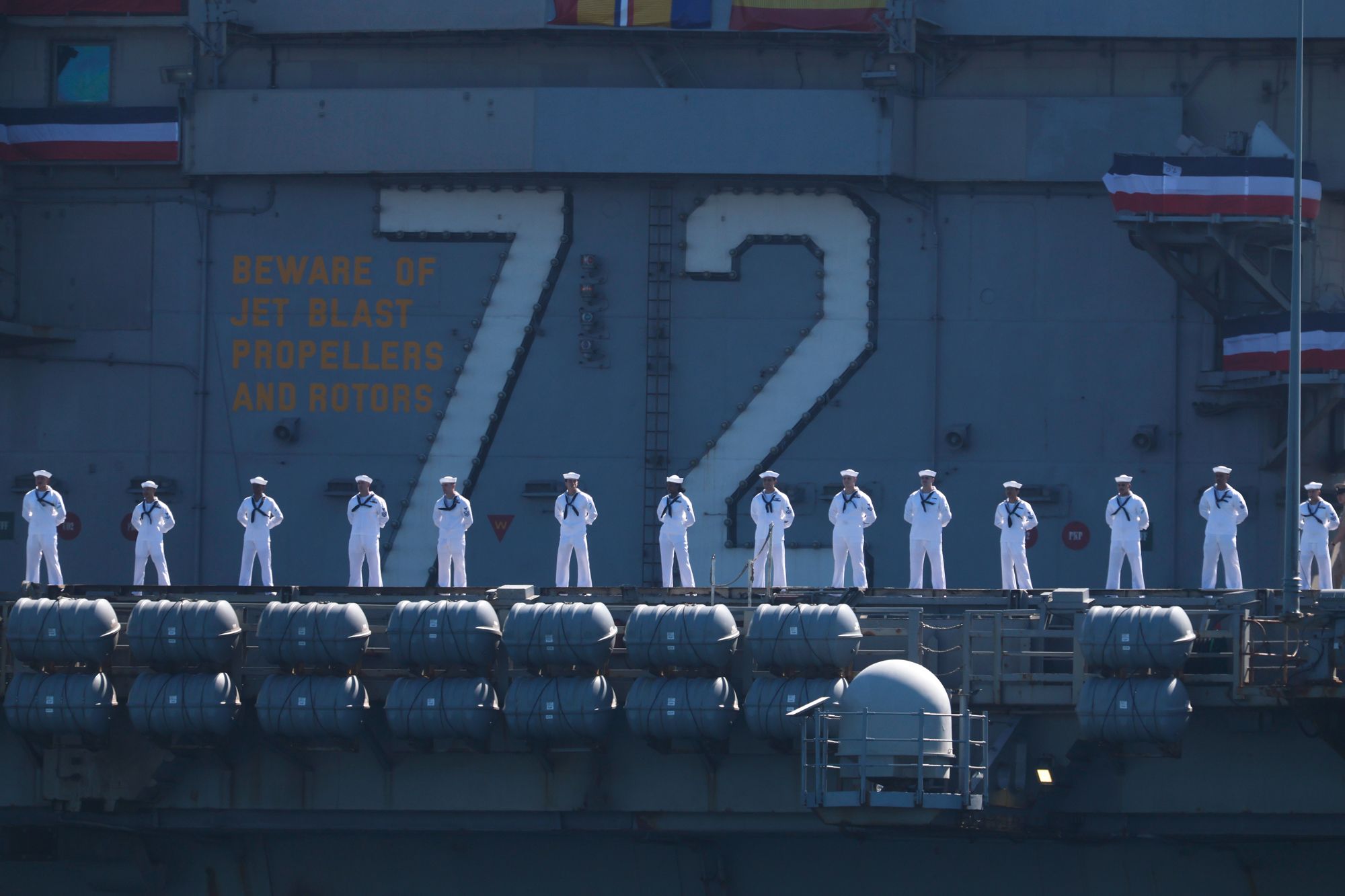
Over 5,000 sailors and marines returned to the base on Coronado island Thursday afternoon, which meant thousands more of their relatives and loved ones descended on San Diego to greet them after a 321-day deployment mostly spent off the coast of Iran. The service members on the Lincoln weathered missile attacks and, according to several media reports, they endured food shortages, moldy showers, broken plumbing, and prolonged confinement that exacerbated mental health issues. Acting Navy Secretary Hung Cao confirmed eight suicide attempts across the Lincoln strike group during the deployment—which partially explained the palpable stress at the visitor center.

Families of sailors deployed on the USS Abraham Lincoln found their seats in the bleachers before the ship returned to port, October 8, 2026.The San Diego Union-Tribune/Getty Images
Defense Secretary Pete Hegseth dismissed reports about the conditions. And when President Donald Trump was asked in August whether the deployment had gone on too long, he said, “Not nearly long enough.” The Lincoln’s deployment was the second longest of any aircraft carrier since the Vietnam War.
By Wednesday afternoon, the line for visitor passes to get on base for the ship’s homecoming stretched several hundred feet, snaking across the lawn in front of the building and doubling back on itself. Families had flown in from across the country, some dragging suitcases straight from the airport. They had spent the better part of a year worrying about their sailors’ safety, and now they worried about getting onto the naval base to hug them, kiss them, and make them feel at home.
By Thursday morning, the operation to vet visitors and get them base credentials was falling apart. The computers couldn’t handle the rush of people—dressed in Navy-branded hats and patriotic T-shirts—who were trying to get passes, and the Navy staff resorted to writing them by hand.
“They sent us to multiple locations,” one woman complained. “We’re in limbo.”
“Officers are giving conflicting information,” said another.
Some family members started getting frustrated.
“If you’re new to the line, welcome to the shit show,” one woman yelled.
“Did you run out of printer paper? This is ridiculous,” another woman said to a Navy staffer.

Dallas Courville held her grand daughter Isabella Courville, 6, in the bleachers before the USS Abraham Lincoln returned to port, October 8, 2026.The San Diego Union-Tribune/Getty Images
When some of the people finally did get their passes, the crowd started cheering like their team won the Super Bowl. One woman embraced the service member who had helped her and said, “You sweet man.”
A mother who had flown in from Hawaii had a fresh lei waiting in her hotel room for her daughter on the ship. She was desperate to get her visitor pass so she could pick up her lei before the ship docked.
At one point, someone from the Navy announced that families who had signed up for passes Thursday morning were still being vetted. “It’s gonna be a while,” he warned.
Then the national anthem began playing, and everyone stopped yelling. When it ended, the complaining picked up right where it left off.
A lot of the people I spoke to while waiting for the sailors to arrive Thursday were fiercely defensive of the Navy, and dismissive of all the negative reporting. One sailor’s father brushed aside reports about the suicide attempts. “That kinda thing happens when they’re on land bases also,” he said.
Others were just nervous to talk about it with journalists.
“I don’t wanna talk about that because my daughter would get me good,” one mother said when Vanity Fair asked if they had heard anything that would support the allegations of deteriorating mental health among sailors and unsanitary conditions onboard. Several others told Vanity Fair they didn’t want to be associated with “negative reporting” about the Lincoln.
Nick Christy, who had flown in from the Midwest, initially thought the deployment had gone on too long. Then his other sons, who also served in the military, pushed back.
“Look, Dad, you don’t understand,” Christy recalled them saying. “You sign up, you don’t know where you’re going. It’s just not something that you get to dictate.”
“You kind of suck it up, and you have to deal with it,” he said. “It’s not the Ritz-Carlton—these guys and girls know that.”
He rejected allegations that sailors hadn’t been getting enough food and said his own son had seemed happy during their frequent conversations. He tried calling his son right there on the spot but nobody answered.
Christy remembered crying upon hearing reports that missiles were fired toward the carrier, and wondering whether his son would survive.
“As a family member, you just pray that everybody returns safely,” he said.
Defense Secretary Pete Hegseth boarded the Lincoln Wednesday to award the carrier strike group the Presidential Unit Citation, the military’s highest honor for a unit’s valor in combat. Christy played me an audio recording his son made of the secretary speaking to troops in which Hegseth acknowledged that he had personally extended the deployment twice. “I plead guilty,” he told the sailors, insisting the mission required it.
The ship’s arrival was a whole production in every sense of the word. There’s the entertainment: performances by multiple musical groups and cheerleaders from the San Diego Seals professional lacrosse team. Then there’s the logistical aspect. Getting thousands of sailors and tons of equipment off the ship is like unloading a small city. Some crew members have to remain aboard for hours after docking to help move stuff off.
Among the last to disembark would be William Dennis Kuehl, an officer whose mother, Sandy, had flown from Indiana to welcome him home. His sister, Sarah, a medical resident at USC, was also there. William’s father was bringing his son and cats from Thousand Oaks, California.
“The military has been really good for William,” Sandy said, “though this deployment maybe not so much.”
Sandy had spent much of the deployment deliberately avoiding Facebook because rumors about missile attacks and the ship’s condition were pervasive. She communicated with William primarily through Facebook Messenger.
“Everyone was complaining about the lack of Wi-Fi to make calls, but it’s not a cruise ship!” she said.
Nor was she particularly moved by reports of broken toilets. “If the toilets aren’t working, it means someone on the ship isn’t doing their job.”

Family and friends including Alexandra Jordan (left) awaited the ship’s arrival and held signs, October 8, 2026.Mario Tama/Getty Images
Back at the visitor center on Thursday, the stress level moderated as it got closer to noon—when the ship was scheduled to dock—but people carrying suitcases continued flowing onto the line for base passes. The military had managed to send a floating city halfway around the world. But printing a few thousand visitor passes was proving to be a formidable challenge.
“I can’t wait to get my grandson off the ship,” said a heavily tattooed man in line at the visitor center who was wearing a shirt that read, “My favorite sailor calls me grandpa.”
Across the bay in San Diego, hundreds of people gathered to watch the ship dock. People stood for pictures when the ship appeared in view.
Members of the Lincoln’s Helicopter Maritime Strike Squadron arrived on Coronado Island before the rest of the ship arrived Thursday afternoon. Thousands of family members who got their passes were there to welcome them. They waved signs reading “Welcome Home Daddy” and “Too Many…Days Later, Welcome Home Ryan!” Service members scooped up their children. Parents wept. Even with all the reports of deteriorating conditions aboard the carrier, the scene was mostly one of relief—and a lot of smiles.
-
Erika Kirk Doesn’t Really Want to Talk Politics. So How’s She Going to Lead Turning Point USA?
-
A Deep Dive Into How Larry Ellison Built His Influence
-
Making the Elizabeth Holmes Doc Fried Nathan Fielder’s and Lance Oppenheim’s Brains
-
“History Will Judge”: Fox News Anchor Bret Baier on Donald Trump and Pete Hegseth’s War With the Press
-
Inside Lane Kiffin’s Trash-Talking, “Joey Freshwater” Era With Nick Saban at Alabama
-
From the Archive: Inside Elizabeth Holmes’s Chilling Final Months at Theranos
