


It’s time to proclaim a new preeminent gallery district in New York. It is finally, actually, all happening in Tribeca. Just this past Wednesday night, at least 70 major blue-chip gallery shows opened in or near the neighborhood—nearly all of them within a few blocks of one another. We’ve come a long way from the days when this area was called the Triangle Below Canal.
In some ways, the gallery world’s migration has been a slow burn. I’ve been tracking galleries opening in Tribeca since at least 2016, when Stefania Bortolami told me she was ditching Chelsea for downtown, and doing so without a twinge of regret.
“I’m pretty happy to be going away from Chelsea. This whole block is going to be torn down to become condos. It’s insane—not only here, but every block,” she told me a decade ago.
And she predicted that, in time, others would join her.
“I know there are some galleries that need to move from Chelsea,” Bortolami said in 2016. “Already, from the moment when I said I was interested in this space, I got a lot of calls.”
They moved in waves, with a major spike happening after the pandemic. In the past few years, though, a larger number of truly global art-selling concerns have claimed a foothold in Tribeca. When Marian Goodman finally gave up its 57th Street location in 2024, it opted to move downtown rather than to the West Side, taking over a gigantic building on Broadway and renovating it top to bottom. In 2022, Pace opened a gallery that would be run solely by its founder, Arne Glimcher. David Zwirner opened a kunsthalle called 52 Walker in 2021; this year, he’s converted the space into a full-blown outpost of his mega-gallery, and next week he will open a show of new paintings by Emma McIntyre. Later this year, Karma, which also has spaces in Chelsea and Los Angeles, will open an outpost on White Street in Tribeca. Other gallery openings, I’m told, are yet to be announced.
The economics of this operation do confuse me. As anyone who shops at Meadow Lane knows, Tribeca is one of the most expensive neighborhoods in Manhattan, which puts it high on the list for the priciest patch of dirt anywhere. Taylor Swift lives in Tribeca. Crypto-loving billionaire Michael Novogratz lives in Tribeca. So does Mukesh Ambani, the Indian businessman worth $120 billion, who’s turning 11 Hubert Street into the largest apartment in New York City. Indeed, Bortolami told me in 2016 that even back then, she wasn’t getting a price cut by moving out of Chelsea—her Tribeca rent was the same, though the space was bigger.
But remarkably, even as the last half-decade has made city living comically unsustainable—bodegas are selling Diet Cokes for $4—rents in Tribeca have stayed relatively stable. This data point is coming from no lesser authority than Jonathan Travis, the real estate agent who, during the pandemic, brokered deals for one gallerist after another looking for spaces in Tribeca. On the lease-signing side, there’s no one more integral to the whole migration.
“Rents on the big ground-floor spaces have not really moved drastically at all since 2020,” Travis tells me, though he mentioned that the inventory of “high-quality large spaces” has been low since day one.
Now all of those spaces have been snapped up by dealers ready for the spotlight, hell-bent on competing in what’s now the most concentrated art-viewing hopscotch in Manhattan. And the energy gets pretty bonkers with 70 openings raging at the same time.
“Tribeca as a neighborhood is absolutely a global arts powerhouse now, with foot traffic that rivals anywhere in the world when the galleries have coordinated openings,” Travis says. “I’ve even seen lines to get into galleries.”

George McNally on Church Street.Photographer Ian Kenneth Bird
As of this month, the neighborhood even has a local artists canteen. Not The Odeon—though The Odeon is still a perfect restaurant and just a convenient stroll away from the Tribeca gallery network.
That restaurant is Faux, a neo-bistro that opened a few days ago on Church Street—just steps away from many galleries on White Street.
Among media and dining-out types, Faux’s not an unknown entity. It’s the work of 23-year-old former Balthazar staffer George McNally, son of Keith McNally, the I Regret Almost Everything author who kicked off his Gotham-conquering run by opening, you guessed it, The Odeon, back in 1980, along with his brother Brian McNally and his then wife Lynn Wagenknecht, who still owns it solo. Faux channels the vibe of another McNally property: Lucky Strike, a place I loved that doubled as SoHo’s art world anchor restaurant before all the galleries moved to Chelsea.
“Eric Fischl went there for lunch with Ralph Gibson. They had a standing thing,” gallerist Jeffrey Deitch told me while mourning Lucky Strike after it closed in 2020. “I used to go there to have a few beers in the evenings with Jeff Koons. It was kind of a ritual.”
George McNally’s restaurant isn’t a carbon copy of Keith’s. It’s got funky paintings-on-tile of tarot cards, tables without white tablecloths, and paperback-size menus. The food, though, is perfect. Particularly the steak frites.
McNally didn’t exactly plan to open Faux in this new gallery district. But as he told me Tuesday, its location is pretty fortuitous. He’s already in talks to host private post-opening celebration dinners at Faux’s downstairs bar, which doubles as a vaulted private dining room. Not that you need a buyout: Among those seated at the two dozen tables Tuesday night were the painters Adam Alessi, Tristan Unrau, and Dustin Hodges, along with dealers Sebastian Gladstone and George Newall and the esteemed ventriloquist Sophie Becker.
When McNally was sitting at our perfectly rickety table, I said that the place looked like it had been here forever. He almost blushed. “That’s the highest compliment anyone could give me,” he said.

Installation view, ‘Rita Ackermann. The Chemical Alphabet’ at Hauser & WirthCourtesy of the artist and Hauser & Wirth. Installation photography by Dario Lasagni.
On Wednesday I made a quick trip to SoHo, where Rita Ackermann was opening a show at the Hauser & Wirth space on Wooster Street—just a block from what was once Andrea Rosen’s gallery in the ’90s. During a brief, rare tour of the new show before doors opened to the public, Ackermann said she had her first New York solo show with Rosen in 1994. Several of the people there for the tour had also been present way back when—like Chloë Sevigny, who told me she met Ackermann when she was 18 and used to walk into Rosen’s gallery three times a day.
Then I headed toward Tribeca—and past the Celine store, which was giving out hot dogs with “Celine” written on them in mustard. I also passed dealer Garth Greenan’s new two-prong SoHo foothold, a pair of elegant ground-floor spaces on Greene Street. The gallery is showing work by the legendary Rosalyn Drexler, a bodybuilder, wrestler, novelist, playwright, and film critic for Vogue, who died last year at the age of 98.
And then I crossed the Rubicon of Canal Street into Tribeca, where art viewers thronged down Broadway and peeled off toward galleries in every direction.

Nate Freeman
I was blown away by everything happening at Maxwell Graham, which just moved to the top floor of the building adjacent to Cortlandt Alley—one of the most sui generis edifices downtown, with a hand-cranked elevator and all sorts of secret entrances and exits. Graham’s new space is generously proportioned, and the inaugural show features Michael E. Smith, the enigmatic poet-artist who sculpts with light and makes balletic, strange ready-mades from everyday objects. Smith is having a banner year, with a solo show at Graham and a survey at MASS MoCA, plus an exhibition at Waldo, Tobias Czudej’s seasonal space in an out-there part of Maine. On Wednesday the place was packed—who needs painting when there’s capital-C conceptual art?
Down the street was Ellie Rines Gallery, formerly known as 56 Henry, which just moved to Tribeca and debuted with a massive installation by Christopher K. Ho. The new ground-floor space is, by my eyeball estimate, about 10 times the size of the old gallery—but just as before, you’re bound to run into some unexpected art people if you sneak into the back room. I walked in to see a giant Cynthia Talmadge on the wall, with Cecily Brown sitting in front of it and 291 Agency cofounder Andrea Crane talking to artist Jo Messer. Nearby, I enjoyed Matt McCormick’s paintings installed inside the façade of a SoCal corner store at Ruttkowski;68. At Chapter NY I loved new work by Alix Vernet. She’s made sculptures from the aluminum condenser coils inside discarded AC units, the guts of the cooling machines that have been weathered by New York City elements. As the press release puts it, they’re “more photographs than ready-mades,” as they process passing time by accumulating dust particles.
But of course, there were painting shows to see as well. Herman Cherry, the late Abstract Expressionist painter who was brought into The Club in the 1950s by Philip Guston, has works looking fresh as ever at Sebastian Gladstone. I was very intrigued by Mia Goldstein’s paintings—paintings of paintings, really, on view at The Journal Gallery. Claire Oswalt had an opening at Broadway Gallery. Alexander Gray had an expansive survey of Melvin Edwards, who died earlier this year.
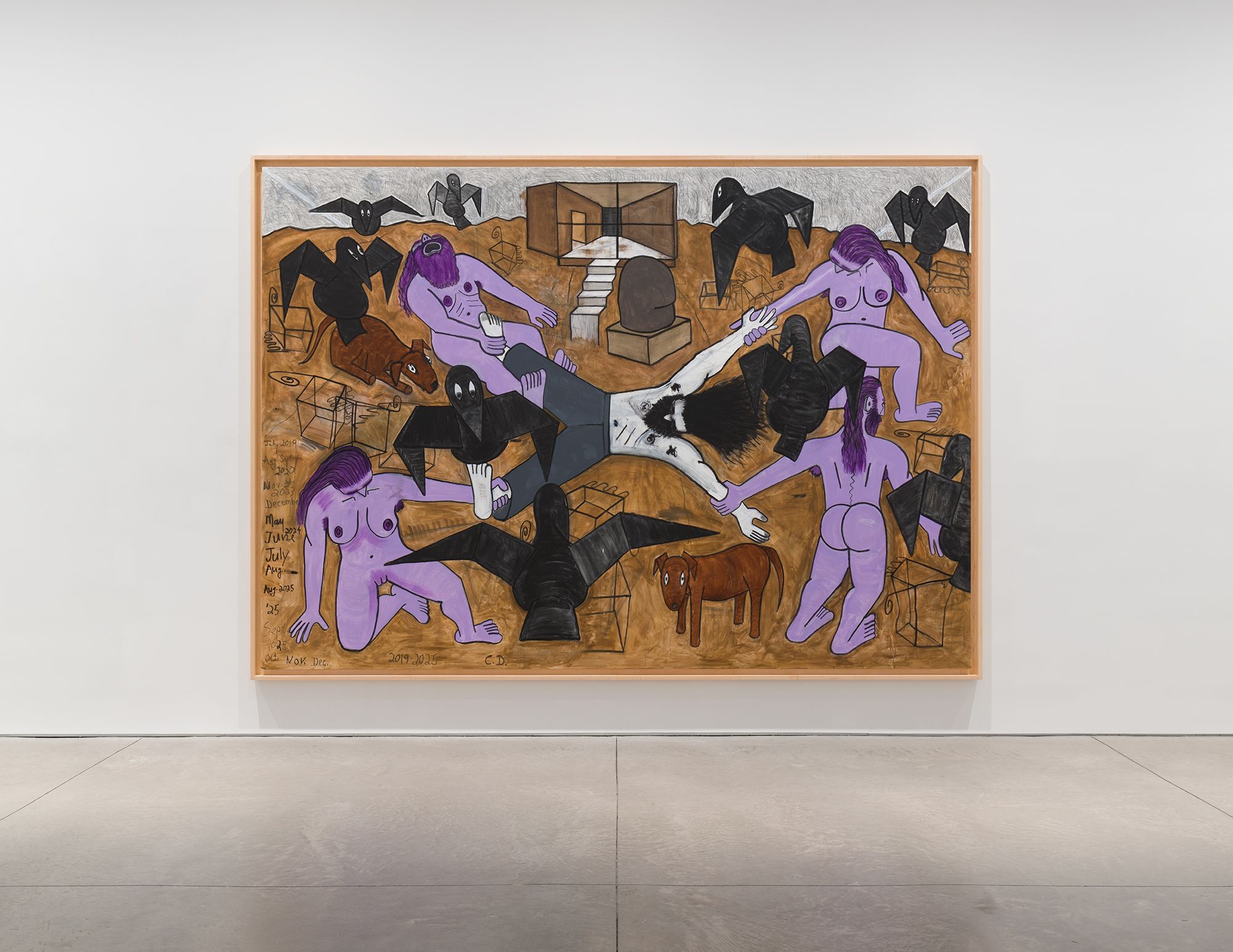
I was most delighted by the Carroll Dunham show at Matthew Brown, a suite of new paintings where Dunham fully bets on himself—making some of his most out-there but oddly endearing work. Word is that several have been snapped up by big institutions, as they should be.
It still felt strange to see such a show in Tribeca rather than Chelsea, where so many canonical painting exhibitions have been staged in the last 30 years. In the back of the gallery, where a bunch of absolutely insane Dunham works on paper hung salon-style on the walls, Brown conceded that a show of such scale and historical oomph could have fit at a Chelsea gallery—but it’s also inspiring to him that this neighborhood is ready for a big Carroll Dunham show.
Brown also hosted a dinner for Dunham at Il Buco Alimentari, Donna Leonard’s offshoot of the beloved Bond Street Il Buco. An entire generation of artists circulated through the restaurant’s two stories: Dana Schutz and Ryan Johnson, Huma Bhabha, Joe Bradley and Valentina Akerman, Mel Kendrick, Louise Lawler, Alexis Rockman, Amy Sillman. Of course, the artist Laurie Simmons, Dunham’s wife, was there, along with their children, Lena and Cyrus. Jerry Saltz went looking for pizza and found it, while Roberta Smith sat at a table with former New Museum director Lisa Phillips. Later, Phillips told me about the show she curated at her old stomping grounds on the Bowery—a show about the Bowery. Along with the legends was a new generation of artists, including Unrau, Alessi, Ohad Meromi, and a number of artists from Brown’s stable: Uri Aran, Olivia van Kuiken, Blair Whiteford.
Dinner ended, but no one really said goodbye. Despite the Tribeca takeover, everyone was planning to storm Chelsea for another set of openings on Thursday.
-
From Prince George to Princess Leonor: Where Young Royals Will Attend School This Fall
-
The Pitt’s Patrick Ball on Shipping, Stardom, and Season 3
-
From Cowboys to Clean Girls: The State of American Style, in Pictures
