


 10 min read
“Have you ever had a Red Bull?” Sam Rockwell asks, apropos of nothing. “I don’t know if I’ve had a Red Bull.”
We had been talking about the tyranny of social media.
“I’ve never had an energy drink ever,” I tell him, unnecessarily proud of myself, while I try to figure out why he’s asked. I’m distracted. The reason I’m distracted is that I don’t want to be here. I don’t mean with Sam Rockwell—Sam Rockwell is delightful. I mean in this room. It’s the greenroom outside a midtown Manhattan video studio. It sucks.
“This is a nice room, actually,” Rockwell said when we first walked in. He cut himself off—he was in the midst of warning me that he might need to stretch because he’d boxed that morning—just to make the observation. He does that a lot: cuts himself off, trails unpredictably from one topic to the next. “Carlito’s Way meets, you know, some sort of industrial workspace.”
He does that a lot too. He has a movie reference for everything, even this L-shaped hall-end space with a couple mini fridges; a table with some trail mix, chips, and granola bars; and, at the other end of the L, a couch and armchairs under the lone window, outside which a tree is swaying and it’s trying to rain. We’ll talk for 145 minutes and he’ll manage to mention thirty-two movies and fifty-three actors.

Anyway, it’s not a nice room. It’s a greenroom. But really it’s not so much that I object to the room itself. It’s that I had been hoping to gin up some action for this story, because as Rockwell will later tell me, explaining his acting philosophy, emotion follows action—walk to grab a beer, get a bite somewhere downtown. I wanted a grand stage for our conversation, and instead I got a black-box theater.
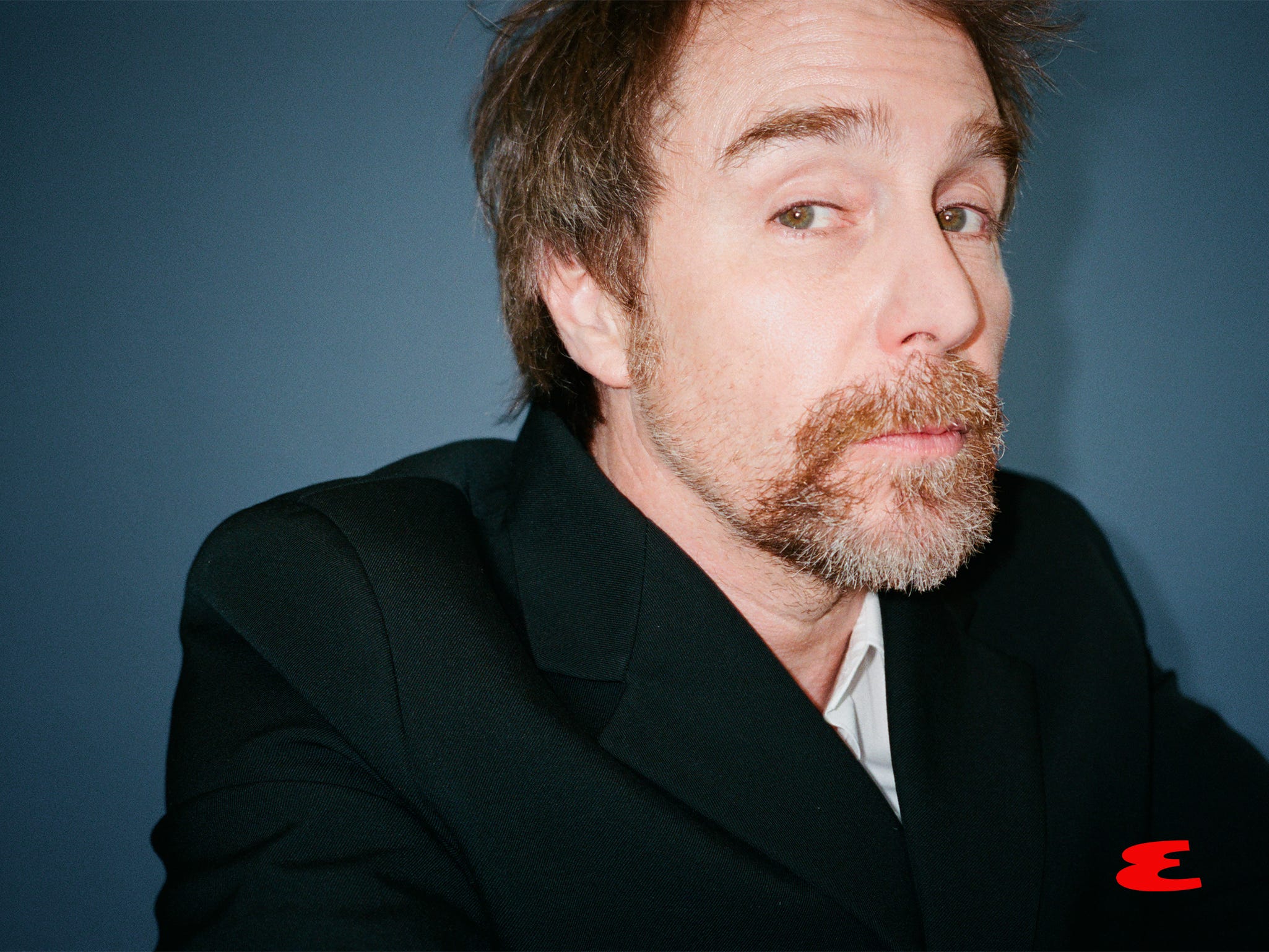
Rockwell, fifty-seven, is wearing Nike boxing shoes, sweaty gray gym shorts, and a rumpled red T-shirt with Redd Foxx on the front. He scratches at a scruffy Vandyke beard that he’s grown for a film in which he plays a soybean farmer. A tuft of unkempt hair on the right side of his head points due north, straight uptown.
I follow Redd Foxx’s gaze, and I notice that in this godforsaken room one of the mini fridges, the one practically right next to me, is exclusively Red Bull. Oh. “Do you want one?” I ask. “Do you want me to grab you one?”

Jacket and shirt by Balenciaga; sunglasses by Thistles.
This article appeared in the September 2026 issue of Esquire
subscribe
“No, I better not do that. But thanks,” he says. And then, almost to himself: “I think I have had one once before.”
And here I thought the only way to find anything interesting to do with Sam Rockwell was to get out of there. Sam Rockwell, meanwhile, walked in and almost immediately started feeling around the room’s edges to identify a point of possible interest, even if it was just a fridge full of Red Bull. To me this room was a prison. To Rockwell, it was a possibility.

Shirt, trousers, and shearling coat (on floor) by Fendi Men’s; shoes by Balenciaga; sunglasses by Bottega Veneta; socks by Falke.
Forty-five minutes into our conversation, he gets up to take a leak. Upon returning from the bathroom, he sees the tree out the window metronoming back and forth. “Is it raining?” He walks over to the window and peers down at the street, where tiny creatures have sprouted umbrellas. He’s been inside virtually all day, shooting photos and videos in closed-off rooms. He furrows his eyebrows slightly, mouth half open, that look of coy appraisal we’ve all seen a million times now.
It’s hard to believe because of the boyish face and irrepressible energy, but Rockwell’s career stretches back nearly forty years. His first film was a low-budget 1989 slasher called Clownhouse, but by 1992 he was in Light Sleeper, directed by Paul Schrader, our foremost poet of male alienation and the writer of one of Rockwell’s favorite movies, Taxi Driver. That’s his career. He’s been in a Marvel film; he’s been in a Clint Eastwood film. He’s played the Big Bad Wolf and George W. Bush and the most influential choreographer of the twentieth century. He’s natural in everything. Last year, a monologue about wanting to be an Asian woman getting railed by white men, from season 3 of The White Lotus, which starred his longtime partner, Leslie Bibb, tipped him from an actor beloved among people like him—cinephiles—to someone everybody knows.
His new film, Wild Horse Nine, comes out in November. Rockwell plays Lee, a CIA agent who, along with his partner, Chris, played by John Malkovich (one of Rockwell’s idols), is part of a CIA misadventure in Chile in the early 1970s. Lee and Chris take a weekend trip to Easter Island, where Lee seems to be keeping tabs on Chris, watching him from the window of his hotel room or out the windshield of an ancient red stick-shift sedan.

Coat, shirt, trousers, shoes, and tie, Saint Laurent by Anthony Vaccarello; socks by Falke.
Wild Horse Nine is the fourth collaboration between Rockwell and writer/director Martin McDonagh, after 2017’s Three Billboards Outside Ebbing, Missouri, for which Rockwell won the Oscar for Best Supporting Actor; 2012’s Seven Psychopaths; and a 2010 play with the macabre title A Behanding in Spokane. I asked McDonagh why he keeps casting Rockwell. “His danger, his truthfulness, his sense of fun, his sex appeal,” he said. “I think especially the first one—there’s always something a little dangerous about Sam in everything he does.”
There is something dangerous about Rockwell in Wild Horse Nine, but he’s playing against Malkovich, who is not known for timidity. The two of them and McDonagh rehearsed for a few weeks at the Public Theater, a legendary institution in New York City. Rockwell, who has been rather relaxed, reclining slightly with boxing shoes flat on the floor, leans in to tell me about it. “We were doing this thing where he goes off on me,” Rockwell says. After a run-through, McDonagh asked Malkovich to “turn up the anger a little bit.” “He just says [lilting], Oh yeah, sure, no problem,” Rockwell says. “He talks kind of gently. And then, just like, WHAM! Out of the gate like a monster.”
Rockwell ate it up. “I was like, I got a front-row ticket to this? I get Malkovich to yell at me?”
I point out that some people might find this intimidating. “I worked with Gene Hackman once,” he says. “And I had to yell at him, and he loved it. He loved it. Because actors are so intimidated by him. If you’re a really good tennis player, you want a good tennis player opposite you.”
Rockwell is a good tennis player. And like any good athlete, he trains. For as much as he appears to get by on natural charm and charisma, he is an actor’s actor, a true believer, in his words, an “acting nerd.” Research. Running lines. Exerci—
“Do you know what a gibbon is?” Rockwell asks.
“Like, a monkey?” I say, confused.

Shirt and trousers by Carlota Barrera; shoes by Repetto; Roadster watch by Cartier; socks by Falke.
“I had a monologue where I talked about this gibbon,” he says. It was in A Behanding in Spokane. So while in Barcelona with his dad, he went to the zoo and found one. “It felt like my responsibility to find out what the fuck a gibbon was,” he says. “You know, I’m going to talk about this animal, so I should probably go figure out what it is. So I went to a few zoos, and I found out it’s an athletic, kind of, chimpanzee kind of animal. And, uh”—the briefest pause—“yeah, so that was helpful.”
For Three Billboards he did ride-alongs with cops in Missouri. (“Big boys. A lot of doughnuts.”) For Frost/Nixon, he called up his dad, a onetime actor cum San Francisco union organizer and history buff, a sensitive, deeply moral man who hated Richard Nixon. The two of them went to Washington, D. C., and listened to Oval Office recordings. And when Rockwell took on Wild Horse Nine, he made some inquiries with the CIA but, ultimately, talked to his dad again, who recommended documentaries and books and talked him through some of the Chilean history.
But research will only take you so far. Rockwell is a student of the Meisner school of acting. It’s often contrasted with the Strasberg school, whence comes the infamous Method and (usually apocryphal) stories of actors staying obnoxiously in character for the duration of a shoot. If Strasberg is about what happens, Rockwell says, Meisner is about imagination, it’s about what if.
Billy Crudup is one of Rockwell’s best friends. They came up in the same iteration of the New York acting scene. Their peers were “unimpressed by success,” Crudup told me. “What they really appreciated was ruthless ingenuity.” He described Rockwell’s peculiar way with finding the truth of a scene, something that for many actors is an exercise in logical and almost schematic script work. Rockwell can build a mood from a magpied collection of references, like a Muhammad Ali fight soundtracked by the jazz of Miles Davis. “That’s a very unusual way of constructing something creatively,”
Crudup said.
Another of Rockwell’s friends, Chris Messina, told me that on a recent project they both worked on, they watched The Deer Hunter while waiting to shoot. For years, Rockwell had been recommending Messina watch films in this way to prepare for parts, and Messina took it as a suggestion he might find aspects of, say, a great Robert De Niro performance that he could ape in his own work. Then they shot their scene together, and Messina realized something. “It wasn’t imitation,” Messina said. “It was just, Let this seep into your heart somewhere and see what this does to you.”
Sometimes it’s not so abstract. Wild Horse Nine shot on Easter Island. “How was that?” I ask Rockwell, thinking of the cosmic influence of the mystical statues and what I imagined as a prehistoric landscape.
“Very big heat,” Rockwell says. “I took one walk the whole time.” He went to the hotel gym—the same hotel in the movie—when the heat was tolerable. He put out milk for stray dogs. “If it hadn’t been so hot, I would have explored more,” he said, looking slightly regretful, “but I was in that hotel with John.” They were always running lines.

Coat, shirt, trousers, shoes, and tie, Saint Laurent by Anthony Vaccarello.

I am no actor, but I felt notes in Rockwell’s performance in Wild Horse Nine that I didn’t think he could find in a documentary or on a ride-along with the CIA. Chris and Lee are middle-aged or older, reckoning with the work they’ve done, the death they’ve caused, maybe with the end of a way of being they have performed, in secret, their entire lives. There’s a melancholy in the looks out the windows, the phone calls home. Rockwell finds tenderness in a hand on Malkovich’s throat. It’s a soulful, contained performance.
In a 2016 appearance on Marc Maron’s WTF podcast, the death of Rockwell’s friend Philip Seymour Hoffman came up. “It’s weird when you start knowing people . . . who are dying,” Rockwell told Maron. “It’s fucked-up.” Maron asked him how his “mortality consciousness” was. “Not good. I think about it every day. I’m forty-seven—I think about all that shit,” Rockwell said.
In our terrible greenroom, Hoffman has come up, as has Hackman, who recently died. So many people who profoundly influenced Rockwell have recently died.
I ask him if he could have played Lee when he was younger.
“No, I wouldn’t have had the emotional maturity to play that part. . . . I mean, you have to have lived a life. . . . That’s the training for that part, a little bit,” he says, turning the idea over. Then he asks me, quite apropos: “I would think it’d be the same for you, right?”
I think about that. I tell him I lost my dad right before I went to journalism school and that I’m sure it changed the empathy with which I approached strangers. It made me able to talk to a lot of people I wouldn’t have been able to otherwise.
Rockwell pulls one leg up into his hand, a quad stretch, I think, and flexes his ankle. “They say losing a parent is . . . you’re forever changed,” he says. There is a shift. Those eyebrows, that mouth—it’s subtle. “I haven’t lost a parent yet,” he says quickly, his voice a little quieter, though it also seems to make this stupid little room big enough to echo. “So I don’t know what that’s gonna be.”
What if can be imaginative, playful, fun. It can be other things too. It can countenance joy, and it can countenance sorrow. You get to the point in life where people are dying and what if, maybe, becomes dangerous. Some what ifs, you wait long enough, will always become what happens.
Out the window, rain.

Jacket, shirt, and tie by Tom Ford.
We pack up to leave. Rockwell is asking if there’s anything else I needed to cover, if we missed anything. And then: “Should we steal all these Red Bulls? Just take the whole thing?”
I turn to look at the mini fridge again, which I now notice has two kinds of Red Bull in it. The normal kind that gives you wings and the “Red Edition.” “This is the Red Edition,” I say. “What do you think that means?”
“I’m scared of that,” Rockwell says.
“Oh, you know what?” I say, looking closer. “Watermelon. Which sounds horrifying.”
“Let’s take a sip of it,” he says, across the room fast, opening the mini fridge.
“You’re gonna do it?”
“Yeah, I’m just going to dip it,” he says, cracking open the can.
I never got the big set piece I’d imagined, but—providence!—right here at the end, with Red Bull Red Edition, Sam Rockwell finds the truth of the scene. There are hazards, and it is not without risk, but if you are alive to the possibilities of the circumstances you find yourself in, what if will make you free.
He knocks back his head and takes a sip.
“No, it’s not terrible,” he says after a second. “Kind of chemical, though.”
“It’s definitely not good,” I say.
“Yeah, no,” he says, kind of panting, trying to breathe the taste back out through his mouth. “You’ve gotta put some . . .” he starts to say, then trails off, leaving unforeclosed the idea that the right mixer could make this drink good. He sets the opened can on the counter. We leave the greenroom.
As seen in the opening image: Jacket and shirt by Prada.
Story by Kevin Dupzyk
Photographs by Florence Sullivan
Styling by Alfonso Fernández Navas
Grooming by Melissa DeZarate using Kevin Murphy
Directors of Video: Amanda Kabbabe, Kathryn Rice
Supervising Producer: Brian Murray-Real
Filmed & Edited by Sam Miller
Esquire Executive Design Director: Martin Hoops
Esquire Visual Director: James Morris
Esquire Senior Entertainment Director: Andrea Cuttler
Esquire Editor in Chief: Michael Sebastian