



 5 min read
David Robert Mitchell would have loved to take his dad to see The End of Oak Street. The filmmaker behind the cult horror hit It Follows and the surreal L.A. odyssey Under the Silver Lake wrote this new suburban survival story with his old man in mind.
His father, Robert Allen Mitchell, was crazy about dinosaurs. “My dad was obsessed,” Mitchell tells me. “He grew up loving the Universal monsters and Ray Harryhausen. He and my uncle, his younger brother, did their own stop-motion animation. My uncle would build the armatures on his own dinosaur models, and they would animate them. I just thought it was incredible, and some of [this movie] was me wanting to do my own version of that.”
His dad passed away in 2024, when the filmmaker was still in the early stages of making the movie. He never even got to tell him the full scope of the story—an entire neighborhood, like the one where their family lived in Michigan, gets transported by a cosmic anomaly to a time of lethal prehistoric predators. “I didn’t tell him too much because I just wanted him to see it, in all honesty,” Mitchell says. “He saw some concept art before it was made. That was very heartbreaking for me.”
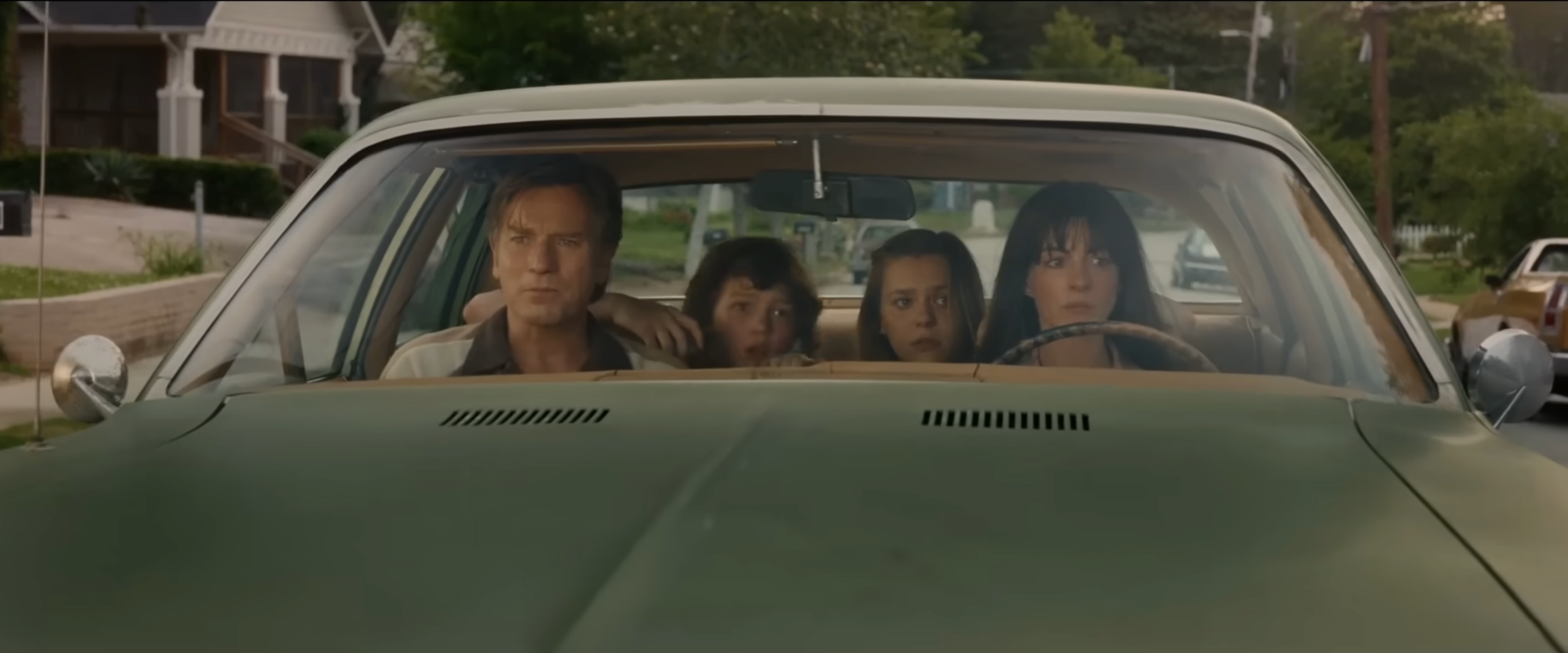
Although the director can’t take his own dad to see The End of Oak Street, you should consider taking yours or bringing your own (older) children. It may sound odd to say this about a movie in which primitive beasts gorge themselves on old ladies, stray pets, and annoying neighbors, but this harrowing tale has an uplifting family story at its heart. Ewan McGregor plays Greg Platt, a laid-off dad who isn’t too proud to take work delivering pizzas to help keep the household afloat. Anne Hathaway is Denise Platt, a smart and resilient mom who for too long has sacrificed her own dreams for everyone else’s.
The kids are the science-minded Audrey (Maisy Stella of My Old Ass) and kindhearted Brian (Christian Convery), who both wander when they shouldn’t, usually in search of their runaway dog Starbuck. The Platts are a good family, but the strain is showing. The End of Oak Street is set in 1982, but the financial strains of our own collapsing economy and the pressure they put on working families are achingly familiar.
Before the time crisis hits, the Platts are already pulling apart, keeping secrets, and turning away from one another. When rampaging, bloodthirsty dinosaurs turn their neighborhood into an all-you-can-eat buffet, the kids and their parents find that they literally can’t live without each other. Life-threatening emergencies aren’t ideal, but they do have a way of clarifying things.
That’s what drew J.J. Abrams to join forces with Mitchell as a producer. “What the story really talks about is, when you are a family, everyone has their own sense of themselves and their sense of purpose and their desires and their frustrations,” Abrams says. “I just loved how the story of this crazy other world with these dinosaurs suddenly forces them to grapple with their issues in a way that they may not have otherwise.”
There are plenty of films for parents to see with little kids. The End of Oak Street is one movie you can see together with older kids or older parents. I took my own family to the premiere, and it’s the first movie both of our teenagers have watched with their mom and dad in ages.
The End of Oak Street is a bonding experience—without the actual threat of getting torn limb from limb by huge, hungry reptiles.

Ever wanted to watch Anne Hathaway mow down hungry dinosaurs? Go see The End of Oak Street.
The idea for the movie was born right near the house where Mitchell grew up. The director was on a walk through his old Michigan neighborhood one night when he imagined a dinosaur prowling between the split-level homes. “I was passing this very average house with aluminum siding, an old garage and chain-link fence and some garbage cans. I saw that and I imagined a dinosaur there,” he told me. “Then I went home and started putting notes down on paper.”
The finished script that resulted made its way to Abrams at his Bad Robot production company, which took an immediate interest in bringing it to life. “We had never met,” Mitchell says, sitting beside Abrams during our interview.
“I was so excited to meet,” Abrams adds. “I just loved it because it was a movie I wanted to see. It had characters that I thought were really entertaining and a family with relatable, human issues. Then the most insane shit of all time happens. That is my favorite cocktail.”
Like Mitchell’s real-life dad, McGregor’s character works at Chrysler. Virtually everyone in the Detroit area in that time worked for one of the big three automakers. After the character is laid off, he does everything he can to make sure his wife doesn’t worry and the family is provided for. “He’s struggling,” Mitchell says. “There’s a sweetness to him.”
The real-life parallels mostly end there, however. Certainly, Mitchell’s own family never got caught in a mysterious cosmic wormhole. “The story of the family is not autobiographical, but placing it in the ’80s, on a personal level there are moments I was thinking about my own parents and my family as a kid,” he says. “So some of those things are inspired by my own father.”
As a producer, Abrams saw a chance to play in the vicinity of one of the greatest blockbusters ever made. “I’m a fan of the Jurassic Park movies, and when I read this, I loved that it reminded me that you can do a dinosaur movie outside of that world,” he says.
Abrams is also a longtime friend and collaborator of Steven Spielberg’s, whose other films, like E.T. the Extra-Terrestrial and Close Encounters of the Third Kind, also provided inspiration. The producer says Spielberg never scolded them for trying to play in his backyard. “Steven was psyched,” Abrams says. “He was probably just wanting to make sure that we were nowhere near any of [his] release dates. But no, he’s always been nothing but supportive.”
What’s so enduringly fascinating about these ancient creatures? Turning to Mitchell, Abrams says: “Your dad was in good company. I think people love dinosaurs. There’s something about that idea that they used to be here, and now they’re not and we are.”
In other words, we cannot exist with overpowering beings that menace us at every turn … which is kind of the way teenagers often come to feel about their parents. So perhaps there is a meta-narrative at work in The End of Oak Street.
“I like to think that anytime I’m writing something, these themes, messages, concepts, and ideas do come through,” Mitchell says. “I tend to avoid trying to say, ‘It’s going to be about this.’ But I love when other people find those things in the work.”
Dad would no doubt be very proud.
