


The Shards Recap: Telling Ourselves Stories
By
Louis Peitzman,
a freelance writer who covers TV, film, and theater.
Louis Peitzman is a freelance entertainment writer who has been covering TV, film, and theater since 2004.
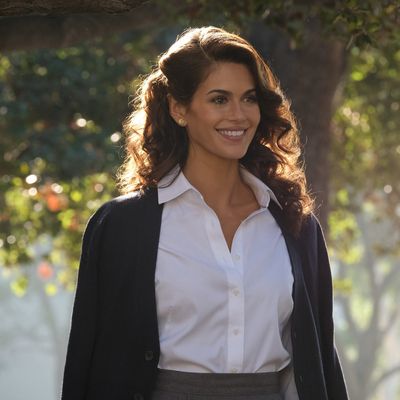
The series’ shift into high-school satire takes out all the dread of a serial killer prowling just off-screen.
Photo: Ray Mickshaw/FX
Are you familiar with the “3 Glees” theory? First coined by writer Emily St. James at the A.V. Club, it was an attempt to make sense of Glee’s wildly divergent tones and inconsistent plotting from episode to episode. She believed the show’s three creators — Ryan Murphy, Ian Brennan, and Brad Falchuk — and their respective styles resulted in weekly installments that felt completely different from what came before. Glee may be behind us (for now!), but it’s impossible not to think about the 3 Glees while watching the third episode of The Shards, which bears little resemblance to the first two installments and at times plays like a brand-new show. There’s no need to theorize about what happened here because the obvious answer is Bret Easton Ellis signed off on the first two episodes and then abandoned the adaptation. Without Ellis to tamp down Ryan Murphy’s excesses or curb deviations from the source material, we’re left with a take on The Shards that is suddenly much closer to Murphy’s past work than it is to the novel. This is The Shards (Glee Cast Version).
This could not be more apparent in the cold open, which suddenly introduces a new Buckley classmate named Really Rhonda, played by the aggressively Gen-Z actress Ivy Wolk. Everything about the character — whose undiagnosed Tourette’s makes her say things like “I wanna fuck Chewbacca, motherfucker” in class — has the flavor of Glee or Murphy’s earlier high-school satire, Popular. My issue isn’t with the fact the show is suddenly adding characters who aren’t in the book but with the whiplash from the dramatic vibe shift. We’re supposed to believe the elitist clique from the first two episodes wouldn’t have completely shunned a girl like Rhonda, who, in addition to her disability, is obsessed with roller disco in a post–“disco sucks” era? Bret’s explanation for his affection is that Rhonda never inadvertently outed him through her coprolalia but also that she didn’t care what other people thought about her, as if that’s a quality these kids value. Nevertheless, Really Rhonda is only here to be kidnapped by the Trawler while roller-skating to “Don’t Stand So Close to Me,” then shoved into a dog cage, where she’s forced to eat live animals — and to that end, she serves her purpose. Bret complains about how quickly the school forgets Matt Kellner following his disappearance, but The Shards appears equally unmoved by him. Clearly unsatisfied with relying on Matt as a victim, the show is already delivering a new one.
“It took about three days for everything to go back to normal,” Bret tells us, which means Debbie has moved on to talking about the welcome party for Robert and the group’s impending appearance on Dance Off! Another new addition to The Shards that smacks of Glee, Dance Off! is an American Bandstand–style teen dancing show and a Los Angeles institution, and Debbie is obsessed with getting on it. Ever since classmate Corazón “Cha Cha” Rodriguez — now we’re cribbing from Grease — kept the camera’s attention for the entirety of Blondie’s “Rapture,” Debbie has craved her own breakout moment. As Bret shares via voice-over, “Becoming a star was her secret ambition, but she was too cool to ever admit it.” Meanwhile, he wonders aloud if it’s not a bad look to be partying on television while two Buckley students are missing. Thom reasons that since no bodies have been found, Matt and Really Rhonda might just have run away. He wants to focus on tuxedo shopping for homecoming, even though Susan continues to register her disinterest. Robert suggests she would look great in a simple black slip dress, and if the others clock the spark between them, they don’t acknowledge it. At least Bret’s protestations seem to have some effect on Susan, who suggests they post flyers for the missing students. When Robert offers to help, Thom’s expression is curiously muted. Bret did call out his “intriguing blankness” in the series premiere, but who can say what’s really going on in his head?
Back at school, Susan and Robert have escalated from flyers and instead put on a “Help Me – Rhonda” assembly, where they ask anyone with information about Really Rhonda’s appearance to come forward. Everything about this feels off: The Beach Boys reference and the branded water they hand out (“If you can’t find a Perrier, reach for a bottle of Really Rhonda water”) would fit in perfectly on a show like Popular but stick out like a sore thumb here. The Shards was already operating within a somewhat heightened reality, but this episode clumsily slides the show into broad satire. Turning this whole thing into a joke also undermines the danger of the Trawler — just how seriously are we supposed to take this threat? I’m sort of on Bret’s side when he tells Thom that his joking isn’t funny, though I appreciate Thom saying, “My dad used to tell me to look on the sunny side, and that’s what I’m trying to do for you,” which is a pretty good articulation of his whole deal. On the whole, The Shards would be better off sticking to subtler dark comedy. Reflecting on Susan from afar, Debbie tells Ryan, “If she wanted to, she could be such a slut. There’s nothing stopping her. I’ve always admired that.” Ryan tells her she’s a really good friend, which Debbie is quick to agree with. Reader, I laughed!
What would Debbie think if she knew her boyfriend was having another clandestine lunch with her dad? Nothing good, presumably, though Terry is at least pretending to be interested in Bret’s script. This is a bit confusing — last we heard, Bret was working on the novel Less Than Zero, which Terry said he’d option sight unseen. Now Bret is talking about a treatment he wrote for a movie based on his life where the main character is Bret Ellis, and that sounds much more like The Shards. (If this series ends with Bret writing the show, I will never forgive anyone involved.) Terry tells Bret that every great movie is about loss. What has Bret Ellis lost?, he wonders. Bret clunkily jumps right to his virginity, suggesting that whatever is going on between them isn’t exactly one-sided. That doesn’t mean he’s willing to follow through on the light flirtation, however. Terry drives him home on an exclusive secret road between Beverly Hills and the Valley (the only other people who Terry knows have the gate code are Jack Nicholson and Warren Beatty) but pulls over to a scenic viewpoint on the way. It’s a great place to be alone, Terry says, before getting bolder with a more pointed, “We could come be alone together.” Bret looks tempted, if noncommittal. But when they’re interrupted by the arrival of a mysterious beige van — the same one viewers may have spotted in the preceding episodes — Bret uses the opportunity to ask Terry to take him home.
I appreciate the way the show is branching out from Bret’s perspective, including in the subsequent scene we get inside the Schaffer household, where Liz is doing coke and dreaming about winning an Oscar. Her fantasy acceptance speech is an excuse to excoriate her daughter (“You are the disappointment of my life”) and the husband “who regularly reminds me that I am a worthless piece of shit.” We see that nastier side of Terry when he returns home and mocks her for still picturing a future for herself as an actress. Wes Bentley and Evan Rachel Wood are the strongest actors on the show, so I’m all for more of them. Wood is even able to sell the soap-opera histrionics of a line like, “I know I could have been more than this, more than just your stupid wife rattling around this mausoleum like a fucking ghost.”
Speaking of ghosts, after getting back from his outing with Terry, Bret finds himself drawn to Matt’s house, where he’s easily able to slip into the vacant pool house. His voice-over offers a defense of his increasingly reckless choices. “I was suddenly struck with a fear I had never experienced before,” he reveals. “It was an adrenaline that acted as a warning for me to save myself but also mixed with an overwhelming compulsion to move forward no matter how I felt.” Bret is determined to find clues about Matt’s disappearance in his room; instead, he stumbles on a school uniform he deeply inhales the scent of while weeping. Memory is a powerful thing, he notes, as he imagines Matt standing in the doorway. Watching the last episode, I complained the series had not done a great job of establishing the stakes of Bret and Matt’s relationship before their breakup, so I’m glad we’re actually seeing the grief Bret feels in Matt’s absence. I’m also appreciative of the split-diopter shot we get when Matt’s phone rings. Bret answers, and though there’s nothing but heavy breathing on the other end, he’s convinced he knows who he’s talking to. “Why are you doing this, Robert?” he demands.
At this point, Bret is confident he’s fingered the perp, even if he’s making a bit of a leap from a lie about not seeing The Shining to serial murder. “I committed myself to the pursuit of a single goal: track Robert and prove he was the Trawler,” he says, once again waiting in the Buckley parking lot so he can follow Robert’s Porsche after school. As Peter Gabriel’s “Games Without Frontiers” plays, he pursues the car to an unfamiliar house on Benedict Canyon, where he cautiously lurks outside. Why is he doing this? Bret paraphrases Joan Didion by way of an answer: He’s telling himself a story in order to live. She meant crafting narratives to make sense of the chaos around us; he may be referring to actual survival. We learn from the voice-over that Bret will eventually discover this is Robert’s aunt’s rental property and he’ll one day tell police he believes the bag he now watches Robert retrieve from the house contains a human head. After Robert leaves, Bret decides to investigate the home and finds his way in through an unlocked back door. Matt and Really Rhonda could be trapped within, he reasons, and he’s not far off. Once inside, he makes his way down a set of dark stairs and into a creepy space below one could comfortably call a “murder basement.” There’s another door deeper inside, and after Bret pushes past the alarm bells in his head and walks through it, he discovers he’s too late. In flashback, we see Rhonda being pulled from her cage by the Trawler. In the present, she’s gone. When Bret finds the cage, it’s empty — save for a Buckley uniform and a live iguana, both covered in blood.
• Episode three makes it clear there will be too many deviations from the novel to discuss them all, but I’ll continue to focus on what the biggest changes mean for the show as a whole and the story it’s telling. As I said above, my issue is less with the introduction of Really Rhonda and Dance Off! and more with the abrupt tonal shift to Glee territory.
• One thing this adaptation is really getting right: the music choices. “Don’t Stand So Close to Me,” “Rapture,” “Games Without Frontiers,” and “Edge of Seventeen” are all pulled from Ellis’s reference-heavy writing.
• In the book, Bret gets excluded from Susan and Debbie’s private conversations, so we don’t know what Debbie is advising her bestie with regard to Robert Mallory. The show suggests Debbie wants Susan to expand her sexual horizons, which means we might see her actively pushing Susan in Robert’s direction.
• At the same time, Robert is reading, well, gay. Yes, in the novel, there’s deliberate ambiguity there, but he doesn’t describe his party as “like Capote’s Black and White Ball.” Maybe that’s Murphy sneaking his Capote fixation into the script; maybe it’s something more. In the book, Thom assumes Robert is gay and therefore not a threat to his relationship; it’s not yet clear what show Thom thinks.
• Drawing out the relationship between Bret and Terry makes sense, but I feel like The Shards is afraid to really go there with Terry’s predation, particularly by including repeated reminders that Bret is 18 (and not 17, as he is in the novel). It’s a notable tweak in that it makes Bret a legal adult instead of someone merely pretending to be grown-up. Of course, none of this makes Terry’s behavior appropriate.
• Last week, I wondered where the show would go from here, given how early Bret gets the Matt tape. Now he’s already gone into the Benedict Canyon house and found proof of Trawler victims being kept there, including a blood-soaked Buckley uniform. Wouldn’t he just go to the police at this point? Even the useless adults of The Shards would surely act quickly to arrest Robert with this much evidence. From a plot perspective, it just doesn’t work.
The Shards Recap: Telling Ourselves Stories
Your product is saved! You’ll receive emails when your saved products go on sale. Manage preferences.
