


Update, September 10, at 3 p.m. ET: NAZA, a documentary that reportedly explores the Israeli military’s targeted killing of Palestinian civilians in Gaza via missile strikes, received a 25-minute standing ovation after its Thursday, September 10, premiere. It’s the longest ovation in the festival’s 83-year history.
NAZA is directed by Israeli filmmaking duo Yuval Abraham and Rachel Szor, half of the foursome who made last year’s Oscar-winning documentary No Other Land, also about the conflict between Israel and Palestine. Together, Abraham and Szor stood solemnly as they took in the almost half-hour of applause. The previous festival record was set last year by The Voice of Hind Rajab, directed by Kaouther Ben Hania, who is a member of Venice’s jury committee this year. Hania’s film, also about the ongoing crisis in Gaza, received a roughly 23-minute standing ovation and wound up getting nominated for best documentary at the Oscars.
According to Deadline, after the lights came up at the NAZA premiere, a handful of audience members began unfurling Palestinian and Lebanese flags. Security guards seemingly began to move to remove the flag-holders, but ultimately let them wave freely inside the Sala Grande. The crisis in Gaza has been a flashpoint at the festival. Just last week, Venice film festival artistic director Alberto Barbera said that the Palestinian flag can’t fly at the festival, claiming that its parent organization, the Venice Biennale, “is only allowed to fly the flags of states recognized by Italy.” But at NAZA’s premiere, the Palestinian flag flew freely, a moment that seems to signify something of a sea change.

Rachel Szor and Yuval Abraham attend the “Naza” Screening during the 83rd Venice International Film Festival.Stephane Cardinale – Corbis/Getty Images
The tensions around the conflict aren’t new. At the press conference for her film The Echo Chamber, Oscar winner Susan Sarandon, who was dropped by her representatives at UTA in 2023 for comments she made at pro-Palestine marches, said that she’s still losing roles for speaking out about Gaza. “I’ve still had movies taken away recently because there are agencies that are telling people not to hire me still. But that’s the power structure,” she said. Penélope Cruz and Javier Bardem, who have also been vocal in their support for Palestine, discussed the importance of speaking out about politics, during the press conference for Bunker.
“There are so many things in this film that it would be really contradictory to then be here and say, ‘Oh, I don’t want to talk about that.’ It’s impossible,” said Cruz. “And that’s why a situation like [this press conference] is sometimes more scary than, I don’t know how many weeks of shooting that we did. But still, I don’t think it would make sense to say, ‘I don’t talk about politics.’” Bardem chimed in as well. “Obviously I have more resources to do it than a taxi driver, because I have this thing [the mic] and I have you guys listening to me. So the responsibility is a different one,” he said. “And that’s what I think is important, to have a responsibility towards the world that we live in and I don’t take it for granted.”
Critics are raving about NAZA, with New York Magazine’s film critic Bilge Ebiri calling it one the most important films of our time. While Wild Horse Nine, Possible Love, and Bunker were much buzzed about at Venice, it’s clear that NAZA has become the defining film of the festival.
The original post continues below.
Before things really kicked off at the Venice Film Festival, rumors swirled that its powers that be were going to do away with the jury press conference, breaking a long-standing tradition in which journalists were free to take the mic and ask jury members, directors, and actors any question they liked. Questions could range from the innocuous, “How do you plan to spend your time in Venice?” to the overtly political, “What is your stance on Israel and Palestine?” Last year Venice juror Alexander Payne demurred when he was asked about the humanitarian crisis in Gaza, saying, “I feel a little bit unprepared for that question. I’m here to judge and talk about cinema.”
These nonmoderated events fill celebrity’s publicists with dread: Just this week several expressed their concerns to Variety about the best way to help their clients handle potentially difficult questions. In a way, it makes sense that Venice would try to opt for a “welcome cocktail” event instead of a journalistic free-for-all. But after public outcry at the suggested cancellation, the Venice Film Festival carried on with the press conferences, and they have lived up to the hype.
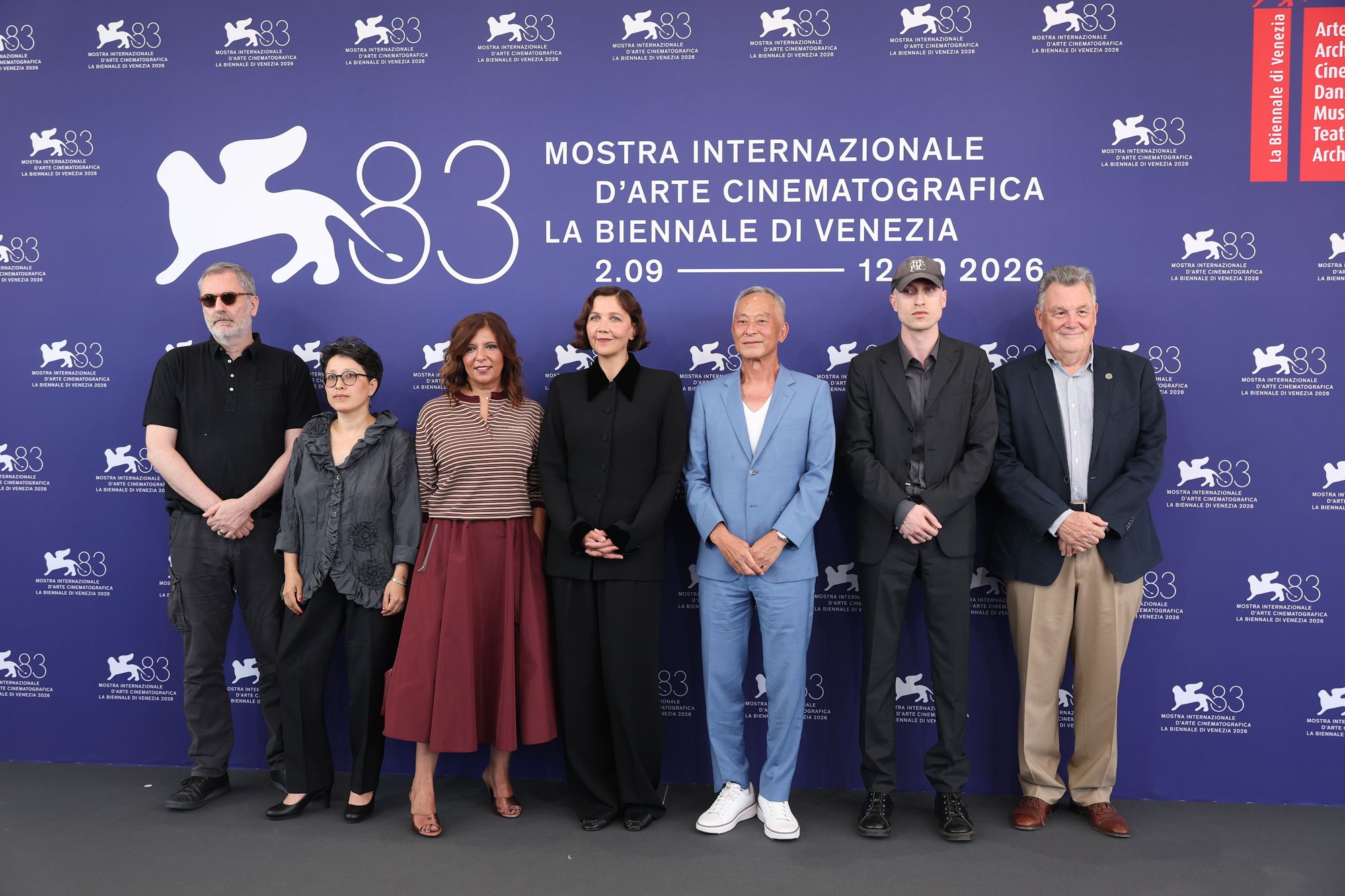
Unscripted, newsmaking moments have always been a crucial element of the Venice festival’s formula, with stars speaking candidly about some of the thorniest issues facing the industry and the world. This year, jury members Kaouther Ben Hania, Daniel Blumberg, Francesco Casetti, Xavier Giannoli, Shahrbanoo Sadat, and Johnnie To sat in the audience as their jury chair, Maggie Gyllenhaal, answered questions on behalf of the entire voting body at the festival kickoff on September 2. And she didn’t disappoint. When asked whether cinema should be political, given the current humanitarian crises in Gaza and Ukraine, Gyllenhaal did not mince her words.
“If movies really are an honest look into other people’s experience, [then] they are fundamentally, unavoidably political,” she said. “Look, we could say, how are we possibly here talking about movies right now when the world is in a state of emergency? To me, the answer has something to do with empathy. I think that film allows an opening into an opportunity to find empathy inside of ourselves.”

Lead juror Maggie Gyllenhaal at the 83rd Venice International Film Festival
TIZIANA FABI/Getty Images
And thus the floodgates opened. Gyllenhaal also addressed the lack of female representation at Venice this year—only one woman, Woman Unknown director May El–Toukhy, has a film in competition. “It’s finally become clear that men make better movies than women do,” she deadpanned, before Venice artistic director Alberto Barbera chimed in to say there was “no prejudice” when selecting the slate.
Gyllenhaal answered the question seriously, citing “a systemic problem” in the film industry for women. “It’s harder for women to get films financed,” she said. “Could it be possible that women, having had a different experience of being alive in the world, want to make movies about [things that] are not always deemed high art? Who decides what’s good? Who decides what is valuable?”
Hours later at his press conference, George Clooney fielded questions about everything from the state of America (“How do you see America?” he volleyed back to a journalist”) to the issue of freedom of speech as it pertains to actor Mark Ruffalo. A vocal supporter of Palestine, Ruffalo recently came under fire for publicly criticizing the Paramount-Warner Bros merger, highlighting the major role Oracle CEO and founder Larry Ellison, father of Paramount Skydance CEO David Ellison, has played in the merger. Paramount Skydance retaliated by accusing Ruffalo of peddling “anti-Semitic tropes,” while Ruffalo maintained that his criticism of the merger was “dishonestly framed as being anti-Israel.”

George Clooney at a press conference in Venice
Elisabetta A. Villa/Getty Images
“I support Mark Ruffalo’s ability to speak freely,” said Clooney. “It’s ridiculous. We’re not going to ban speech. I believe in free speech even when I completely disagree with it. That’s important. In fact, it’s part of how democracy works…. He’s a good man.” Regarding the merger, Clooney didn’t seem like a big fan either. “I don’t see how the merger financially ends up making sense for the people who are trying to do it,” he said. “Usually, it ends up with people losing their jobs.”
At his own press conference, director Paul Schrader, whose film The Basics of Philosophy is playing out of competition at Venice, had a somewhat bleaker take on the Paramount-Warner Bros. merger. “Well, the studio system is sort of dead,” he said, bluntly. “But for me, it’s kind of like that scene in The End of Oak Street when Ewan McGregor’s character comes across two dinosaurs fucking and his wife gets him to pose in front of them for a picture…. That’s sort of how I feel about Paramount and Warner Bros.”
Beyond the merger, Clooney also lobbed criticisms at the Trump administration. “There’s a great word, ‘kakistocracy,’ which is a country run by the least-qualified people,” Clooney continued. “I think maybe we have a kakistocracy right now, but we’ll get through it. We will have an election in November that should be a check and balance. And then in 2028, we will have a restoration of some normalcy.” He also singled out Secretary of Defense Pete Hegseth for mocking the appearance of a female Canadian military official, lamenting the lack of decorum of our nation’s leaders.
“You see that the secretary of defense just tweeted out a picture about women in the military in Canada, and you’re going, ‘What’s wrong with you? Where’s the sense of decency in all of this?’” Clooney said. “And I’m ashamed of all of that, but we will get through it, and we will come out better on the other side.”
While receiving his lifetime achievement award, Clooney homed in on the importance of storytellers and truth seekers. “We’re living through a moment in time where people in charge, the people with the most money, are telling us to fear one another. Fear one another. But we know better than that, don’t we?” he asked. “Because history does teach us a lesson. It teaches us something. The first people that authoritarians try to shut down are not politicians. They’re journalists who ask questions. They’re the artists who refuse simple answers. They’re the filmmakers, writers, actors…who insist that someone you have never met is deserving of your empathy.”
At the Wild Horse 9 press conference, writer-director Martin McDonagh talked at length about his inherently political film about two CIA agents in 1970s Chile. “I like questioning authority, questioning what we are told we have to accept,” said McDonagh. “I’ve been very interested in the truth of what the CIA has been doing over the last 60 years, and the awful things they’ve done all around the world. “I think maybe that’s something that’s not talked about enough. We know what the KGB are like, but we probably don’t question the CIA’s activity as much as we ought to.”

Sam Rockwell, Martin McDonagh, and John Malkovich of Wild Horse Nine at a press conference in Venice.
Getty Images
Politics have moved out of the press room and onto the streets. An open letter, Venice4Palestine, has been circulating on social media, urging the Venice Film Festival to take “concrete action” in support of Palestine. More than 200 actors and artists have signed the open letter, including but not limited to Alia Shawkat, Annie Earneaux, and Guy Pearce, who starred as media mogul Rupert Murdoch in Ink, Venice’s opening night film.
That doesn’t mean every actor is necessarily game to answer the tough questions. When asked for their thoughts about the Trump administration’s capture of Venezuelan president Nicolás Maduro this past January, the Wild Horse 9 cast members, which include John Malkovich, Sam Rockwell, and Parker Posey, were reluctant to take the mic. “I can’t think anymore,” said Malkovich. But McDonagh, who’s Irish, answered the question. “I think, for me, one of the frightening things is that they don’t seem to be making it covert anymore, which is very strange,” he said. “Like in the 70s, at least these horrible people had the intelligence to keep their acts secret, but it just feels like things are getting stupider and stupider and stupider.”
-
From Prince George to Princess Leonor: Where Young Royals Will Attend School This Fall
-
The Pitt’s Patrick Ball on Shipping, Stardom, and Season 3
-
From Cowboys to Clean Girls: The State of American Style, in Pictures
