


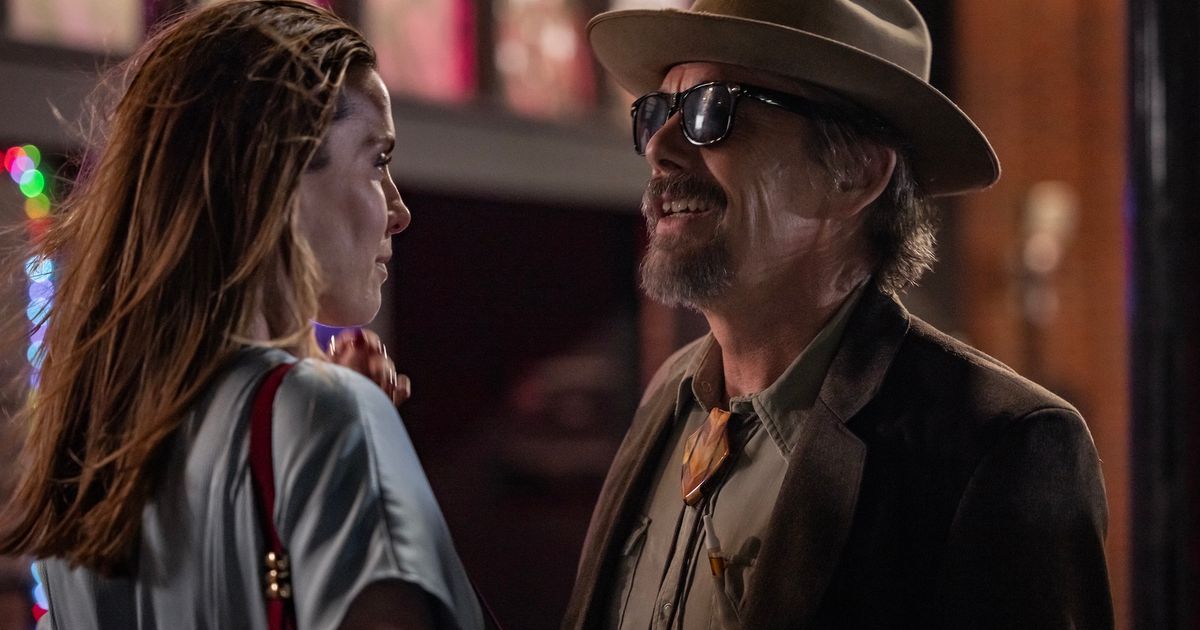

Season two’s dynamic between Ginger (Betty Gilpin) and Lee (Ethan Hawke) shifts the energy of the entire series.
Photo: Shane Brown/FX
The chief gift of television as a form is that it allows projects like season two of The Lowdown to exist. It doesn’t happen very often, especially in the current era of television where second seasons frequently feel like forgotten afterthoughts. But TV still has a capacity to do something film typically does not: Creators can finish a shaggy yet promising season of TV, step back and take a careful look at what was working and what wasn’t, and then come back for season two with all the dials now tuned to the best, most confident version of what the show can be. It’s hard, and many shows go the other direction, coming back for second seasons that lose track of what was working before. Occasionally, though, we get a case like The Lowdown, a show with an appealing, messy first season that comes back for a second season that’s so good it feels like it’s been shot out of a cannon.
Like its first season, season two of The Lowdown follows Ethan Hawke as Lee Raybon, a freelance journalist and bookstore owner in Tulsa, Oklahoma, with a nose for trouble and a hefty dose of quixotic, self-righteous moral indignation. But the first season was hampered by the show’s narrative ambitions and the complication of Lee as the protagonist. The Lowdown is a mystery, but in season one the show could not always manage the balance between mystery plotting and the odd character-development culs-de-sac it often found its way into. And like so many noirish detectives before him, Lee is always both the solution and the problem. He’s the only one foolhardy, naïve, and single-minded enough to take on the deep injustices in his community. He is also a scummy, delusional dirtbag fueled by his own self-importance. Season one struggled to incorporate all of those elements of Lee without either forgiving or betraying his flaws. He was too magnetic, and the mystery plot’s inevitable curl toward satisfying resolution made it too easy to come away with a simplistic image of him as a lovable rascal.
Season two makes an immediate, winkingly metatexual course correction. In the first of the season’s eight episodes, premiering tonight on FX and Hulu, Lee’s won a local journalism award for the piece he wrote at the end of season one, but rather than give an inspirational or bracing acceptance speech about the social inequities he claims to care about, he gets wasted and lurches up to the stage. He declares all of it to be bullshit, says “fuck you” to his absent dad, and insists that every other local journalist is a coward. His daughter is humiliated, and the message could not be clearer. Being the center of the story does not make Lee Raybon the hero.
That first episode, written and directed by series creator and showrunner Sterlin Harjo, also introduces the most compelling and most valuable new addition to The Lowdown: this season’s femme-fatale character, Ginger, a local defense attorney played by Betty Gilpin. There are many things going right this season, but Gilpin is what shifts The Lowdown out of “promising but uneven” territory and into “this show knows exactly what it’s doing.” Ginger shares some of Lee’s strangeness and impulsivity and is undeniably attracted to him for it, but she’s anchored in reality where Lee is not, constantly calling him out on all of his worst ideas and most clueless decisions. She’s more than just a mirror for Lee — The Lowdown gives Ginger many opportunities to be her own weird self, including one notable scene involving feet — she is also the best possible audience surrogate for this show. She finds Lee infuriatingly, bafflingly hot. She loathes him. She has no better option than to accept his help investigating the case of her client, who’s gone missing in prison. She cannot believe what an idiot he is. She finds it shocking when something he does works out, like when he starts peeling back some corruption happening among the prison guards. She could not be less surprised when he screws up, which he does constantly.
The dynamic between Ginger and Lee shifts the energy of the entire series. Where the first season is full of minor characters who needle and eventually confront Lee with his mistakes, they’re all resolutely secondary figures, stuck in subordinate roles that make them important life lessons for Lee more than real people. But Ginger sees him again and again, and she’s never afraid to remind him of all the ways he’s already botched this investigation. Hawke is still excellent as Lee, who’s in the zone of character he can play so well: Lee Raybon, John Brown in The Good Lord Bird, and Lorenz Hart in Blue Moon are superficially characters on completely different planets, but they’re all different flavors of a passionate gremlin, blinded by his vision of how the world should be. Gilpin, though, is truly perfect as Ginger. Like Hawke’s performance of Lee, Ginger allows Gilpin to capitalize on a type of character she excels at, someone who feels both inside and outside the story at once, reflecting but also directing how an audience sees the story.
While the relationship between Ginger and Lee is the most significant adjustment from season one, season two of The Lowdown is so full of other fantastic guest performances that it’s almost possible to underrate Gilpin’s role. Tommy Lee Jones plays Lee’s estranged father, who walks back into Lee’s life unexpectedly. Steve Earle has a minor role as another Tulsa-area journalist who pushes back on some of Lee’s assumptions of what constitutes good work. Keith David, Macon Blair, Killer Mike, Cody Lightning, Siena East, and Michael Hitchcock all return as some of Lee’s Tulsa-area buddies, employees, and resentful acquaintances. Martha Plimpton plays a gloriously terrifying TV sheriff. There is a truly mind-boggling guest performance from Paul Schneider as a prison guard with the unlikely name Chili Franks, which is so transformative and so unnerving that for a few moments, Schneider pulls the show’s entire center of gravity into a nightmarish Ballad of Chili Franks alternate universe.
This, nearly as much as the Ginger-Lee relationship, is what transforms season two of The Lowdown from its previous state of uneasily executed mystery into something stranger and more exciting. Harjo’s previous series, Reservation Dogs, excelled at the episodic experience of abruptly dropping into new tones and settings, and this season of The Lowdown regains that rhythm. Lee’s world is made up of infinite tiny pockets of culture and experience and narrative, and he keeps wandering into them, overconfident and cheerfully perplexed each time. Doors open into spaces like Chili Franks’s life, or a local Native American tourist attraction, or a car trip with his father, and every time Lee assumes he can handle himself. Usually, he can’t. The Lowdown gets to inhabit these new settings and weave in new characters while also doubling down on its favorite underlying theme: Lee is a dumbass, but at least he’s curious enough about the world to keep stumbling into something new. Even better, this season of The Lowdown has a better sense of how to explore those unexpected little worlds without losing its grip on the mystery underneath it all.
With the season’s final two episodes not provided to critics, there’s no way to say yet whether The Lowdown achieves that mythical outcome of all mystery seasons, the Finale That Pulls It All Together. But six episodes is more than enough to recognize when a TV series has accepted its strengths and addressed its weaknesses and used that insight to become the best drama on TV this fall.
-
North of North Can Do the Hard Stuff
-
The Gilded Age Has Perfected the Art of Trivial Drama
-
Everyone on The Mob Is Having Fun, and So Am I
The Lowdown Flies High
Your product is saved! You’ll receive emails when your saved products go on sale. Manage preferences.
