


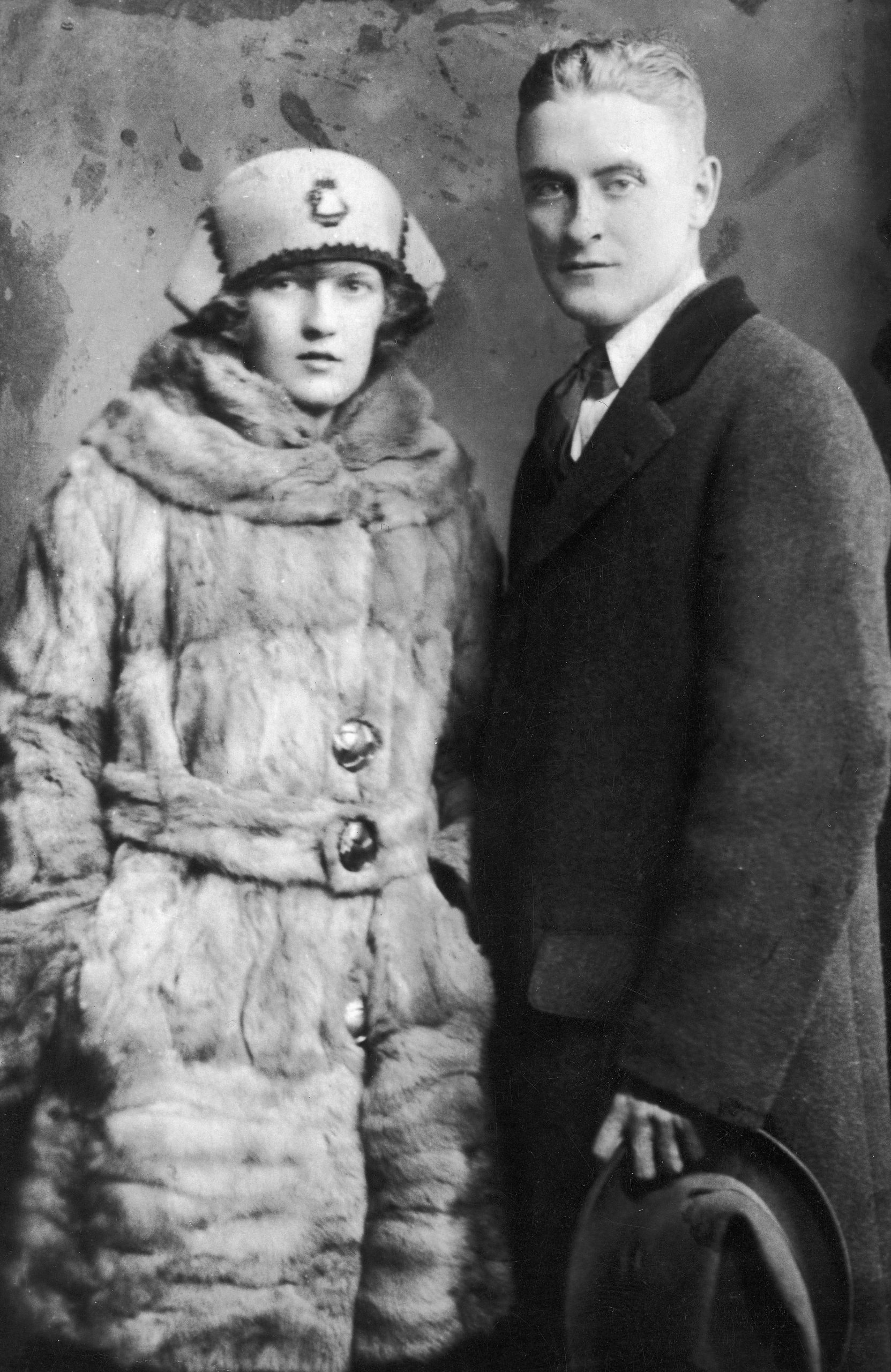
In 1921, a 24-year-old F. Scott Fitzgerald posed for a portrait with his wife, Zelda. At the time they were the bright young things of New York: A year earlier he’d published his first novel, This Side of Paradise, to critical acclaim. A second book, The Beautiful and Damned, was underway. On this cusp of literary superstardom, they sat for a photographer—Zelda wearing a gray fur coat and F. Scott Fitzgerald in a charcoal wool coat with a velvet collar.
In this image, there is often a focus on Zelda. The photo supports the theory that she inspired the character of the status-obsessed Gloria Gilbert in her husband’s The Beautiful and Damned. (“Throughout the previous winter one small matter had been a subtle and omnipresent irritant—the question of Gloria’s gray fur coat. At that time women enveloped in long squirrel wraps could be seen every few yards along Fifth Avenue. The women were converted to the shape of tops. They seemed porcine and obscene; they resembled kept women in the concealing richness, the feminine animality of the garment. Yet—Gloria wanted a gray squirrel coat,” Fitzgerald wrote.) However, it’s now her husband’s fashion that’s getting a second look.
His more than 100-year-old Chesterfield coat, made by Brooks Brothers, is currently up for sale at the New York Antiquarian Book Fair at Johnson Rare Books booth. The price tag? $25,000.
“It’s one of those ‘if this coat could talk’ sort of things,” says Brad Johnson, founder of the Covina, California, store, as we sit at the Fitzpatrick hotel in Midtown, blocks away from the former Biltmore Hotel, where Fitzgerald used to meet his friends under the property’s famed clock. The coat is in an archive box next to us. Can I see it? Johnson obliges, gently removing the lid. Other than some fading on the velvet collar, it looks remarkably pristine to my untrained-archivist eye. “I mean, he’s a Minnesotan, so he knows the value of a good overcoat,” says Johnson.

F. Scott Fitzgerald’s Brooks Brothers Chesterfield coat, as seen today.
Courtesy of Johnson Rare Books
Johnson found it from a collector in the Sacramento area. The collector had bought the coat during a June 1994 auction at Christie’s, which offered the property of three Hollywood men: Clark Gable, Vincent Price, and Sydney Guilaroff. At the time, the coat belonged to Guilaroff.
Guilaroff was a legendary hairstylist at MGM. He dyed Lucille Ball’s hair red and put Judy Garland’s hair in braids for The Wizard of Oz. He coiffed Marilyn Monroe’s signature bob for Gentlemen Prefer Blondes. And when Grace Kelly married Prince Rainier in Monaco, it was Guilaroff who did her wedding-day updo.
F. Scott Fitzgerald also worked for MGM, though the men were involved in very different stages of the movie making process. (Fitzgerald wrote scripts, whereas Guilaroff was on set with actors during production.) A film that links them is 1939’s The Women, starring Joan Crawford and Norma Shearer. Fitzgerald collaborated on an early version of its script. While shooting, Guilaroff did the hair. Alas, the connection is tenuous—perhaps the two men overlapped, or perhaps Guilaroff bought it at an auction that predated Christie’s or another means entirely. All we know for certain, as Christie’s confirms, is that the coat was in Guilaroff’s possession. Read the listing in the Christie’s catalogue: “An overcoat of author F. Scott Fitzgerald who penned such classics as The Great Gatsby, The Last Time I Saw Paris, and Tender Is the Night. The Brooks Brothers gray wool coat is trimmed on the collar with velvet and lined in black satin.”
What is interesting is that the coat is in a Southern California–based collection at all. Fitzgerald died of a heart attack in 1940 at the Los Angeles apartment of gossip columnist Sheilah Graham. At the time, he’d been living in the city. Deeply in debt and an alcoholic, he was trying to make it as an MGM screenwriter as well as finish his novel The Last Tycoon. It wasn’t going well: “I felt that Hollywood had me down in its books as a ruined man—a label which I had done nothing to deserve,” he said of his life in LA. Was the coat in his possession when he died? For Fitzgerald, it seems a good wool overcoat was always in his wardrobe: In This Side of Paradise, Amory Blaine—the protagonist that Fitzgerald wrote as the most idealized version of himself—sets off to a New England boarding school with “six suits summer underwear, six suits winter underwear, one sweater or T-shirt, one jersey, one overcoat…”
_2June1994_lot102-2%2520(1).jpg)
A Christie’s catalogue from June 1994 that shows the lot description for F. Scott Fitzgerald’s Brooks Brothers coat.
Courtesy of Christie’s
Alas, all of that is stylish speculation. However, it is a physical symbol of Fitzgerald’s specific moneyed aesthetic—which he both lived and wrote about. Earlier in This Side of Paradise, Blaine’s mother tells him that “you must go to Brooks’ and get some really nice suits.” The meticulous Fitzgerald didn’t drop brand names aimlessly. In this case, the relaxed, preppy look of the elite East Coast class during the Jazz Age was very much propped up by the American outfitter. They had stores in the most moneyed parts of the region—and to “go to Brooks’” meant you had to reside in one. “In the ’20s through the 1930s, we had outposts in places like Newport, Palm Beach, and Boston,” Brooks Brothers’ creative director, Michael Bastian, tells Vanity Fair.
He hasn’t seen this specific F. Scott Fitzgerald coat. But he’s well familiar with the design: “The Chesterfield was hugely popular in that era, and Brooks Brothers would have sold them in a variety of fabrics and trims. Generally lean and minimal, they were considered sophisticated and meant to be worn over a suit or formalwear,” he says, also adding they still sell a similar style.
It’s unlikely F. Scott Fitzgerald’s coat will be worn again. When I ask Johnson who he expects to buy the coat, he explains he expects it to end up in the hands of a literary memorabilia collector or a museum. A century later, the coat will have another chapter.
