


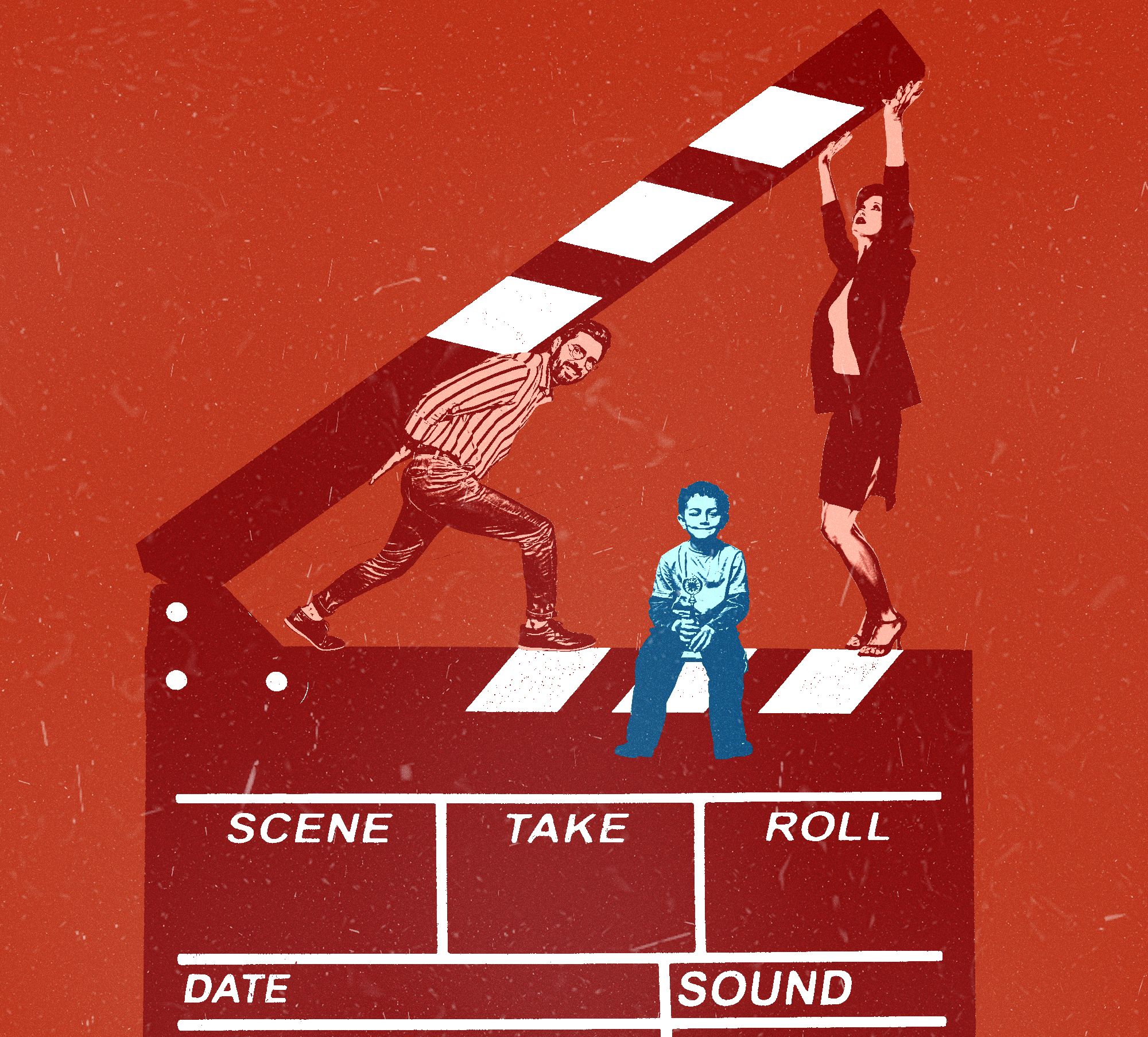
“No matter how good the union safeguards get, no matter the policing of grooming behavior, none of it will change the fact that acting while so young strips us of our childhoods and leaves us to suffer the consequences—alone.”
Alison Pill had wanted to express this message for decades. But she didn’t publicly articulate it until this summer—less than two weeks after Hayden Panettiere, who shot her first commercial before she celebrated her first birthday, died of an accidental overdose at 36. Months after Daveigh Chase, star of The Ring, died at 35 from AIDS complications following a long period of homelessness. A year and a half after Harriet the Spy star Michelle Trachtenberg died at 39 due to diabetes complications, though the full story may be more complicated.
Pill laid out her blunt assessment in a New York Times op-ed headlined “I Was a Child Actor. No One Deserves That Fate.” The conclusion she reached was stark: “The greatest storytellers should find a way to capture the world we live in without child actors, for all our sakes.”
“It took me a while to figure out what, exactly, I wanted to say,” Pill tells Vanity Fair. Once she did, though, she made her point simply and elegantly: that it’s basically impossible to pay a child to act without exploiting them in some way, even unintentionally. That kids who are set up to succeed—kids with loving parents, financial security, on-set support systems, and a burning and internally motivated desire to perform—still grow up to become adults who feel they were taken advantage of and not protected in the way they should have been.

Alison Pill as Mattie Lyons in The Pilot’s Wife, 2002.Getty Images
Pill counts herself among that group. “My parents are wonderful people. I didn’t have my money stolen,” she says. Yet in the years since her own child-acting days—when she played a young Lorna Luft in a celebrated Judy Garland miniseries, and Katie Holmes’s little sister in Pieces of April, and Lindsay Lohan’s best friend in Confessions of a Teenage Drama Queen—she’s grown increasingly uncomfortable with the realities of what it means to put children onscreen. Especially now that she’s both a mother in real life and often playing one in her work. “If we can’t protect the most innocent of innocents in any meaningful way, or even attempt to,” says Pill, “what are we doing?”
I spoke with five other former child actors for this story—and while not all of them take the same hard-line position that Pill does, everyone in the group tends to agree on two things.
The first is that acting in a professional setting inherently hurts kids. “There will 100% be consequences to a child in an adultified, high-stress, and high-stakes industry—both in terms of the potential harm to that kid and just the developmental loss,” says Alex Winter, who made his Broadway debut at the age of 12. “That’s just a given. You cannot develop normally as a child if you are a working child.” Mara Wilson, of Mrs. Doubtfire and Matilda fame, puts a finer point on it: “I think that you could probably be a somewhat healthy child actor. I do not think you could be a healthy child star.”
The second is that there’s more to be done to keep those kids safe—simple, concrete changes productions could enact now. “I think we could protect children without necessarily taking away their opportunities,” says Who’s the Boss? alum Alyssa Milano.
“There’s this mysticism surrounding what there is to be done, and there’s a lot of theories and a lot of outside opinion,” former Disney star Christy Carlson Romano adds. “And I think this is an industry issue that needs to be handled effectively inside.”

Jackie Coogan in a promotional portrait for Charlie Chaplin’s film The Kid, 1921.Hulton Archive/Getty Images
“I have been asked many times which of my pictures I liked best,” Charlie Chaplin wrote in the pages of this magazine in 1921. “Perhaps the one I most enjoyed making is my last picture, The Kid, written expressly to bring out the qualities of another actor, a five-year-old actor this time, Jack Coogan.” Chaplin said he was charmed by Coogan from the moment they met: “He was with his parents in a Los Angeles hotel, sleeping, as a child will, in a chair. He was roused in order to meet me. He rubbed his eyes, jumped up, made his politest bow, and promptly went back to sleep.”
So Chaplin built an entire feature around that sleepy little boy, thus launching the career of the kid generally agreed to be Hollywood’s very first bona fide child star. Coogan would inadvertently set the template for those following in his wake.
Long before adolescence, Coogan earned millions from his films and the merch that bore his face. But after aging out of cute-kid roles and flunking out of college, he learned that his profligate parents had squandered his fortune. His legacy is a litany of stories with headlines like “The Very Sad Story of Jackie Coogan”—and California’s Coogan Law, which requires employers to deposit 15% of a minor’s gross wages into a trust account that only the child can access when they turn 18. Coogan also played Uncle Fester in the original Addams Family, making a triumphant return to the screen as an adult—older and wiser.
Child actors aren’t a monolith. Some, like Coogan, end up traumatized by their time in the industry. Others have overwhelmingly positive experiences before growing into highly functioning adults. Many fall somewhere in the middle. Armchair critics have a proclivity to focus on the negative outcomes, which “tends to stigmatize the business in a way that isn’t particularly helpful for anyone,” says Winter, who’s spoken openly about the sexual abuse he survived as a child actor. As an adult, says Wilson, “I see a lot of people making the assumption that any child who was in the industry must have been abused on sets.”
Since his Bill & Ted days, Winter has largely traded acting for directing, working frequently on TV series for kids. And according to him, those sets are generally much healthier places to spend time than they once were. “Despite the MAGA discourse that they’re all pedophiles—which is really, really not true—most people who go into that environment are family-oriented by nature,” he says. “The days of the really crass, bullish, patriarchal, male-run sets of the ’70s and ’80s into the early ’90s—that is really a bygone era. You would not get away with being that person today.”

Alyssa Milano and Tony Danza, Who’s the Boss?, 1985.
Getty Images
In some cases, growing up on a set might actually be better for a kid’s well-being than the alternative. “I was dyslexic,” Milano says. “I don’t know that I would’ve been okay in a normal classroom, under normal social structures.” She points out that performing is one of the few ways that a talented but underprivileged kid can earn enough money to change their circumstances.
Yet for every kid actor who becomes a successful and seemingly well-adjusted adult, every Daniel Radcliffe or Drew Barrymore, there seems to be a River Phoenix: a bright light snuffed out too soon, a cautionary tale. And even the Radcliffes and Barrymores hardly seem to emerge into adulthood unscathed.
So yes, it’s hard to know definitively whether child actors have worse adult outcomes than any other group. “There’s this spectrum of experience,” says Romano, “so there’s no clarity.” But what we know for sure is that, especially in the post-MeToo era, former child actors who did have negative experiences have been speaking more publicly about them: in pieces like Pill’s, in documentaries like ID’s Quiet on Set and Winter’s own Showbiz Kids, in blockbuster books like Jennette McCurdy’s I’m Glad My Mom Died and Alyson Stoner’s Semi-Well-Adjusted Despite Literally Everything. (Via reps, both McCurdy and Stoner politely declined interview requests.) Romano recently released her own memoir about her Disney days, titled Once Upon a Trainwreck: The Fall and Rise of a Child Star.
These onetime kid actors have spoken movingly about facing isolation, external pressure, intense public scrutiny, and the psychic pain of constant rejection on the audition circuit. In an article Romano published after Panettiere’s death, she compared early fame to CTE: “Not as a diagnosis,” she wrote. “As a way of thinking about repeated impact.”

Alex Winter and Keanu Reeves in Bill & Ted’s Excellent Adventure, 1989.
Getty Images
It seems high time, then, that the entertainment industry followed the NFL’s lead by enacting stricter metaphorical concussion protocols. Nobody I spoke to believes that banning child actors altogether is realistic; everyone similarly agrees that, say, replacing actual kids with AI-generated ones isn’t the answer. “I know that’ll be the argument: What if instead of adding staff to a production and considering the human element of any of this, we just AI them? I think it’s depraved,” says Pill.
Even Bryn Mooser, the cofounder of Asteria—a company that brands itself as Hollywood’s ethical AI studio—is with them. “Replacing kids might help alleviate having less kids on set,” he says, “but it’s certainly not going to solve another massive problem, which is that people don’t want virtual actors in a movie.” And though Mooser allows that de-aging technology has gotten vastly more sophisticated than it once ws, he maintains that “it’s so much easier to have a child playing a child. You know what I’m saying?”
This informal conclave suggests more practical solutions. Wilson proposes taking the Coogan Law further—ensuring that more than 15% of a child’s earnings will be secured for the child—and making sure it’s enacted nationally. Romano wants to see more investment in the Entertainment Community Fund’s Looking Ahead program—which offers trainings, resources, and support to young actors—as well as a formal study that can actually determine how many former child actors are struggling, and in which ways. Milano would like to see action from SAG-AFTRA: “I think the unions could do a better job of training our young performers about what it means to have self-care and to protect themselves.” More than one source notes that the union might have a vested interest in this issue particularly because its current president, Sean Astin, is a former child actor himself.
Pill suggests what might be the most radical idea: that sets where kids are working should hire designated child welfare advocates. They would operate sort of like intimacy coordinators do, acting as a buffer between the child actor, the rest of the production, and, if necessary, the child’s parent or guardian—who “must be present at all times while a minor is working,” according to SAG-AFTRA policy.

Christy Carlson Romano attending The Kid premier in 2000.
Ron Galella/Getty Images
It’s true that film staffers have unofficially served functions like this one in the past. “On the film sets I was on, I had studio teachers who basically acted like that,” says Wilson—referring to the educators who are required to be employed on any set where a minor is working for at least three consecutive days, according to SAG-AFTRA policy. But there’s a difference between ad hoc advocacy and the kind that’s mandatory. Especially when it comes to studio teachers, who “are easily corrupted, in my opinion,” says Romano, “because they are the liaison between production and the child.”
Few people understand this better than Maggie Blake. She too was once a child actor, appearing in ’90s and ’00s-era Canadian productions like Emily of New Moon. She now works as a designated child safety and well-being consultant on film and TV sets. “When I was a kid, I had a therapist on set—but I didn’t know who she was,” says Blake. “She was a random lady in the corner. And I don’t want to be that random lady.”
Her ethos is straightforward: “I want to prepare the production for the child, rather than expecting the child to adapt to an adult system,” Blake says. “So I’m there talking to ADs and producers and directors, saying, ‘How are we going to support this child?’ I want to meet them before they come to set and understand their developmental needs. I want to talk to their parents and caregivers and understand where they’re at, then build a relationship.”
Blake helps prepare kids emotionally to perform violent or mature material. She speaks out when her charges are too tired during a night shoot to do their best work. She counsels young performers who are despondent after losing out on a part. She works with their parents too, urging them to release the pressure valve.
For an industry that’s already forced to navigate competing union interests, corporate headwinds, and endless miles of red tape, adding another layer of compliance may seem impossible. To the people who think that way, “I would say, ‘Risk mitigation, risk mitigation, risk mitigation,’” says Blake. “We have intimacy coordinators. We have stunt directors for adults. And yet the most vulnerable population that is working on sets has no one.” Intimacy and stunt coordinators aren’t infallible, of course—but most would agree they’re better than nothing.

Mara Wilson and Robin Williams, Mrs. Doubtfire, 1993.
Everett Collection
Like almost all of the former child actors in this story, Blake is a parent herself. Like most of them, she will not let her own kids act professionally. “I think that it’s telling that there aren’t very many second-generation child actors,” says Wilson—who doesn’t have kids, but wouldn’t want them to act in a professional capacity if she did. Most child actors whose parents were also child actors, she points out, “tend to be in projects with their families.”
Milano’s daughter, 12-year-old Elizabella, is one of them. This summer, the two of them shot a film together in Canada.
“Before she was born, I was like, Oh, what am I going to do if I want a kid in this business? But then after she was born, I realized she came out who she is,” Milano says. Former child actors can recognize the type. “There are kids who really want to be onstage, performing and taking dancing and singing lessons, and that’s who they are,” says Winter. “That’s absolutely who I was, and my parents kind of had to get out of the way.”
But Milano didn’t. She was close by as her daughter filmed on what sounds like a particularly nurturing set. “Bella had a social worker…and there was someone there making sure she had her breaks, and was comfortable, and didn’t work longer than the hours that she was supposed to work,” she says.
When asked how it felt to work with Bella, her mother’s voice turns dreamy. “It was amazing,” Milano says. “My most memorable moment on set—I think ever in my entire career—was watching them shoot her close up from the monitor. It was really beautiful.”
-
Penélope Cruz Says She and Husband Javier Bardem are Selective When They Work Together
-
Making the Elizabeth Holmes Doc Fried Nathan Fielder’s and Lance Oppenheim’s Brains
-
“I Hate My Fucking Life Right Now”: How DC Republicans Reacted to the Blue Wave
-
Inside Lane Kiffin’s Trash-Talking, “Joey Freshwater” Era With Nick Saban at Alabama
-
Stacey Abrams Discusses the 2026 Midterms—and Her Future—with Ta-Nehisi Coates
-
From the Archive: Inside Elizabeth Holmes’s Chilling Final Months at Theranos
