


Should a School Shooting Be Turned Into Opera?

By
Justin Davidson,
New York Magazine’s architecture and classical-music critic
since 2007 and was the recipient of the Pulitzer Prize for Criticism in 2002.
Despite its beauty and power, the Met’s Innocence had me wanting to run.
Photo: Karen Almond/Met Opera
For 400 years, opera’s business has been the aestheticization of pain. Wrenching loss, blinding rage followed by unending regret, lifelong resentments, rape, slavery, incest, abandonment — whatever kind of suffering humans can imagine, someone has set it to music that audiences want to bathe in so they can experience nastiness and its antidote all at once. So I shouldn’t be troubled by the way the late Kaija Saariaho turned a fictional school shooting into a work of modernist refinement. Teenagers stumble through classroom doors and collapse, leaving bloody streaks on the walls. We don’t hear from the silently murderous teenager, but we see him being bullied and taunted, as if that were a reason for an indiscriminate attack on his classmates. A decade later, the bullets he fired are still ricocheting through the lives of traumatized survivors and the killer’s own family. And through all this, Saariaho’s elaborately beautiful orchestration scintillates, jabs, caresses, and swerves, giving all that vivid misery a sheen of lyric glamour. At Monday’s Metropolitan Opera premiere of Innocence, a fast-moving, intermissionless, two-hour swarm of an opera, I found myself desperate to run.
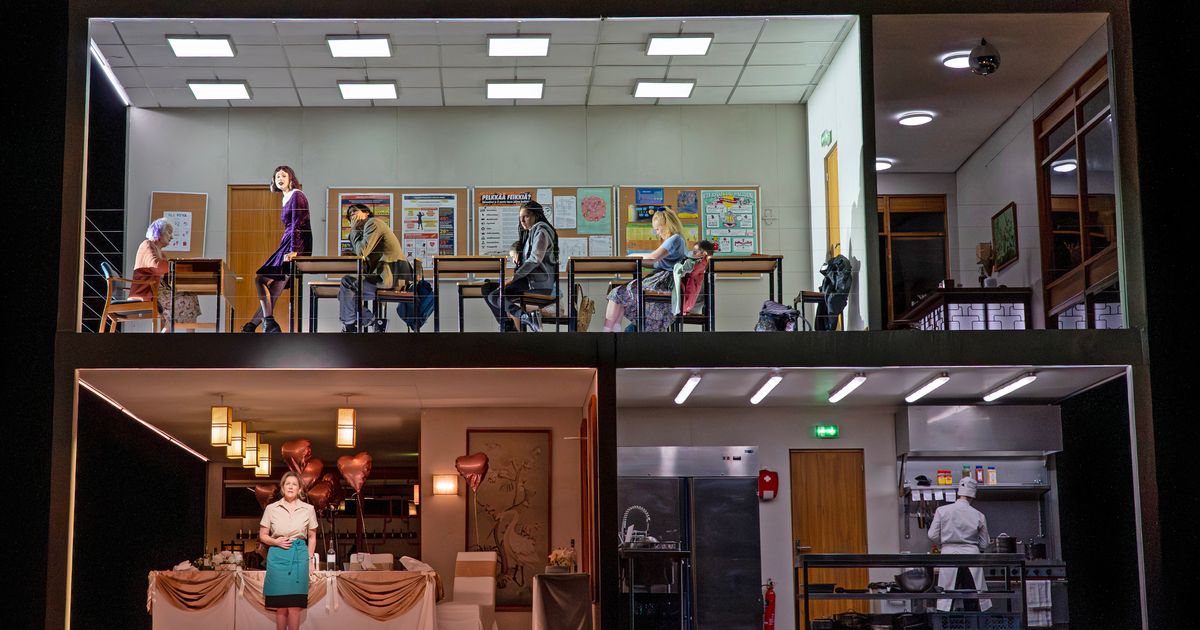
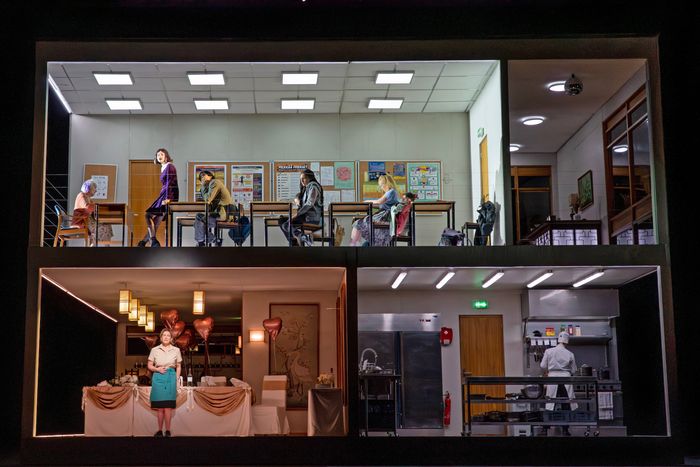
That’s not to say it wasn’t good. Saariaho, whom I’ve long admired for her dazzling sonorities and her ability to mix delicacy and power, decanted a lifetime of expert passion and social sincerity into her final opera. (She died in 2023.) Simon Stone’s production, which originated at the Aix-en Provence Festival in 2021 and moved on to the San Francisco Opera before wending its way to the Met, delivers the score in a tight package of high-intensity choreography and effectively restrained scenery. And the composer’s friend and champion Susanna Mälkki conducts a superb cast and nimble orchestra, making all the complexity crystalline.
And yet this buildup of talent, enthusiasm, and experience — along with the rare opportunity for a new work to mature over several productions, for varied audiences — has produced an opera that to me feels deeply, unfixably wrong. Partly, it’s about the rawness of the events taking place onstage, unsoftened by time. Innocence isn’t even about the recent past; statistically speaking, the grimly familiar scenes of mayhem might take place somewhere next week. But mostly I’m reacting to the unsettling conflation of artistic sophistication and the hideous routines of violence.
Saariaho and the librettists Sofi Oksanen and Aleksi Barrière focus less on the shooter or the crime than on the long tail of grief and disorientation they leave behind. The setting is an international school in Finland, and the opera is interracial, polyglot, and multistylistic. The world we see onstage is a thoroughly pluralistic one, vulnerable to the terrible homogenization wrought by an automatic weapon. Innocence traces not one aftermath but several, their stories intertwining onstage and in the music. At a wedding a decade after the crime, a bride (spectacularly sung by Jacquelyn Stucker) is unknowingly marrying into the killer’s family; his brother is her groom. One member of the catering team (performed with heartrending stoicism by Joyce DiDonato) lost her daughter that day, and the inevitable confrontation between the two mothers devolves into cake-throwing farce. There’s a place for humor even amid the unthinkable.
Saariaho tracks these stories masterfully, giving each character a vocal idiom so distinct that you could practically identify each one with your eyes closed. The caterer’s dead daughter, Marketa, is sung by Vilma Jää, an ethno-pop performer whose forays into Finnish folk techniques have her slinging her voice up into thrillingly high engine-whines. The soprano Lucy Shelton, who is making her shockingly belated Met debut at 82 as the students’ teacher, has the aplomb of a singer long accustomed to big leaps and tricky rhythms.
Complexities abound. Characters are constantly zipping through the two-story rotating set, from classroom to kitchen to banquet hall, inhabiting their stories in alternating snippets. Aftermath and flashback are braided together, too, as if in perpetual PTSD. Musical events move even faster than dramatic ones, so that we hear emotions flicker and fade, the way you might track them on an especially motile face. Saariaho never once loses control of momentum and never insults her own tastefulness. There’s nothing primal or unfiltered about the score; every measure is filled with elaborately constructed mood effects, little supernovas and burning comets shooting through the orchestra.
The opera is not politically heavy-handed, either — we get no sung screeds against permissive gun laws or violent video games. The shooter’s French-speaking sidekick, Iris, performed with biting brilliance by Julie Helga, addresses him as a friend, but the creators have gone out of their way to avoid glorifying him or his nihilistic destruction.
Despite the jeweler’s eye for detail, though, Saariaho has created an array of archetypes, not a cast of humans who might develop, relating to one another in evolving ways. Instead, each character is webbed by trauma, caught in a repetitive cycle of behavior, acting out an assigned role in a pageant of pain. What makes Innocence difficult for me to digest is the gulf between the opera’s stylized form and its brutal content, between the symbolic stasis of the plot and the emotional directness of the music. That fusion, I know, is the source of the art form’s strength: We turn to opera so we can mainline someone’s inner life with a drip of narcotic music, regardless of whether the character is a death-row inmate, an 18th-century nun, or the king of Sweden. In this case, though, I can’t accept the urge to decorate the mass slaughter of children with a flourish of beguiling sounds. Certain truths should not be delivered in song.
Should a School Shooting Be Turned Into Opera?
Your product is saved! You’ll receive emails when your saved products go on sale. Manage preferences.
