


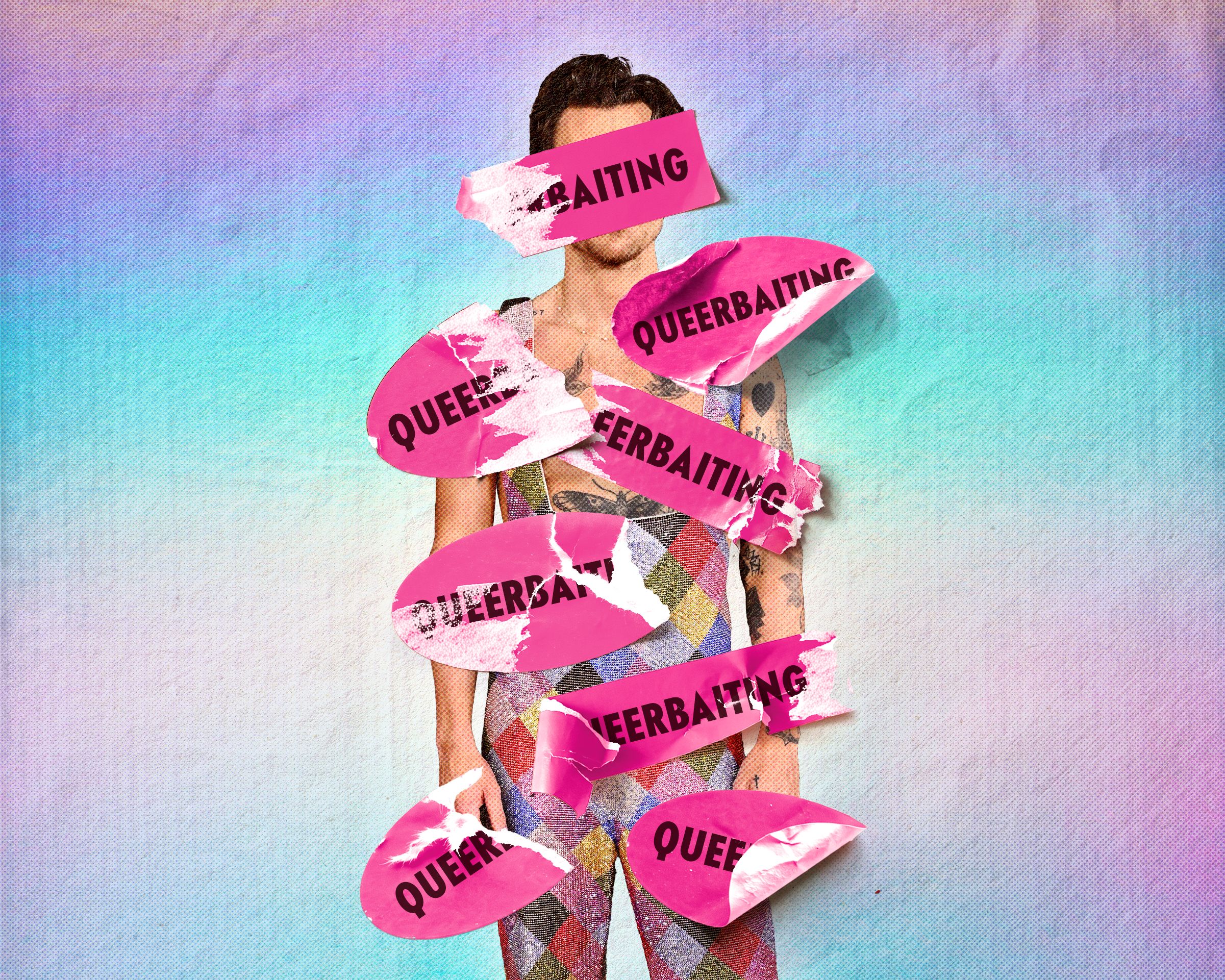
A nude photo of Harry Styles is currently on display in a queer art exhibit. Yes, you read that right. The former One Direction member and current Madison Square Garden artist in residence is featured in artist Tim Walker’s latest exhibit, “Tim Walker’s Fairyland: Love and Legends,” which opened at London’s National Portrait Gallery on October 9. The exhibit is described as “an exploration of queer identity, community, and love through the lens of one of Britain’s foremost photographers.” The problem? To many, Styles is the patron saint of one of society’s many ills: queerbaiting—basically, pretending to be queer for attention. It certainly doesn’t help matters that Styles recently got heterosexually engaged to actor Zoë Kravitz. Now he’s featured in an art exhibit about queer identity? I can hear the queerbait warriors sharpening their pitchforks as I write this.
That’s not the only recent instance of alleged queerbaiting. In late September, the concept was thrust back into the public consciousness thanks to a Variety interview with actor Jack Innanen, who plays the Canadian himbo Paul Baker on the excellent sitcom Adults. Paul Baker is sexually fluid. (Light spoilers incoming.) On Adults, he dates his female roommate Issa (Amita Rao) but has a flirtation with male roommate Anton (Owen Thiele) throughout, which results in a passionate kiss. In real life, Innanen identifies as heterosexual. By playing Paul Baker, a queer character, was Innanen, a straight guy, guilty of the sin of queerbaiting?
Innanen answered the question to the best of his ability. “I think my understanding is that queerbaiting is when someone is falsely portraying themselves as queer,” he said. “Paul Baker is pretty fluid to the core, and I think that that resonated with many people…. I think that there wasn’t much queerbait to him.” Of course, one could argue that, as a self-proclaimed straight dude, Innanen was falsely portraying himself as queer on the show. As noted in Innanen’s considered response, though, Paul Baker’s sexuality isn’t binary, making it harder for the allegation of queerbaiting to stick. Was Innanen engaging in an act of radical allyship by playing a character who shares a percentage of his own sexual identity? Or was he a dreaded queerbaiter, pulling the wool over the public’s eyes about his sexuality for his own gain? As you can imagine, the internet couldn’t decide, and debates erupted online about queerbaiting and the ethics of straight actors playing queer roles.
If you are chronically online (and if you are reading this article, you probably are), then you’ve likely come across the term queerbaiting before. But what, exactly, is queerbaiting? Technically, it’s a term that describes a marketing or media practice where, in an effort to appeal to the LGBTQ+ community, homosexual or queer activity between two characters is teased but never made manifest. In recent years, however, this word has seemingly become a catch-all term for anything that might upset or mislead members of the LGBTQ+ community. These two characters of the same sex keep flirting but never actually hook up? That’s queerbaiting. A straight actor is playing a queer role? Queerbait. There’s a photo of a bunch of guys hanging out together in a sauna? I’m calling the queerbait police.
And speaking of saunas, the term and all that comes with it also crept up in other corners of the cultural landscape recently. Was New York magazine’s Men’s Style Issue spread featuring male celebrities like Mike Faist, Christopher Abbott, Isaac Cole Powell, and others hanging out in their underwear in a sauna an exercise in queerbaiting? Is King Princess, a musician who identifies as a lesbian but made recently resurfaced comments about her experiences sleeping with men, a queerbaiter? And what does it mean that Hacks Emmy winner Hannah Einbinder, a bisexual, liked an Instagram post promoting a Them story about King Princess and the dangers of trying to police another person’s sexual identity that some online deemed “lesbophobic”? Where does album-of-the-year Grammy recipient Bad Bunny—who told Vanity Fair that he gets an “endless number of negative comments and sexist and homophobic ones, without being homosexual,” for dressing the way he does—fall on the supposed queerbaiter scale? And what do we do with progressive Twitch streamer Hasan Piker, who, on an episode of Ziwe’s YouTube show, said that he tells people he’s “not gay” all the time, but was called out by the host for making misleading comments about his sexual activity?
Clearly, queerbaiting and its attendant minutiae—heated discussions about sexual identity and sexuality labels, discussions about representation in media, and an examination of opportunities available for LGBTQ+ entertainers and artists—are suddenly en vogue again. But for all the hand-wringing and discourse generated by the term, it seems clear that queerbaiting, both as a concept and something to be legitimately mad about, has passed its sell-by date. It belonged to Woke 1.0, and it’s best if we leave it there.
It makes sense that queerbaiting first arose as a legitimate issue for many in the 2010s, right alongside gentrification and Occupy Wall Street. It was the Obama era, after all—we didn’t know how good we had it, relatively speaking. Going the extra step felt almost noble. We didn’t just want equality—we effectively had that now. We needed to take steps toward creating equity—tailoring resources to account for individual and systemic disadvantages. Woke 1.0 was, in many ways, a time period dedicated to redressing old wounds and grievances in an attempt to level historically uneven playing fields and right legitimate wrongs.
But two Trump administrations later, a lot has changed. Many of the progressive political gains that we earned and took for granted over the past 60 years—like Roe v. Wade—have received devastating blows or have been stripped away entirely. The Trump administration has waged a very real war on the LGBTQ+ community. In January 2025, Trump issued an executive order banning transgender people from the military, another seeking to restrict access to gender-affirming care, and one more mandating that US passports have binary gender markers based on sex assigned at birth. In light of this, to be legitimately upset about a marketing tactic, or an actor taking a role that doesn’t align with their sexuality, or how an individual chooses to define their personal sexual identity, is to miss the forest for the trees. To quote a foundational queer text (Keeping Up With the Kardashians), “Kim, there are people that are dying.” We no longer have the luxury to care about such trivial matters. There are simply greater problems at hand.
In this time period, the progressive principle at the heart of queerbaiting—that it is wrong to falsely advertise queer activity where there is none to be found—morphed into something more specious and dangerous. Some people began to feel that we were owed private information about our favorite actor’s sexuality—if only to ensure that nothing akin to queerbaiting was taking place. This was the kind of environment that Heartstopper’s Kit Connor said forced him to come out of the closet as bisexual in 2022 before he felt comfortable doing so. Just a few years later, Heated Rivalry star Hudson Williams would endure intense speculation about his sexuality and allegations that he was “gaybaiting” after fans found out he had a girlfriend. While fighting so-called queerbaiting began as a noble cause, these days it’s become little more than a justification for a sort of sexual-identity witch hunt, a sad byproduct of our increasingly toxic and parasocial world.
By this point, you’d think that people would understand that sexuality is a spectrum (remember the Kinsey scale!) and not simple to define. Is an actor queerbaiting if they play a queer character before coming to terms with their own sexuality? This is to say nothing about gender, kinks, preferences, fluidity, and other nuanced things that complicate sexuality. Ultimately, we don’t know what anyone is up to behind closed doors (as much as it would thrill some of us to know), so caring too much about labels is a fruitless enterprise. Furthermore, being mad at an actor for taking a role in the current entertainment ecosystem is a bit shortsighted when actors of all identities—from Jack Haven, the trans star of I Saw the TV Glow, to Heather Matarazzo, the cisgender Princess Diaries star—are in jeopardy of losing their health care due to a lack of employment opportunities. If anyone should be held accountable for what queer representation looks like onscreen and who gets the opportunity to play the dwindling number of queer characters that exist, it’s the producers and casting directors, not the actors auditioning for roles.
But all that considered, there are so many other productive things we can do as a community in 2026 rather than complain about alleged queerbaiting. As queer people, we get to choose our family, and we also get to choose what we give a shit about. It’s high time that queerbaiting be removed from that list. Instead, donate time, energy, and money to supporting the trans community. Attend Drag Story Hour at your local library. Uplift Tinashe. I promise it’s a better use of your time than sitting online, arguing about what it means whenever Harry Styles wears a dress.
So let’s put away the rod, (queer)bait, and tackle. Right now, at least, we’ve got bigger fish to fry.
-
Erika Kirk Doesn’t Really Want to Talk Politics. So How’s She Going to Lead Turning Point USA?
-
A Deep Dive Into How Larry Ellison Built His Influence
-
Making the Elizabeth Holmes Doc Fried Nathan Fielder’s and Lance Oppenheim’s Brains
-
“History Will Judge”: Fox News Anchor Bret Baier on Donald Trump and Pete Hegseth’s War With the Press
-
Inside Lane Kiffin’s Trash-Talking, “Joey Freshwater” Era With Nick Saban at Alabama
-
From the Archive: Inside Elizabeth Holmes’s Chilling Final Months at Theranos
