


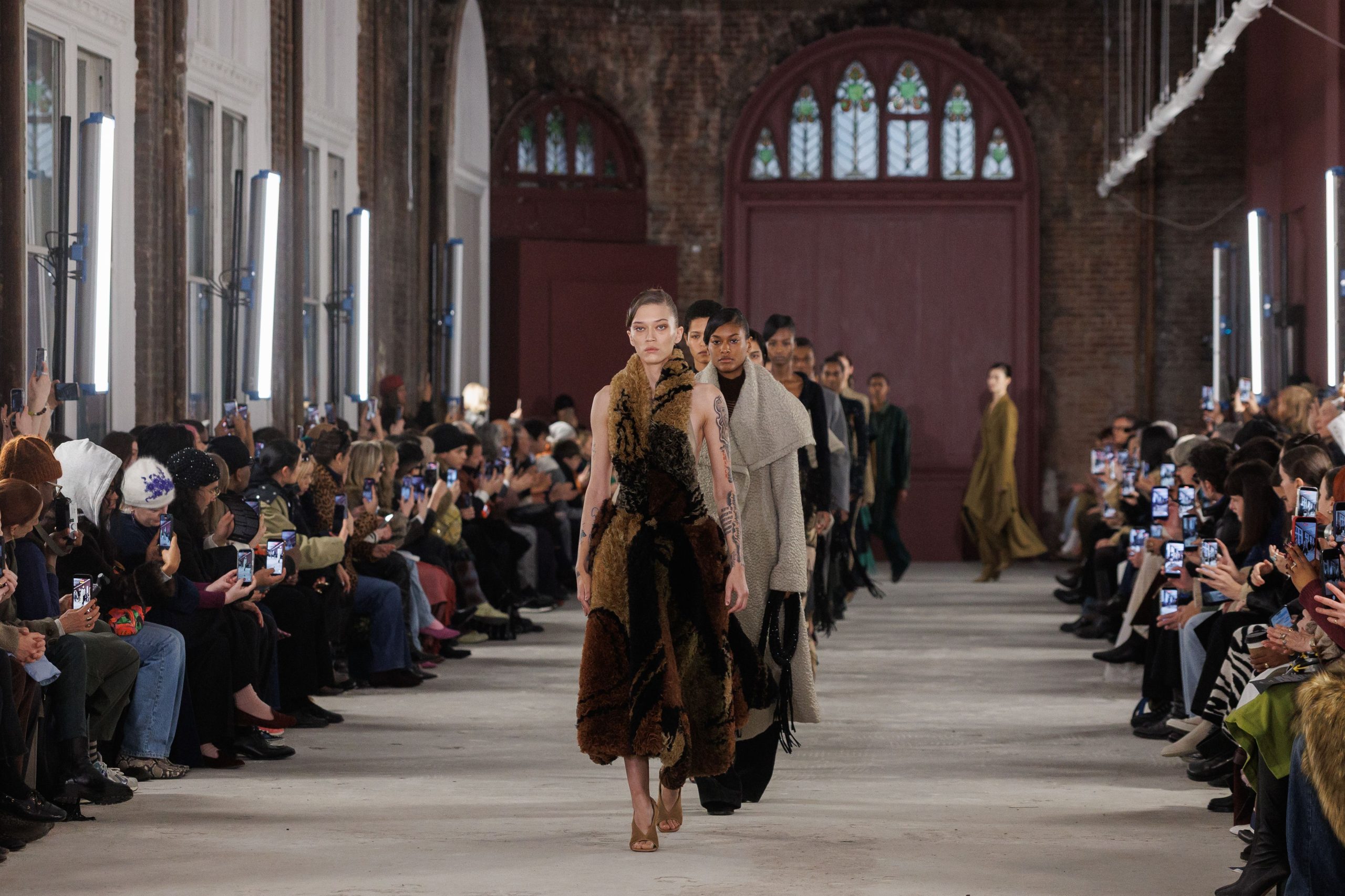
On the second-to-last day of New York Fashion Week and on the eve of President’s Day, Rachel Scott, the designer behind the independent label Diotima, hosted an extraordinary and emotionally charged runway show that, after a week defined by political apathy, at last placed the industry in direct conversation with the social landscape of America.
Not America as in the United States, as the country is colloquially known, but America as a whole—North, South, Central, the Caribbean—a crucial distinction in the context of Scott’s work.

Photo: IK Aldama / Courtesy of Diotima

Photo: IK Aldama / Courtesy of Diotima
There is a reason why Rama Duwaji, the freshly-minted first lady of New York, sat front row at the show, her one and only appearance this New York Fashion Week.
While some of the week’s biggest names—I will let you guess who—donated tens of thousands to Andrew Cuomo’s failed re-election campaign and have avoided any and all political talk this season, Scott addressed reporters after the show following a round of raucous applause from the audience and a teary-eyed greeting from her models backstage while wearing an “Ice Out” pin. That accessory had been seen throughout the week on attendees and a handful of designers, but this was the first instance in which a collection directly addressed the current political context.
“It’s disappointing,” Scott said of how few of her colleagues have addressed the ongoing immigration crackdown in the US. “If you have a platform of any form, you need to be saying something about what’s happening, especially in fashion, which operates in the realm of culture.”
Scott, 42, was born and raised in Jamaica and relocated to the US to attend Colgate University, where she studied art history and French. An internship at Vogue dissuaded her from pursuing a career in magazines, choosing to pivot toward fashion design. After continuing her education and working in Milan, she returned to New York to work with Rachel Comey, eventually launching her label Diotima in 2020.

Photo: IK Aldama / Courtesy of Diotima

Photo: IK Aldama / Courtesy of Diotima
In the six years since, she has become New York City’s inarguable designer to watch. In September of last year, as an explicit confirmation of her talent and broad remit, Scott was named the creative director of Proenza Schouler, a label founded by Jack McCollough and Lazaro Hernandez (who have relocated to Paris to helm Loewe) that emerged in the early 2000s and quickly became the go-to outfitter for some of New York’s most well-dressed women, including Mary-Kate Olsen, Ashley Olsen, Chloë Sevigny. Scott’s Diotima has come to occupy a similar space today, dressing the new generation of, albeit more diverse, fashion glitterati. She showed her first collection for Proenza Schouler on Wednesday, a terrific opening effort.
Much of Scott’s work at Diotima revolves around decolonization, be that by her centering of her home country of Jamaica or by considering elegance from a non-white, non-Eurocentric point of view, oftentimes with an emphasis on craft. This season, Scott partnered with the family and estate of the late Cuban artist Wifredo Lam, whose work is currently the subject of its first US retrospective at the Museum of Modern Art in New York.
A Cuban artist of African and Chinese descent, Lam would often refer to his art as an “act of decolonization.” His work expanded the context of modernist art into the realm of Black diasporic culture by way of transporting landscapes and living characters. He studied in Spain and developed his practice under a war-torn Europe, gaining the support of the likes of Pablo Picasso and Joan Miró. During the Spanish Civil War, he worked with the Republicans to create posters and propaganda, and later illustrated André Breton’s famous surrealist poem Fata Morgana.
Upon his return to Cuba in 1941, he became reacquainted with Afro-Cuban culture. His work developed in style as he merged European surrealism and cubism with Caribbean motifs. Above all, it continued to be political in spirit but this time with a singular focus, to reconnect Cuba with its African heritage. This is a tradition that Scott seeks to uphold by remarking on her own individual cultural lineage.
“He is my favorite artist,” Scott said, “his work had so much influence on me and my life and what I want to do with Diotima,” she explained, adding that the “whole idea of his work was this Trojan horse [through which] he could push an anti-imperialist statement through beautiful work.”
Scott has achieved something similarly astounding with this collection. By not conceding to either her own political voice or her pursuit for beauty in the context of fashion, she has not only stepped up as the American industry’s backbone, but outlined a blueprint on how the industry can engage with the zeitgeist in earnest. No empty messaging, no outdated escapism, not a footnote in a press release.
To her credit, Scott did not reproduce or simply place Lam’s works over her clothes. Rather, she had her collection engage with some of his most famous works, letting Lam’s imagery inform her color and material choices: warm browns, deep oranges, cool blues; gobelin jacquards, fine knits, firm suiting, and organza intarsia. Primarily, Scott leveraged Lam’s femme cheval motif, a horse-headed woman he developed in the 1940s, and both titled her collection after it and designed around the concept. It’s a figure that is both human and divine, that, with its roots in the tradition of Santería, challenges colonialist puritanism and exudes both power and eroticism.
“Rachel and I come from the same soil in Jamaica, but we were called to impact the world through different gifts,” Shelly-Ann Fraser-Pryce, the retired Jamaican sprinter who in 2008 became the first Caribbean woman to win Olympic gold in the 100 meters race, told me after the show. “To witness her shaping the future of fashion on a global stage feels both personal and powerful. When one Jamaican woman rises, it expands what the world believes Jamaican women can be,” she continued. “Jamaica may be small, but its influence is vast, and this collection is a reminder that excellence rooted in culture can travel anywhere.”
Scott also worked with the Refugee Atelier in New York, a nonprofit organization that supports refugee women in New York, which she was introduced to by milliner Gigi Burris. Scott said she worked with women from all over the world, but particularly with Jocelyn, a 28-year-old woman from Mexico who did some of the crochet in the collection.
“Doing this work right now, with the work of a Cuban artist talking about anti-imperialism in this moment of imperialism, especially in the region, and what is happening across America has been weighing on me,” Scott said. She complimented her words with her collection notes: “This collection takes shape in a political and cultural moment marked by exhaustion and division, where resilience, identity and memory become acts of resistance,” she wrote, “To the honour of those who crossed borders—by force, by choice, by necessity—and the ancestors who endure through us.”
At the core of Diotima and Scott’s collection is actionable political thinking and activism—what does fashion look like past the slogan? Look to Scott to find out.
-
Everything Trump Needs to Know to Broker a Deal With Xi Jinping
-
All the Drama Surrounding The Drama, Explained
