


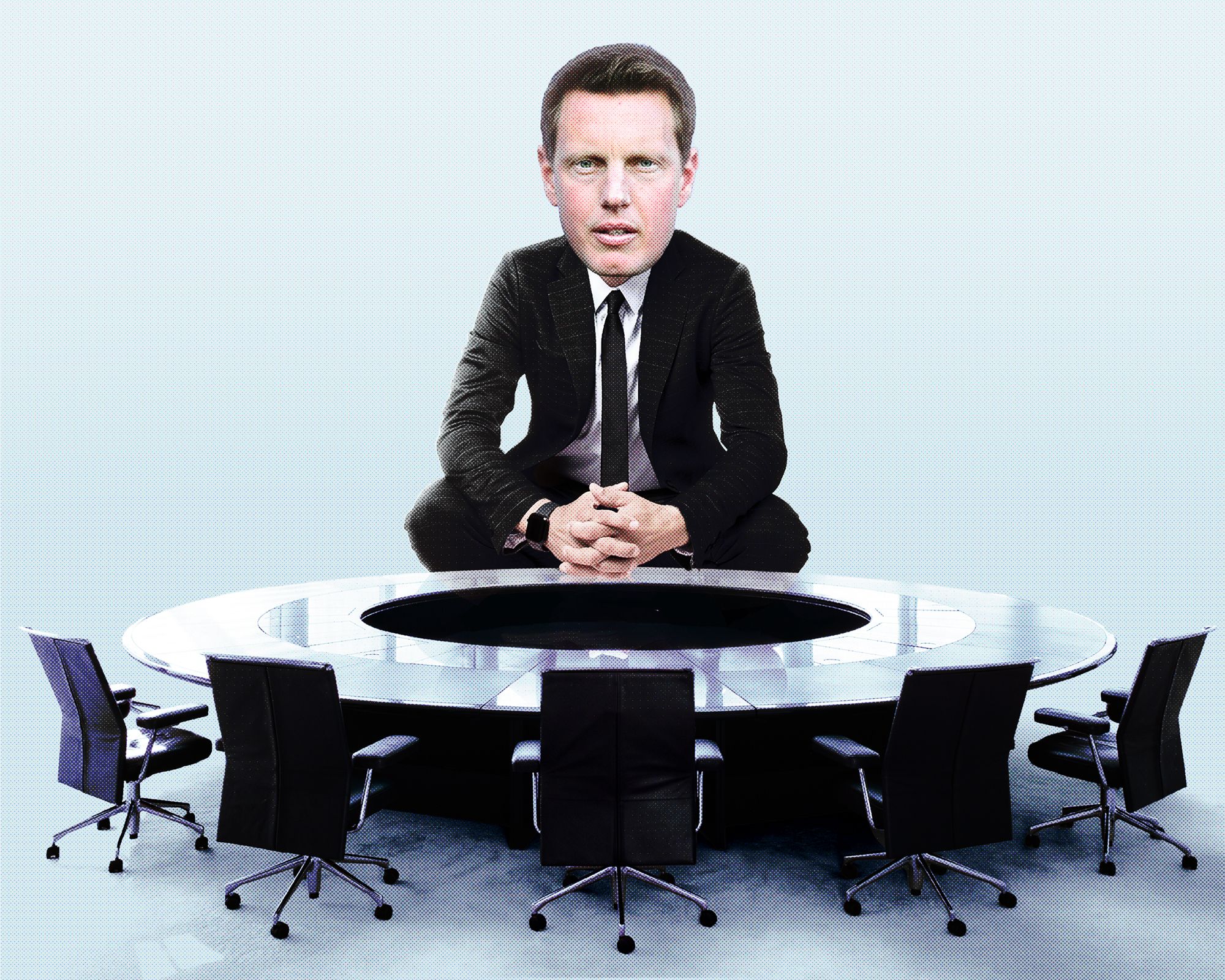
Skydance chairman David Ellison is looking for five widely respected journalists to serve on a new independent editorial oversight board at CNN and CBS News—a watchdog panel he agreed to create only under the pressure of an antitrust lawsuit that threatened to blow up his deal to acquire Warner Bros. Discovery. Moreover, the board has been tasked with keeping the media mogul from meddling in his own newsrooms.
The trick will be finding five journalists who command respect across the political spectrum—and are willing to stake their reputations on an oversight panel appointed by the very executives they’re supposed to keep in check. The board’s five members must be current or former journalists with at least 10 years of experience and no more than two appointees can share a political affiliation. The partisan provision was included to create the appearance of political balance but several veteran journalists say it will ultimately act as a deterrent because it’s not easy to find journalists who openly declare allegiances to political parties.
“A lot of journalists are going to be extremely uncomfortable, probably to the point of declining to participate, to be identified with a political party in terms of their appointment,” Dick Tofel, the former president of ProPublica, tells Vanity Fair.
Little has been made public yet about what this board will look like, or how its members will be selected. For this story, Vanity Fair spoke with journalism veterans and industry insiders, including former leaders of major national news organizations, about who they think might be asked to serve on the board—and whether it will have any real power. One former editor-in-chief of a legacy national newspaper says he heard that Charles Forelle, a former Wall Street Journal reporter now working under Bari Weiss at CBS News, is the person burdened with the unenviable assignment of finding board members. They say they heard Forelle has been speaking with candidates. Skydance has until April 4, 2027, to make its board appointments. Forelle did not initially respond to a request for comment sent via LinkedIn. He reached out after publication to deny his involvement in recruiting members for the board. “Absolutely false!” Forelle wrote in a text message to VF. “Alas your former legacy editor-in-chief is misinformed.” If one of Weiss’s deputies was seen influencing the board’s recruitment, it could immediately taint its public perception.
A former cable news president familiar with the companies tells VF that likely recruits are old-school media executives eager to get back in the game. They said the board seat offers more in terms of status than authority, and journalists who already have significant influence and editorial power are unlikely to be enticed.
Some of the names being floated include former NBC News chairman Andrew Lack; veteran news producer Jim Bell, who is currently the senior vice president of media for the LA28 Olympic and Paralympic Games; tech journalist Kara Swisher; and former CNN chairman Walter Isaacson—though there is no indication any of those people have been approached yet. Swisher, one person suggested, is probably too outspoken to accept a position with so little power although they say her presence would give the board some credibility considering her public criticism of the Ellisons and CBS News. Isaacson, Swisher, Bell, and Lack did not respond to VF’s request for comment.
The board was a condition of the settlement with state attorneys general that cleared the way for Skydance’s acquisition of CNN’s previous parent company. The idea was to put some distance between Ellison’s (or Weiss’) personal politics and the journalism produced by CNN.
“It matters not who gets on this board because it’s completely performative,” says the former cable news president who spoke with Vanity Fair on background.
“I wouldn’t advise anyone I respect to be part of it,” says Dan Gillmor, cofounder of the News Co/Lab at Arizona State University’s Walter Cronkite School of Journalism and Mass Communication.
Tofel, who says he has not been approached about serving, calls the partisan requirement a fundamental flaw in the board’s design. He pointed to his own experience as a resident of New York, where voters generally have to register with a political party to participate in primary elections. Although he is enrolled in a party, he doesn’t consider his political affiliation central to his professional identity. However, party registration could be used by Skydance during the recruitment process as a measure of a journalist’s partisan slant. Journalists who live in open-primary states likely wouldn’t face that problem.
“I would not want to be appointed as a partisan to a board like this because I think that completely misunderstands the role of independent journalism,” he says.
Seth Stern, director of advocacy at the Freedom of the Press Foundation, is equally skeptical. He predicted that the political requirements, combined with concerns about Ellison’s stewardship of CBS News, would discourage many qualified candidates.
A lack of qualified candidates doesn’t serve either of the parties involved in the settlement well. For Ellison and Skydance, there could actually be some financial benefits derived from appointing a widely respected board. “They want to signal to their advertisers, to their commercial partners, that they’re not meddling, and that they’re respecting the integrity of the news organization,” says Marcus W. Brauchli, a former managing editor of The Wall Street Journal and executive editor of The Washington Post.
Several people VF talked to said another issue is that the attorneys general have created a mechanism that could invite future government interference in journalism. The AGs who brought the suit against Skydance were particularly worried that CNN could follow CBS News down a more conservative path. After taking control of CBS, Ellison installed Weiss, the former New York Times opinion journalist and founder of The Free Press, to shake things up. And she certainly has, drawing criticism for her editorial interventions and raising concerns that her politics are shaping the network’s journalism. But still, several industry insiders don’t believe those concerns justify government intervention.
“The answer to Trump meddling in the news is not for attorneys general to meddle in the news,” Stern says. “It’s for the government to stay out of the news altogether.”
Even Connecticut attorney general William Tong wasn’t particularly happy with the settlement and he was one of the architects of the antitrust lawsuit against Skydance’s acquisition of Warner Bros. Discovery. He tells Vanity Fair that the oversight board was a compromise, and not one he’s eager to celebrate. He also says he wasn’t pleased with the partisan-balance requirement.
“What I wanted to see was a full divestiture of both CNN and CBS News,” Tong says. “I wanted to see them both spun out, and I wanted to see them stand alone. What we ended up with was less than that.”
Tofel suggests that Skydance should renegotiate the provision with the attorneys general, replacing it with a commitment to diversity of viewpoints and professional experience.
And for what it’s worth, Tong says he plans to scrutinize the appointments and keep an eye on whether the company respects the panel’s independence. If Skydance fails to honor its obligations, he warned, the states can return to court.
This article has been updated.
-
Erika Kirk Doesn’t Really Want to Talk Politics. So How’s She Going to Lead Turning Point USA?
-
A Deep Dive Into How Larry Ellison Built His Influence
-
Making the Elizabeth Holmes Doc Fried Nathan Fielder’s and Lance Oppenheim’s Brains
-
“History Will Judge”: Fox News Anchor Bret Baier on Donald Trump and Pete Hegseth’s War With the Press
-
Inside Lane Kiffin’s Trash-Talking, “Joey Freshwater” Era With Nick Saban at Alabama
-
From the Archive: Inside Elizabeth Holmes’s Chilling Final Months at Theranos
