



 9 min read
FOR OVER A decade, the high point of martial arts cinema has been The Raid. As such, the stars of those films, Iko Uwais and Yayan Ruhian, have become crossover stars. Even if you don’t know their names, you’ve likely identified them as the faces of Indonesian action; they’ve even appeared together in blockbuster films like Star Wars: The Force Awakens. There is, however, a third face of Indonesian action you should be familiar with, and his name is Joe Taslim.
After a decades-long career as a judo champion in Indonesia, Taslim finally pursued his dream of acting, landing a small part in the first Raid film. He kept working his way up, eventually landing a lead role in The Night Comes For Us, the 2018 face-melter from prolific director Timo Tjahjanto.
From there, Taslim hit the ground running, landing a starring role in the cult-favorite TV show Warrior, making appearances in Hollywood productions, and stepping into a villainous turn in the Korean period action film The Swordsman. In 2021, his face became familiar to mainstream audiences when he was cast as the iconic Mortal Kombat character Sub-Zero. Getting to showcase his gifts on a major stage, Taslim was a perfect fit for the blue ninja. In Mortal Kombat II, which came out earlier this year, Taslim evolved from Sub-Zero to another of the franchise’s iconic characters: Noob Saibot, a demon resurrected in hell. Yes, the lore goes deep for a game comprised of punches and kicks.

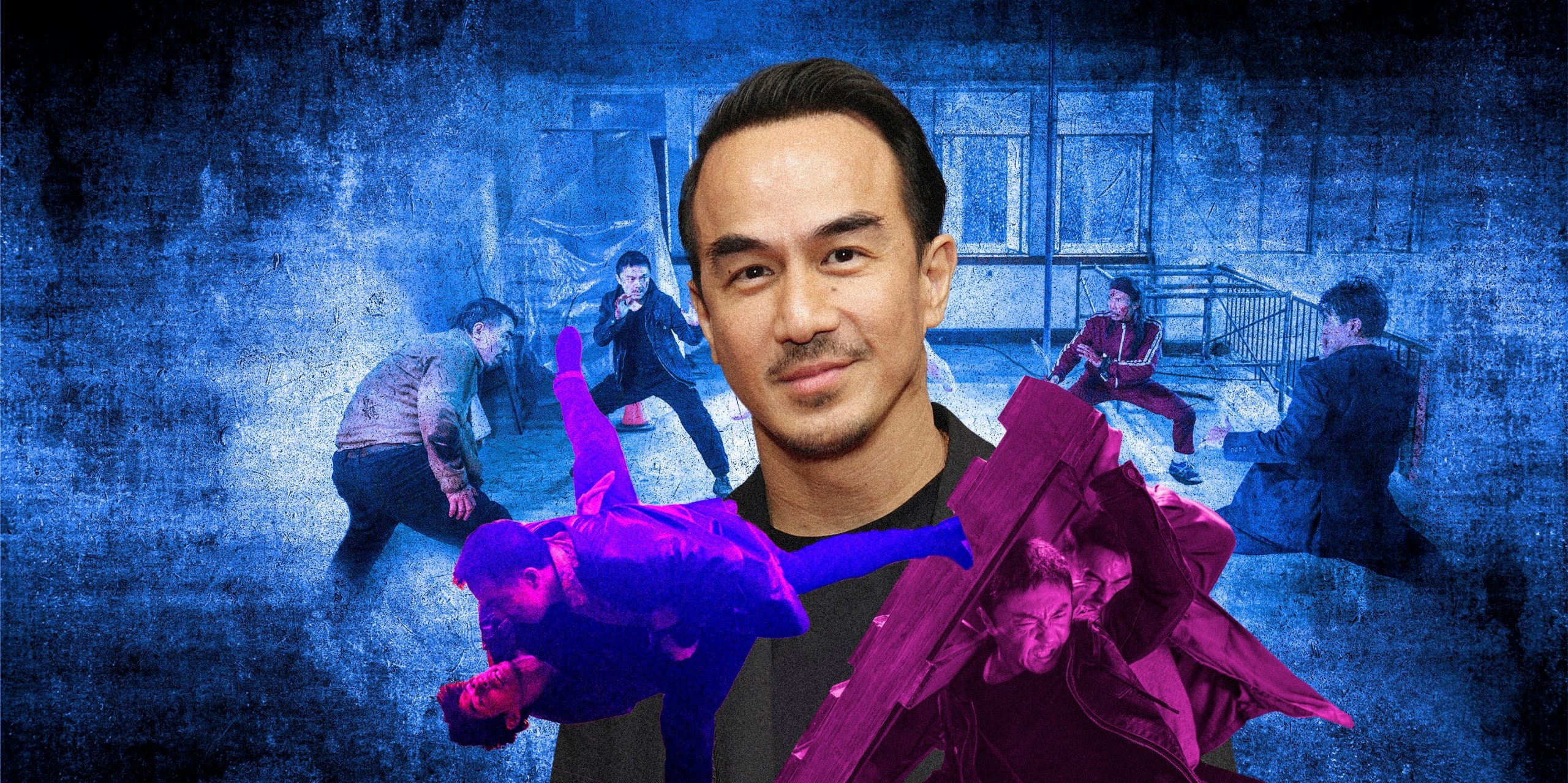
Taslim gets his meatiest role yet in Kenji Tanigaki’s The Furious. Premiering at TIFF to thunderous reactions last year, the film recently hit theaters to even louder cheers. It follows a father (Hong Kong legend Xie Miao) searching for his abducted daughter; he eventually crosses paths with an undercover journalist played by Taslim, searching for his missing wife. Their journey takes them into an underground child trafficking ring and, as such, leads to fight after fight with a wild cast of characters, including Ruhian and Brian Le (Everything Everywhere All at Once).
Through Tanigaki’s Hong Kong-inspired filmmaking and Japanese choreographer Kensuke Sonomura’s fight design, The Furious represents the next step in fight film evolution. That’s not an exaggeration—you’ve never seen anything like the fights in this film. We’re talking sequences that depict an astonishing collision of bodies that stack, twist, and roll against one another. For his part, Taslim’s judo background is on full display as he throws goons with abandon, constantly grabbing and flinging them around; it’s part of what makes The Furious so compelling. His acting is excellent in the movie as well, playing a tortured soul with a wry smile, a delightful change of flavor next to Xie Miao’s mute, purpose-driven father.
Before The Furious swept action fans into a fervor, Taslim sat down with Men’s Health to talk about his journey into acting, how intuition guides him, playing icons, and the differences between Hollywood and Asia.
MEN’S HEALTH: You’ve been a part of so many watershed moments in modern action. How do you pick your projects?
JOE TASLIM: I was an athlete for twenty years before becoming an actor. When I pivoted, I was still young, but I had a strategy. I picked Gareth [Evans]. He didn’t pick me. I watched his first film, Merantau, and was like, “If I someday become an actor and do action movies, I need to know who I’m going to work with.” That’s something I subconsciously planned in my head.
So I texted Gareth, and I begged him to give me a chance to audition for The Raid. He was like, “Who is this guy?” I said, “Give me a chance. Give me one audition, and if you don’t like me, then it’s fine.” We didn’t know each other back then—I was just a crazy young guy who was so hungry to do something and try to challenge myself. We did the audition, and he liked me. I got the part, and The Raid changed my life entirely.
From there, it was the same thing. Subconsciously, on any project, I always ask myself, “Are they the right people? Am I going to be able to surrender and give 100% for them? Is it going to be worth it?” If the answer is “No” or even 50/50, I didn’t do it.
MH: You come from a judo background. When Kenji and Kensuke Sonomura are building out and choreographing the film, how often are you able to step in and say, “I wouldn’t throw him that way, I’d do it this way”?
JT: The process, for me, is you either trust your director 100 percent, or you don’t. Of course, conversations happen in between takes where you might question things. First, they design choreography and present it to you. Then, as an actor, you jump into that choreography, and learn the structure of it. You point at certain parts and might say, “I need a moment here, because my character is not strong. After that, what happens? He got injured. I don’t think he gets up straight away. It doesn’t make any sense.” Action designers design without thinking about the logic of the character doing it.
As an actor, that’s on you. You see the diagram. You put the idea into your head: “If I’m winning, it means there’s motivation inside that drives me. I’m confident. But if I’m losing, am I going to die?” I used to fight. There were a lot of fights that I knew I was going to lose before I lost. That’s the beautiful thing: I experienced that in life. There are a lot of fights, even halfway through, where I knew I was going to win. You can feel it.
When you’re fighting someone, you can feel it. Because I experienced that, I put that in my performances, and it makes it feel alive. The performance is inside the fight without you having to say lines. People can’t just think “That’s cool.” They have to watch it and think, “I’m feeling something, but I don’t know why.” Great action scenes are supposed to be that way.
When you’re fighting someone, you can feel it. Because I experienced that, I put that in my performances, and it makes it feel alive.
MH: You mentioned being a competitive fighter. When was the moment you put that aside and said to yourself, “I want to become an actor”?
JT: I wanted to do this since I was a kid, but my father put me on a different path. My two brothers and I were first forced to be athletes, because my father wanted us to carry the flag, for the family, for the country, etc. The whole time, I wanted to become an actor. I watched a lot of great films with actors who inspired me. When I was a kid, I remember watching The Godfather Part II and saying to myself, “I want to do this.”
There’s a scene of Al Pacino and his wife in The Godfather Part II. I don’t remember the context; there’s no specific scene that really triggered me, but his performance mesmerized me. I was in awe. I was so young back then, and I was like, “I want to do this.” My father always said, though, “No, you’ve got to train three times a day, and you’ve got to win that competition.” I did that for my father. I fell in love with that life during the process. Then I joined the national team, and then I retired. After my father passed away in 2003, I told my mom, “Mom, I did it for my country. I did it for you. I did it for Dad. I did it for myself. It’s time for me to do things I’ve really wanted to do since I was a kid.” That’s when I started auditioning.
MH: When you approach something like the astonishing five-person fight at the end of The Furious, what’s that like, having to meld your background in judo with Xie Miao’s in wushu or Yayan Ruhian’s in silat or Joe Iwanaga’s in tae kwon do?
JT: It was a lot of work, but we built beautiful chemistry. The final fight happened at the end of the shoot, so throughout the shooting process, we became friends. We had dinner, hung out, and had tons of training sessions. We became like a band of brothers. The chemistry was already so strong, but it was still hard because the fight choreography is so complex. Even though we’re close, we have to measure how fast Brian’s going to respond to this or that. At the same time, how fast Xie Miao is going to do his next move, and how fast Joey is going to do his kick after I do that. When is Yayan going to slash his dagger?
We have to calculate every second while doing long takes, because Kenji doesn’t like to cut. Kenji’s going to let you fight and tell the story. We cut if there’s a storytelling purpose, rather than “Oh, our actor is tired, cut the fight into four, let them rest.” The first week, it was hard to find the synergy. I had to fight and then understand we’re fighting in the same rhythm. Once we found it, it was magical. It was like, “Okay, I feel you. I know you can feel me. Let’s dance.”

MH: You’ve worked with Indonesian stunt teams. You’ve worked in Hollywood. In The Furious, you’re working with Kenji, who comes from a Hong Kong background, and Kensuke Sonomura, who comes from a Japanese background, but you’re all working with a Thai stunt team. Can you tell me a bit about those differences?
JT: Before The Raid, for action movies, the mecca was Hong Kong. At one point, the action in Korea grew so much that it was then equally good. Now we see Hong Kong still evolving, and at the same time, the level of action in other countries is also growing so fast. It’s not like Hollywood can’t do it. I think Hollywood can do it, but Hollywood has restrictions, rules, and safety, which are higher compared to other countries. I remember in a Hollywood project, I had to fight on a higher platform. I knew if I fell, nothing would happen to me. If that was shot in Asia, we might not wire people. [Laughs]
In Hollywood, safety is a priority, which I think is great. I believe that it should be. It’s just very hard to find the balance. In Hollywood, they had to wire my waist, and I said, “But if you wire me, I can’t move. How am I going to build a fight—every time I want to look forward, this wire will pull me back.” But it is what it is. If something happens to you, people will lose their jobs. Then for me, like, “Oh, okay, wire me. I don’t want people to lose a job because of me.”
I don’t see one as bad, and one as good. It’s just two different worlds, and then, probably someday, there will be a balance. In Hong Kong, safety is still there, but it’s more relaxed because we understand that in order to achieve good action scenes, good fight scenes, it’s impossible to not get hurt. Whether I work in Korea, Hong Kong, or Indonesia, the theory is that pain is part of the game, because you need that pain to act. If your character’s going to get hit and fall and roll on the floor, I think you’ve got to do it. Then once you do it, it gives you a performance that feels natural, because that happened to you. So it can be a good thing.
MH: This has become something I ask of anyone who does action, but how do you come down from something like this? I can’t imagine it’s easy.
JT: I don’t. [Laughs] Usually, for me, if there’s a three-month shooting process, my mind never stops processing. I’ve been a sleepwalker since I was a kid, and I talk when I sleep. So my wife knows everything. [Laughs]
During those three months, my mind doesn’t stop processing, cooking that character; what’s going to happen, what I’m going to do, everything, until we wrap. Physically, it was draining, but at the same time, mentally, it’s draining too. It never really stops until we wrap the project, and then you’re like, “Ah, it’s done.” Then you channel it somewhere else. That’s why I love gaming. I’m a gamer. For me, when I go to that world, I can just disappear.
MH: As a gamer, did you love Mortal Kombat?
JT: Oh yeah. I grew up playing it. It was pretty amazing. The universe planned for me to play Sub-Zero. I mean, I’m not from the U.S. I’m not even from the capital of Indonesia. Many people don’t even know what Indonesia is. So, being born in South Sumatra, and then getting the chance to play that iconic character I used to play as when I was a kid? The universe had to plan for that. Because mathematically, I don’t see the calculation where I could play that character.
MH: I mean, you’ve played two! Sub-Zero and Noob Saibot. That’s pretty astonishing.
JT: It’s insane. When I was playing it when I was younger, I was like, “This is the character that’s impossible to kill, impossible to beat. Whoever chooses this character is cheating.” I told my friends, “Don’t pick Noob. It’s not fair because it’s impossible to beat Noob.” Then I played Noob in a movie. I’m blessed.

Brandon Streussnig is a freelance film journalist in New York City with bylines in Vulture, GQ, Inverse, Fangoria and more. He is the creator of the annual Vulture Stunt Awards celebrating the best in cinematic stunt work.
