


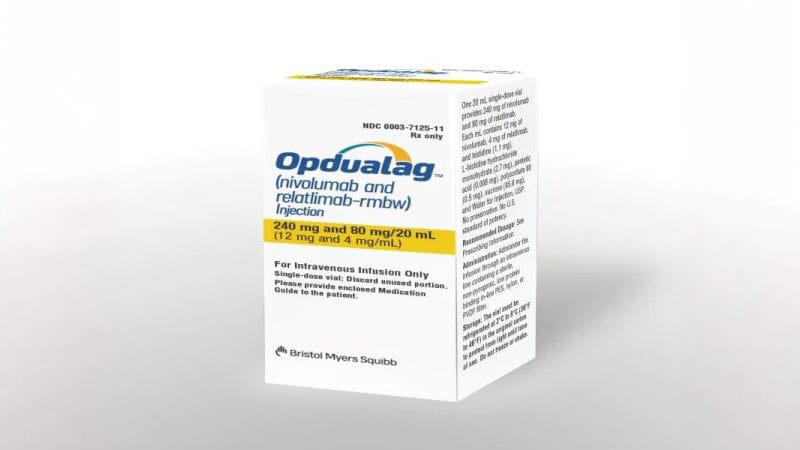
The European Medicines Agency’s (EMA) Committee for Medicinal Products for Human Use has said no to an application to extend the use of Opdualag (nivolumab/relatlimab, Bristol Myers Squibb) to the treatment of advanced melanoma with PD-L1 levels higher than 1%.
Opdualag is currently authorised as a first-line treatment for melanoma that has spread or cannot be surgically removed in patients 12 years and older whose cancer cells produce low levels (< 1%) of PD-L1.
The EMA concluded that trial data analyses were not sufficient to show a beneficial effect of Opdualag in patients with higher PD-L1 levels. But it agreed that relevant data submitted with the application can be included in the medicine’s product information.
Combination Treatment More Effective
Opdualag contains the monoclonal antibodies nivolumab and relatlimab and is administered intravenously over 30 minutes once every 4 weeks.
Nivolumab attaches to PD-1 receptors on T cells, protecting them from being switched off by the cancer-produced PD-L1 and PD-L2 proteins so they can kill the tumor cells.
Relatlimab attaches to and blocks the LAG-3 receptor, which is involved in reducing the immune response. This activates more T cells and increases their ability to attack and kill cancer cells.
Nivolumab and relatlimab in combination are more effective at killing cancer cells than either one of them alone.
The most common side effects with Opdualag include tiredness, pain in muscles and bones, rash, joint pain, diarrhoea, itching, headache, nausea, cough, and reduced appetite. Hypothyroidism, abdominal pain, vitiligo, fever, urinary tract infection, and dyspnea may also occur.
More serious side effects include adrenal insufficiency, anemia, colitis, and myocarditis.
The initial authorisation of Opdualag was based on the RELATIVITY-047 trial, a study involving 714 patients with previously untreated advanced melanoma who received either Opdualag or nivolumab alone. The researchers found that patients whose cancer produced a low level of PD-L1 and were treated with Opdualag had a median progression-free survival of 10.1 months, compared with 4.6 months for those who only received nivolumab.
Although there are more side effects with Opdualag than with nivolumab alone, the benefits in delaying disease progression outweighed the risks in these patients, the EMA said, and thus it recommended authorizing the medicine in the EU.
Opdualag is expected to work in advanced melanoma with PD-L1 levels > 1% in the same way as it does with lower levels. However, at the time of the initial authorisation, the EMA concluded that the data did not show the drug had a benefit in people with tumour PD-L1 levels of 1% or higher.
The company provided 5-year follow-up data to support the extended use of Opdualag, but the EMA said that the analysis was only exploratory and not designed to address the main study question. Therefore, it said it “could not be relied on” to support the treatment’s extended use. The EMA added that since Opdualag is less tolerated than nivolumab alone, the benefits of the medicine did not outweigh its risks in this patient population.
Rob Hicks is a retired National Health Service doctor. A well-known TV and radio broadcaster, he has written several books and has regularly contributed to national newspapers, magazines, and online publications. He is based in the United Kingdom.
