


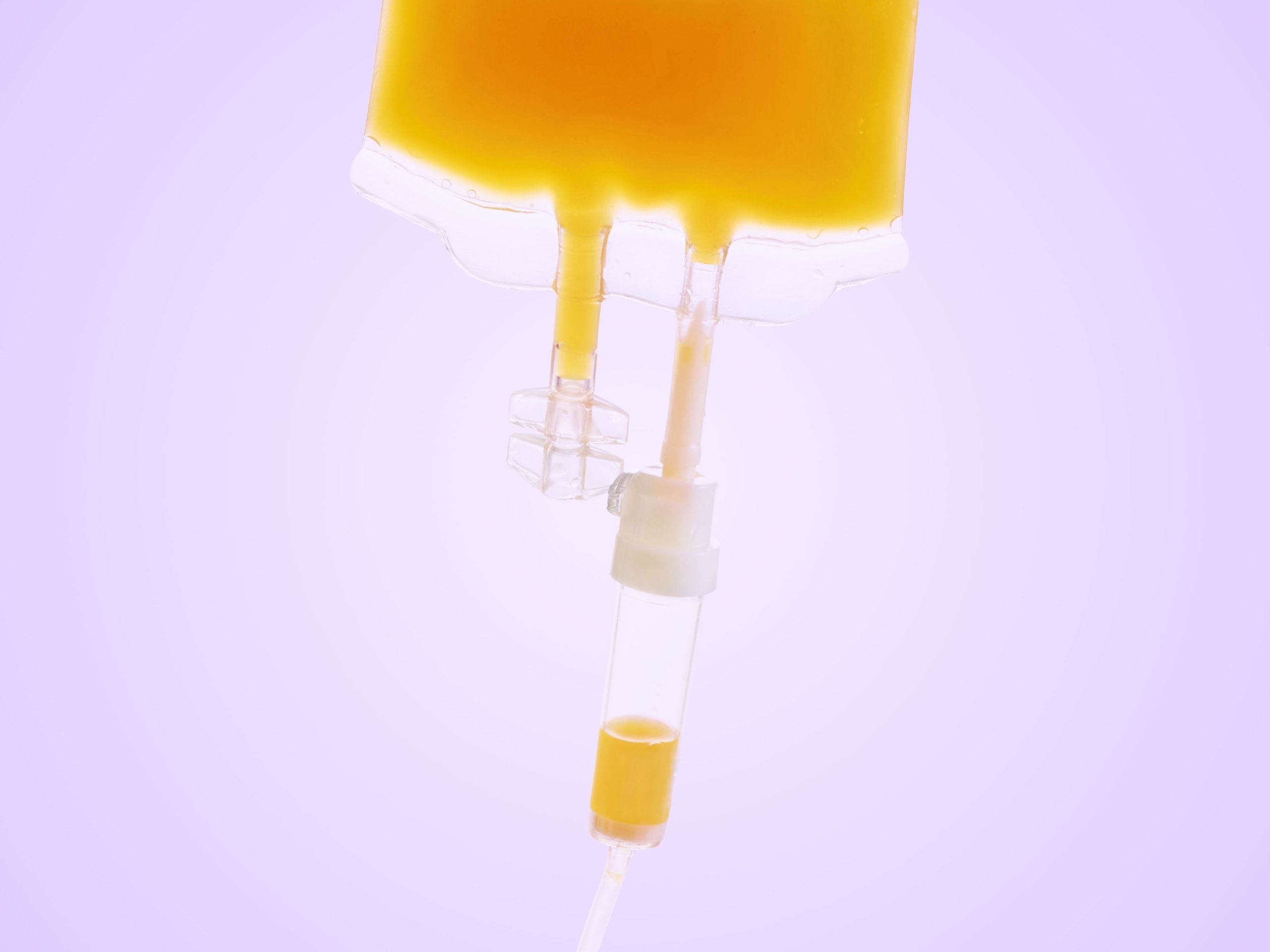
Discovering the fountain of youth is an age-old pursuit (pun not intended). One of the latest clock-reversing experiments causing a buzz is a technique called therapeutic plasma exchange, a procedure that filters and replaces the liquid portion of your blood. A 2025 study in Aging Cell suggests the technique could lower biological age by two and a half years.
But before you start googling “plasma clinics near me,” it’s important to look past the headlines to what the study’s saying, and what it means—and doesn’t mean—about new plasma as an anti-aging elixir.
Why longevity experts care about plasma
Plasma is more than just the liquid that surrounds the red and white blood cells in your bloodstream. Although it’s mostly water, it’s also rich in proteins, metabolites, hormones, and inflammatory signals—molecules that reflect and influence what’s happening across your organ systems, Andrea Maier, MD, PhD, geriatrician and board member of the Academy for Health and Lifespan Research, tells SELF.
“It’s a transport system like DHL, a vehicle to bring things from your brain to your muscles, from kidney to lungs, and so on. So it’s fluid with lots of information,” she says.
This makes it a smart focal point for longevity studies because it can capture a wide-angle view of your body’s internal state, also sometimes called your “biological age.” By measuring changes in the levels of thousands of circulating proteins in your plasma, you can get some sense of how well you’re functioning.
What that means is you may be 40, but your biology acts more like that of a 30-year-old—or a 50-year-old. It’s not a fixed or precise measurement, but it’s helpful health information, Keenan Walker, PhD, senior investigator at the National Institute on Aging, tells SELF.
“There’s no one biological age, but people try to estimate it,” he says. “And what studies have found is that people whose biological age is older than their chronological age are at greater risk for chronic conditions, diseases, and mortality.”
About 15 years ago, researchers started exploring the connection between plasma and the aging process. This led to experiments using a process called parabiosis, a surgical technique that links together the circulatory systems of two different organisms. In studies, researchers would stitch together the systems of old mice and young mice, with the hypothesis that if you circulated younger plasma in an older organism, the older organism’s body would reap the benefits.
And the studies did show that. Older mice who received the plasma of younger mice had more resilience to tissue and organ stress. This led to the development of using plasma exchange as a way to treat certain autoimmune diseases, neurological disorders, and blood cancers.
“So everything really came out of that question: Is there something in our circulation we could get rid of or infuse into it to be able to live longer?” says Dr. Maier. But there’s not a definitive answer to that question—yet.
The study has potential, but it’s not a panacea, experts say.
In the Aging Cell study, researchers enrolled 42 people and exchanged their plasma with purified albumin (a blood protein) and saline. Some participants also got a type of immune therapy called IVIG added in. Researchers measured changes in their bodies with advanced lab tests that track aging at the molecular level.
At first glance, the results look significant: Some people in the study reduced their biological age by roughly 2.5 years. But Dr. Maier points out that this data comes from the middle of the study, not the end.
“If you are digging a little bit deeper, this ‘2.5 years younger’ is comparing people at midterm to the baseline, not at the end of the study and the baseline. At the end, the effect was nearly gone,” she says.
Part of the reason for this, says Dr. Maier, is you overwhelm your body when you take all its plasma out and reintroduce different plasma. The influx of young cells can produce a shift in your biological age, but then your body starts experiencing stress as it adapts to this major change, and your biomarkers swing back to what they were before. In other words, you may get some rejuvenation in the short-term, but it’s temporary.
Another noteworthy detail about the study was the health of the participants, says Dr. Walker. “Those who were less healthy saw a stronger intervention effect,” he says. “So I think it’ll be important to find out for whom this works.”
As a concept, both Drs. Maier and Walker see some promise in blood-based interventions for improving overall health but hope to see a more personalized approach rather than a generalized non-specific plasma filtering process.
“I would call this a phase 1 study,” says Dr. Maier. “We’ve basically learned that we can safely do it, and now we have to see it in much bigger studies and look at the long-term effect. It’s not a crazy idea. It’s absolutely grounded in lots of evidence, but not for everybody. It needs to be more precise. The future is great in our field, and this is the first tiny step, but we should absolutely not implement it now in clinical practice because it is so rough on the body. I love innovation, and I love this study, but I think the future will give something else.”
Related:
- Incline Walking vs. Running: What’s the Better Workout?
- After Losing My Son, I Didn’t Want to Be ‘Strong’
- Everyone Wants This Unapproved Weight-Loss Drug—And Some Have Found a Way to Get It
Get more of SELF’s great fitness and nutrition reporting delivered right to your inbox (for free!).
