


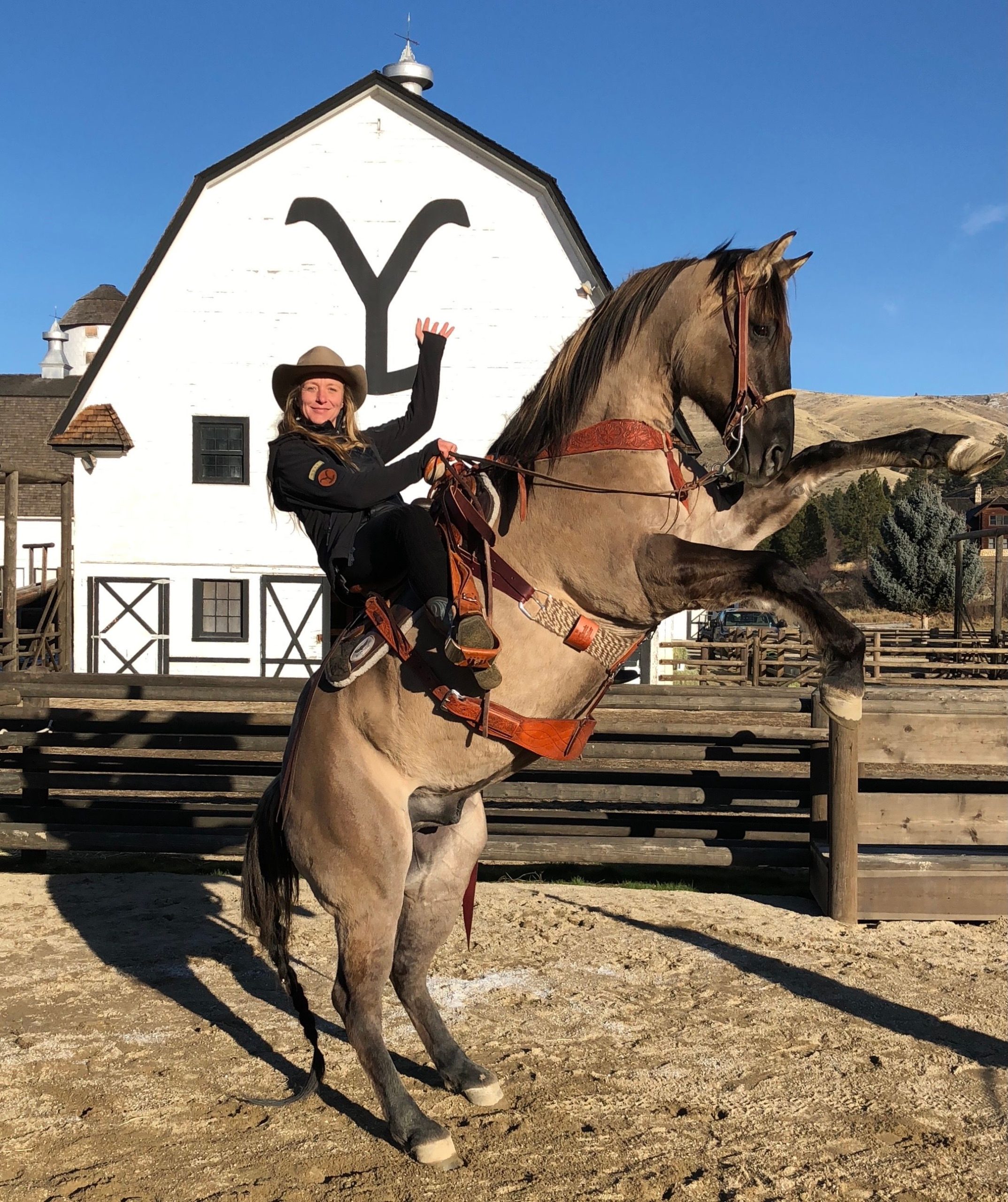
If you’ve been watching The Madison, then you’ve probably noticed Christina Alexandra Voros’s name by now. As the director of every episode in seasons one and two, as well as the director of photography on the picturesque series, she has worked in tandem with creator Taylor Sheridan to bring the story of the multigenerational Clyburn family to life.
But Voros’s connection to Sheridan stretches far beyond the Paramount+ show. In 2017 she started as a B-camera operator on Yellowstone, working her way up to executive producer and director. She’s been instrumental to 1883, where she was co-executive producer and director of photography and earned her first Emmy nomination for outstanding cinematography. After wrapping The Madison in December, she’s been working on Yellowstone spin-off The Dutton Ranch. Next up, she’s off to direct and executive-produce Frisco King, a spin-off of Tulsa King.
Her résumé speaks for itself, but it was a journey to get there. Born in Cambridge, Massachusetts, Voros majored in English at Harvard University and hoped to eventually parlay that into a career as an actor in the theater, her first love. But then a friend suggested that she apply to film school. “It seemed crazy because I was not a technical person, nor did I fancy myself as someone who had a need to make decisions,” she says. She did anyway, however, and earned a fellowship to New York University’s Tisch School of the Arts, which she says “completely rerouted my entire creative life.”
While working on a movie in 2012, she met a man from West Texas who worked as an animal coordinator, wrangler, and stuntman. They couldn’t stand each other. Voros thought he was cocky in a slightly mansplain-y way, with very different political ideas than her own. He pegged her as a bleeding-heart liberal hipster from Brooklyn who didn’t know her way around animals. (Turns out, they were both kind of right.) Three years later they were married. Now, 11 years into their marriage, Voros and her husband, Jason Owen, both work in the Sheridan-verse and spend time at their new place in Fort Worth or their other home in Owen’s hometown, about 19 miles from the Mexican border in West Texas. (“It’s a little, bitty one-grocery-store town,” Voros says.) Voros still has her apartment in New York, which she’s been subletting since before the pandemic and hasn’t actually stepped foot in for over six years.

Christina and husband, Jason, on the set of Yellowstone.
Courtesy of Christina Alexandra Voros
Even with the two homes in Texas, Voros and Owen have been spending most of their time on the road for the last seven years (since she started working with Sheridan). “Now I’ve been spending as much time in Montana [for The Madison] as I have been anywhere else,” she says.
If this sounds like a storyline straight out of The Madison, you wouldn’t be entirely wrong. In that series, Michelle Pfeiffer’s cosmopolitan Stacy Clyburn learns to embrace the American West after a tragedy forces her to leave New York City for the Madison River Valley in central Montana. While she may or may not fall in love with a local, it sure seems her daughter, Abby, will. And even though Voros says Sheridan didn’t base the characters on her life, she knew the minute she read the scripts that she was the person to direct the series.
How did Voros—who actually got her first major directing job from Ava DuVernay on Queen Sugar—come to be part of Sheridan’s inner circle? And what does she think about the narrative that Sheridan writes his female characters “as caricatures”? In Voros’s wide-ranging interview with Glamour, she opens up about the criticism, including what the public doesn’t know about Sheridan, and how her own life experience has been instrumental to understanding the fragmented world we now live in.

Christina Voros directing The Madison.
Christopher Saunders/Paramount+
Glamour: Both you and Taylor Sheridan originally wanted to have a career as actors. Have you talked about this with each other?
Christina Alexandra Voros: I don’t even know if he’s aware of that part of my backstory. But it’s something that comes into play a lot when I’m working with actors. I’m always conscious of trying to create a space that allows actors the most space to do their job and how they get into story and character. I’m also grateful for my background in documentary because it taught me so much about letting go of your preconceived notions of what a story might be.
What do you say when people come to you for career advice?
Learning how to trust your gut is very important. It’s a skill I’m still honing and that can mean any manner of things. That can mean not believing someone when they say no. If I had listened to all the nos and really let that get under my skin, I wouldn’t be where I am. I had to trust my gut when I thought the no was in error, but it also means trusting your gut in terms of the kind of people you want to be working with and telling stories with.
And even though my niche now is this sort of muscular Western storytelling style that Taylor embodies, I did a low-budget horror film with Tate Taylor for Blumhouse. I came up doing documentary work that had a real emphasis towards social change. So I’ve kind of morphed from project to project. The thing that has always connected me through it is gravitating toward people who had a similar creative style or synergy, and allowed those people and those relationships to guide my career rather than going, “I got to do this, and then I got to do this, and I got to do this.” My path has been very untraditional.
How so?
I was a camera operator on season one of Yellowstone. I had been a DP [director of photography] prior to that, but not in the mainstream television space. So I went from being a camera operator to a DP the second year, to a director the third year, to a producer the fourth year.
A lot of that is because I found a creative collaborator in Taylor Sheridan who really believed in me. Even before, Ava DuVernay gave me my first episode of directing in television. Tate Taylor gave me my second. I’ve had some really phenomenal creative minds open doors for me and see something in me that maybe I didn’t see in myself. It’s very important to find those people that will not only lift you up, but that you can be of service to their kind of storytelling.
I often hear, “You have to leave your job in order to grow or make more money.” It’s nice to see someone who has climbed the ladder and been given opportunities in the same space. Did you have to fight for every promotion you got, or was it something that Taylor and the team recognized and approached you about?
It was a combination. I think you always have to fight, and you always have to believe that you are deserving of the next place that you want to go. Taylor has always had my back and has been the one kind of tossing me into the deep end from the beginning. That’s not to say that there is not going to be resistance from other people in other places every step of the way. Look, I get it from a studio and a network perspective. It is a very expensive enterprise that we are part of. Why would you take a gamble on someone who’s never done something before, when you could take a safer bet on someone who’s done it a whole lot? So every step of the way, it was always a leap of faith on someone’s part to allow me to jump into the next phase of what I’m doing.
What was your experience like when you started production on Yellowstone?
I started as a camera operator on season one of Yellowstone in 2017. I had never been an operator for another DP. I had come up as a cinematographer and would operate for myself on indie features.
Halfway through that season, I called a mentor of mine and said, “Have I made a mistake? Is this a step backwards?” Because I’d been moving forward as a cinematographer in my own right. She said, “If it’s a mistake, you won’t feel like you’re learning anything. Do you feel like you’re learning something?” And I said, “Every single day.” She goes, “Then it’s not a mistake. You may not know where this is going, but as long as every day you’re showing up on set, you are learning something that makes what you do make more sense to you, then you are in the right place.” She could not have been more right. A month after that, Taylor asked me to come on as a DP of the second season.

Voros directing The Madison.
Christopher Saunders/Paramount+
What was your first impression of Taylor Sheridan?
He’s just a force. He’s smart and funny. He’s a strong, formidable presence. And he was a little bit inscrutable. He was the kind of person that you wanted to try to make laugh because it felt like a challenge, but he’s funny and knows what he wants. If you told me my first couple of weeks of shooting that I would end up directing and producing for him five years later, I never would’ve been able to make that leap in my mind.
And now you’re directing every episode in the first two seasons of The Madison, in addition to being director of photography.
When I got that script, I felt like I’d never read anything I understood more. I’m someone who grew up on the East Coast in Boston and New York, and I didn’t discover the West until I met my husband, who’s an animal coordinator on Taylor’s shows, and really until I started working on Yellowstone.
I had already begun to dabble in the world of Western stories because when I met my husband, I started working on a documentary about young cowgirls, and that was my first time going to Montana. That was my first time going to a rodeo. That had happened prior to my joining on Yellowstone. I was very much an East Coast girl that thought I would never leave New York; in the process of discovering the West, I discovered a great deal about myself and what my preconceived notions had been, who I thought I was, and what I thought was important.
When Taylor sent me the script for The Madison, not only did it resonate as someone who’s gone through the loss of a parent, but also someone who has reinvented what their understanding of their place in the world is based on discovering a landscape I never ever thought I would have a place in.
Do you think he was writing Abby’s story [the character is played by Beau Garrett] with you in mind?
No, I mean, I think there are probably more of those stories than you would think.
Oh, trust me. I’m ready to leave Los Angeles and move to Montana after watching this series. Montana seems lovely. Maybe I’ll meet a cowboy there. [Laughs.]
Yeah. When I met my husband, people who had known me for five years were like, “What are you doing? This is never going to work.” And people who had known me my whole life said, “Actually, this kind of makes sense.”
But no, I don’t think I inspired anything in The Madison. There are things in my life that made me a really good candidate to tell that story. There’s a lot in the Abby storyline that I can relate to. It was funny; my husband was the animal coordinator on the show and was the person giving people riding lessons and working with Kevin [Zegers] and Ben [Schnetzer] as they were finding their characters. I remember having conversations with Ben and Beau, going, “Okay, so when I had this conversation with my husband.…” It’s a very rare thing to be able to tell a story that you feel so connected to.
What was your wedding like, and the merging of families?
We got married in Isla Mujeres, Mexico, in 2015. The script I should write someday as a rom-com is my husband and his cowboy posse from Texas and me and my Brooklyn mafia of artists descend on an island in Mexico and hilarity ensues. It was really a wonderful mash-up of these two very different groups of people that never would be partying on a Mexican island together if we hadn’t decided to get married. It was very much a meeting of two very different worlds. And my marriage has been that. We were recently in New York for the premiere of The Madison, and I brought Jason, my husband. He’d never been to see a Broadway play. We went to do a tasting dinner at Restaurant Daniel. On the flip side, I’ve learned about team ropings and rodeos and shipping cattle. We live on this expansive land out in West Texas. Every winter there are bottled baby goats that are suddenly living in our kitchen. Nothing in my life prepared me for what my world was going to become meeting my husband.
Prior to meeting your husband, had you been wondering when you were going to meet your person? Or what that looked like?
My 30s were a cautionary tale of bad relationship decisions. When I met my husband, it was at a time when I had kind of given up. I was like, “Maybe I’m just not meant to find someone who can weather the unique cadence of my life as an artist and as a strong woman.” I kept running into experiences where my partner would feel sort of resistant toward any big things that were happening for me career-wise. When I met Jason, I was shooting a movie for James Franco, and a lot of it took place in a wagon pulled by a team of mules. Jason was the wrangler and the blind driver of those mules in that movie. And we couldn’t stand each other when we first met. I thought he was a really kind of cocky, I don’t know, slightly mansplain-y West Texas cowboy with very different political ideas than my own.
He thought I was kind of a bleeding-heart liberal hipster from Brooklyn who didn’t understand her way around animals. I think we were both right. But over the course of making that show, we became friends and then more than friends. I don’t think either of us ever thought our showmance, as they call it, had legs, but it did. We met in 2012 and got married in 2015. We’ve been very lucky over the last five years to be working together a lot, both with Taylor but also, when I was doing work for Tate Taylor, Jason was an animal coordinator on movies that he was doing. We’re sort of a circus family. We pack up the dogs and the horses, and travel around and work together. It’s kind of a dream come true.

Christina and husband, Jason, on the set of 1883.
Courtesy of Christina Alexandra Voros
I need you to write a rom-com.
There’s a lot of material there. I remember Jason came to New York for Thanksgiving the first year we were dating, and I looked across the room, and he was talking to my mom. She was laughing so hard. I asked her later, “What were you talking about? Why were you laughing so hard?” She was like, “He said he’s going to move you to Texas.” And then my mom moved to Fort Worth two years ago. I convinced her to move here. She lives a mile away from us.
Does your mom watch the animals if you guys are traveling?
We’ve got a couple of dogs that will sometimes stay at her place when we’re traveling, but she lived with us during the pandemic. She came out to West Texas and stayed with us. We had a baby goat that winter that the mom rejected and was living in the house. And so she became the caretaker of this goat. It was very Green Acres. My mom is very elegant, lived on the Upper East Side for a long time, worked in finance. She’s a beautiful, brassy, wonderful woman, but not someone you would imagine to be living in a double-wide trailer in the middle of the desert in West Texas bottle feeding a baby goat in a laundry basket. So that chapter of our lives was the best reality show no one was making: my mom in West Texas during COVID.
So your mother is Michelle Pfeiffer’s character, Stacy Clyburn?
A little bit, yeah. I mean, if Stacy Clyburn were a Hungarian immigrant. [Laughs.] It’s funny, some of the press has been negative toward the way Taylor is attacking the coastal elite, and I have a different perspective on it. I was definitely the East Coast girl that showed up in West Texas with ideas of what certain things should or should not be, from cell service to not having…you get spoiled living in a city. Everything you think you need is right there. And the, you move out to a rural community and it’s not.
At first that feels different or tricky or hard to navigate, and then you realize how little it really matters. And so I think there’s a tremendous sense of humor in the way Taylor is portraying that “city mouse versus country mouse” thing that, if you haven’t experienced it, could seem too cynical. I kind of lived it myself, and I think people who are pushing up against it might be taking it a little bit too more seriously than it’s meant to be.

Christina Alexandra Voros.
Courtesy of Christina Alexandra Voros
I remember when I would tell people I loved Landman, and some people would call me crazy because they said the female characters were written from such a stereotypical standpoint, while others would tell me it’s their favorite show and characters. Ainsley and Angela certainly lean into some stereotypes, but I know women like that. There’s also more to them than what’s on the surface.
I also think that good art provokes conversation. It’s been so interesting watching the perspective on The Madison because I feel like 70% of it has been, “God, this resonates so much. Michelle is phenomenal. This story makes sense to me. I recognize myself in this character and this character.” And then 30% of it is railing against the humor or attacking [Taylor’s] writing style. And look, everyone is allowed their opinion. I think the most interesting art in the world provokes very extreme reactions from people, and this seems to be doing that.
There’s a reason these shows resonate so much, and I think it’s because it homes in on what a lot of the country is feeling. It’s not necessarily to the left or to the right, but very center.
I think that we could do well with stories that allow us to be less polarized rather than more polarized. Ultimately, that’s what this is. I’m someone who thought my identity was completely wrapped up in living in New York. I could never imagine myself ejecting from that ecosystem and didn’t see it coming. And I am much happier with the shape of my life and the world that I inhabit now that I have both sides of that as part of my experience. I feel like I understand so much more about this country, about myself. I am a less judgmental person because of it. I don’t think a television show can change the world, but if it gets some people to look at things a little bit differently, it’s a win.
I don’t think Taylor gets enough credit for…yes, a lot of his shows are more of a man-centric universe. And yes, I am the primary female director and producer working in this space. But most of Taylor’s department heads are women. You look at what [production designers] Yvonne Boudreaux and Charisse Cardenas have done in terms of creating his worlds. You look at [costume designers] Janie Bryant and Johnetta Boone. He surrounds himself with strong, talented women. It doesn’t get press because it doesn’t fit people’s whatever narrative they want to write about him.

Voros directing The Madison.
Christopher Saunders/Paramount+
Kurt Russell said something about The Madison being a more female lens than is typical for Taylor. But if you really want to do an in-depth analysis of his writing, he’s always had strong, complicated female characters. For all the flack that the ladies on Landman have gotten, I agree with you. I know women like that, and they are beautiful and love shopping, but they are also strong and complicated and tough, and hold their own in a room full of men or at a dinner table full of men. It’s not doing anyone any favors by pretending to oversimplify characters that are not that simple. I mean, you go back to Beth Dutton.
Yes.
Look at Elsa Dutton. Look at the women of Lioness. Show me another writer that is creating this many stories with this many badass female characters played by actors of this caliber and tell me that Taylor isn’t someone to tell women’s stories.
I feel so inspired by the women that play these characters. Kelly Reilly, I would walk through fire for. Michelle Pfeiffer, I would walk through fire for. I feel so lucky to be able to be any small part of their creative process and bringing these characters to life. It’s a real gift, and I feel very, very lucky to do it. I feel lucky that Taylor trusts me to do it.
The Madison’s first season is now streaming on Paramount+. This interview has been edited for length and clarity.
