


This story is part of ‘My First Job in Fashion‘, interviews with fashion insiders on the roles who made them who they are today.
My first ever job outside my family’s farm was as a carpenter. Every summer, from the age of 10 until I was 16, I worked for a woodworking company that made kitchen furniture. One summer, they put me with two guys building a dining table — one of those extendable ones where you add a leaf in the middle. Every day I went to work and did exactly the same thing: I was the kid helping two men put together the same table, over and over again.
Within a month, the owner had moved the other two onto a different project and left me to make the tables by myself.

A young Renzo Rosso with his father, Vittorio, and mother Fortunata.
Photo: Courtesy of Renzo Rosso
I’ve always had a slightly different way of working; I think a little differently from most people. But I love being part of a team, and I have always looked for people who know the things I don’t. That’s how I worked with John Galliano, for instance. I am not a designer — he is. But we were always in conversation, and together we made Maison Margiela a real success.
I grew up in Brugine, in the countryside not far from Venice, Italy. My parents were farmers, and they wanted at least one of their three children to study. My father decided it should be me. For secondary school, I chose the textile program at the Marconi Technical Institute in Padua — a fashion school — because it was the easiest. I didn’t like studying.
But I loved jeans. Growing up, I wore my brother’s hand-me-downs. Then one day, when I was 12, I saw a pair of jeans at the market and begged my mother to please, please buy them for me. She did, that same day. I felt like a king at school; all the kids admired those jeans. I loved them so much I never took the paper tag off the back pocket. I just wore them to school with the tag on. Something inside me was already calling me to fashion. I just didn’t know it yet.
It was the early 1970s, and you have to understand what that time was like. Kids were really starting to rebel against their parents’ generation. It was the Beatles and the Rolling Stones, marijuana, people throwing away their suits for denim. It was a revolution.

Rosso’s old sewing machine.
Photo: Courtesy of Renzo Rosso
At Marconi, I made my first pair of jeans: low-rise and flared. Then I made more on my mother’s sewing machine and sold them to my friends. That’s also when I had the idea of stone-washing. The denim felt too stiff, so I took a stone and started rubbing the jeans with it to soften them.
Fashion school gave me structure. It taught me patterns, stitching, and how the industry works. But I am not a designer; I am someone with good ideas. I went on to study economics at Ca’ Foscari, the University of Venice, but I dropped out in 1976 to take my first real job in fashion.
A friend told me about an opening at a clothing manufacturer called Moltex. I went in for an interview with the owner, Adriano Goldschmied, and told him two things: that I was qualified for the job, and that I had already done my military service, which was mandatory in Italy at the time. Neither was true. I had never worked in fashion, and I was still waiting for my call-up letter. Thank God, it never came.

Photo: Courtesy of Renzo Rosso
Adriano hired me as production manager at Moltex, which made trousers for one of his brands, Daily Blue. There were 20 girls working there and huge stacks of denim to get through every day. Luckily, I learn fast. Unluckily, I also liked to party — a lot — and sometimes that got in the way. At one point, Adriano wanted to fire me, but his wife told him to give me a second chance because I was clever and had a winner’s attitude. It’s true: even when I lose, I make sure I learn from my mistakes so I win the next time.
Instead of firing me, Adriano changed my pay structure from a fixed salary to a performance-based one to motivate me, and in a single month, my salary went from 240,000 lira ($137) to 2.4 million lira ($1,375). After that, I worked like crazy. But it didn’t last long: a few months later I quit, because I wanted to start my own brand. Adriano didn’t want to let me go, so he proposed we start Diesel together. We did, in 1978.

Rosso with Adriano Goldschmied in Breganze.
Photo: Courtesy of Renzo Rosso
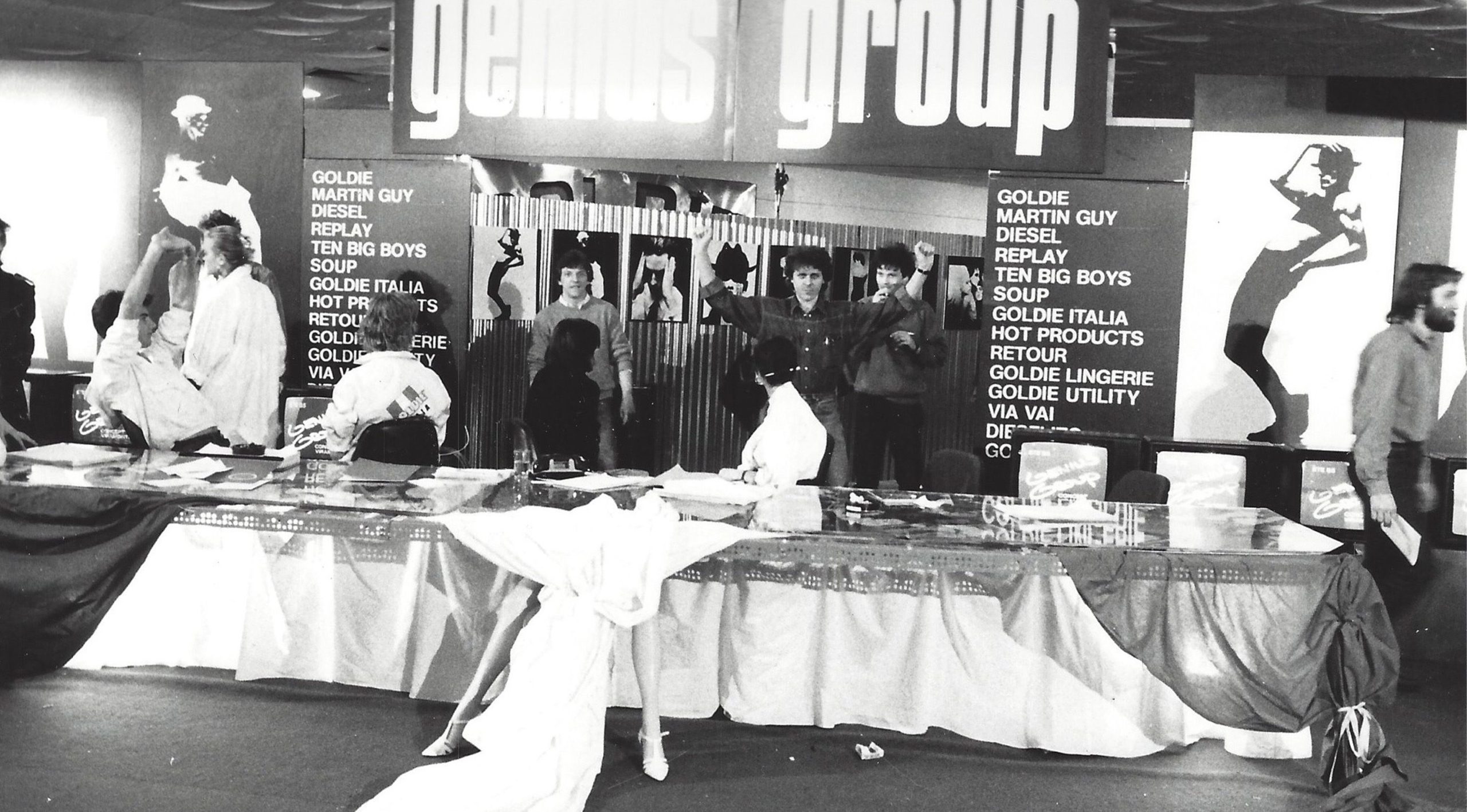
Adriano was very well known in the Italian fashion industry back then, and thanks to him, doors opened for me. I started traveling to trade shows and meeting customers from all over the world — Los Angeles, Helsinki, Stockholm, Berlin, New York, Tokyo. We also bought and launched many other brands, like Replay, King Jeans, Viavai, Hot Product and Martin Guy, and that’s how the Genius Group was born. It was a real education.
I worked day and night on eight different lines, eight different collections. I took care of the product side and made sure everything got delivered, while my partner was in charge of design. Eventually I got tired of working on all those brands, so I sold my stakes in the Genius Group back to Adriano and, in 1985, bought 100% of Diesel.
That’s when I really started doing things my way. It wasn’t easy, but I was so convinced of what Diesel could become that I never gave up. I drove all over Europe with nothing but samples in my bag. Around that time, I also started making jeans from denim scraps. Some stores sent them back, convinced we had made a mistake and shipped them old trousers.

A truck Rosso drove in the early years of Diesel to deliver samples and collections all over Europe.
Photo: Courtesy of Renzo Rosso

The first Diesel HQ in Molvena, Italy.
Photo: Courtesy of Renzo Rosso
It took Italy a while to understand Diesel. The 1980s were the Paninari years, and they all wore the same uniform: puffer jackets and Levi’s. My Italian agents begged me to make the collections more commercial. I refused. That’s why Diesel was always more successful abroad than at home. My first wholesale customers were Fred Segal in Los Angeles, Henry Lehr in New York, Mario’s in Seattle, and Riccardi in Boston.
Diesel was one of the first companies with a truly global mindset. The French thought we were French, the Americans thought we were American, the Germans thought we were German. And so on.

Rosso with Diesel garments.
Photo: Carlo Orsi/ Carlo Orsi Archive
I couldn’t find Italians who understood my way of thinking, so I started hiring people I met on the street, in bars, at Studio 54. Wherever I traveled, if I met someone who matched my philosophy, I brought them to Italy to work with me. People with different backgrounds, different education, different religions — and we all spoke English. That’s why the product was global from day one.

Opening of a Diesel store in Milan in the late ’90s.
Photo: Courtesy of Renzo Rosso

The first Diesel store opened in 1996 in Lexington, New York.
Photo: Courtesy of Renzo Rosso
I could go on for hours. I could talk about the crazy graphic designer I met in London who ended up creating the Diesel “Only the Brave” logo with the metropolitan punk, or the countless campaigns we dreamt up. There’s just so much to cover.
A documentary on the story of my life called Be Brave, directed by Francesco Carrozzini, was recently presented at the Venice International Film Festival, and I have just finished working on my biography written by Simone Marchetti of Vanity Fair Italy. Reading it back reminded me how much I’ve done in my life. I’m proud of it, of course. But what surprises me most is how many people I’ve met along the way. The people are the best part.

Photo: Carlo Orsi/ Carlo Orsi Archive
