


In Paris, an exhibition of Mario Sorrenti’s personal diaries from the 1990s reveals the life, relationships and experiences behind some of fashion photography’s most iconic images. An intimate journey into the world of a photographer who transformed the way we see beauty, desire and sensuality.
During Paris Photo, I visited Mario Sorrenti Diaries, 1991–2000, an exhibition curated by Aaron Stern at LSD, a small gallery on Rue de la Folie Méricourt, in a space that once housed a photographic laboratory. The room was packed, almost overwhelmingly so, and what struck me immediately was the number of young people there. A generation that has grown up with smartphones, accustomed to producing and consuming images at an unprecedented speed, seemed completely fascinated by these handmade books, filled with photographs, Polaroids, contact sheets, handwritten notes, drawings and fragments of a life lived more than thirty years ago.
I found myself wondering what drew them so strongly to these objects. Was it nostalgia for a time they had never experienced? A fascination with the physicality of photography, with the idea that images once existed as tangible things, objects to be touched, collected, cut, pasted and preserved? Or perhaps something more profound: a longing for authenticity, for the traces of real experiences, for a relationship with images that feels increasingly distant from the way we encounter them today?
The more I looked at Mario’s diaries, the more I felt that the answer lay somewhere in that last possibility.

Courtesy of Mario Sorrenti Diaries, LSD Paris

Courtesy of Mario Sorrenti Diaries, LSD Paris
Mario Sorrenti is one of the defining photographers of his generation, an artist whose work has profoundly influenced the visual language of fashion photography since the early 1990s. His contribution to Vogue Italia alone is extraordinary. Over the years, he has created an extensive body of editorials that remain part of the magazine’s visual history, images that helped shape not only the aesthetics of fashion but also the way fashion could communicate desire, intimacy and emotion.
There are photographers whose work you recognize immediately, even before reading the credit. Mario is one of them.
His signature is unmistakable, yet it cannot be reduced to a particular technique or aesthetic formula. There is the extraordinary sensitivity with which he approaches light, whether soft and natural or dramatic and carefully controlled. There is his attention to skin, texture and the physical presence of the body, his ability to move between the immediacy of a seemingly spontaneous photograph and the formal sophistication of an elaborately constructed image.
Above all, there is his particular way of representing sensuality.
Fashion photography has always had a complex relationship with desire, and Mario certainly wasn’t the first photographer to explore intimacy or eroticism. But he brought something distinctly his own to that tradition. In his photographs, sensuality never feels imposed on the subject. It seems to emerge from the relationship between the photographer and the person in front of his camera. Even when an image is provocative, there is often a tenderness, a vulnerability, an emotional proximity that prevents it from becoming merely an exercise in seduction.
His subjects are not simply bodies to be admired; even within fashion’s carefully constructed world, they retain their individuality and interiority. Mario makes us feel that something genuine is taking place within the image.
Perhaps the most famous example remains his photographs of Kate Moss, who was his girlfriend at the time, particularly the images that led to the iconic Calvin Klein Obsession campaign in 1993. Their extraordinary power came not simply from Kate’s beauty or Mario’s photographic talent, but from the genuine intimacy of their relationship. These were not images in which intimacy was staged for the camera. They emerged from an existing emotional connection, from a shared life, before becoming part of the collective visual memory of an era.

Courtesy of Mario Sorrenti Diaries, LSD Paris

Courtesy of Mario Sorrenti Diaries, LSD Paris
And this is where the exhibition in Paris becomes especially revealing.
Rather than presenting the celebrated photographs that established Mario’s reputation, it turns its attention to the world from which those images emerged.
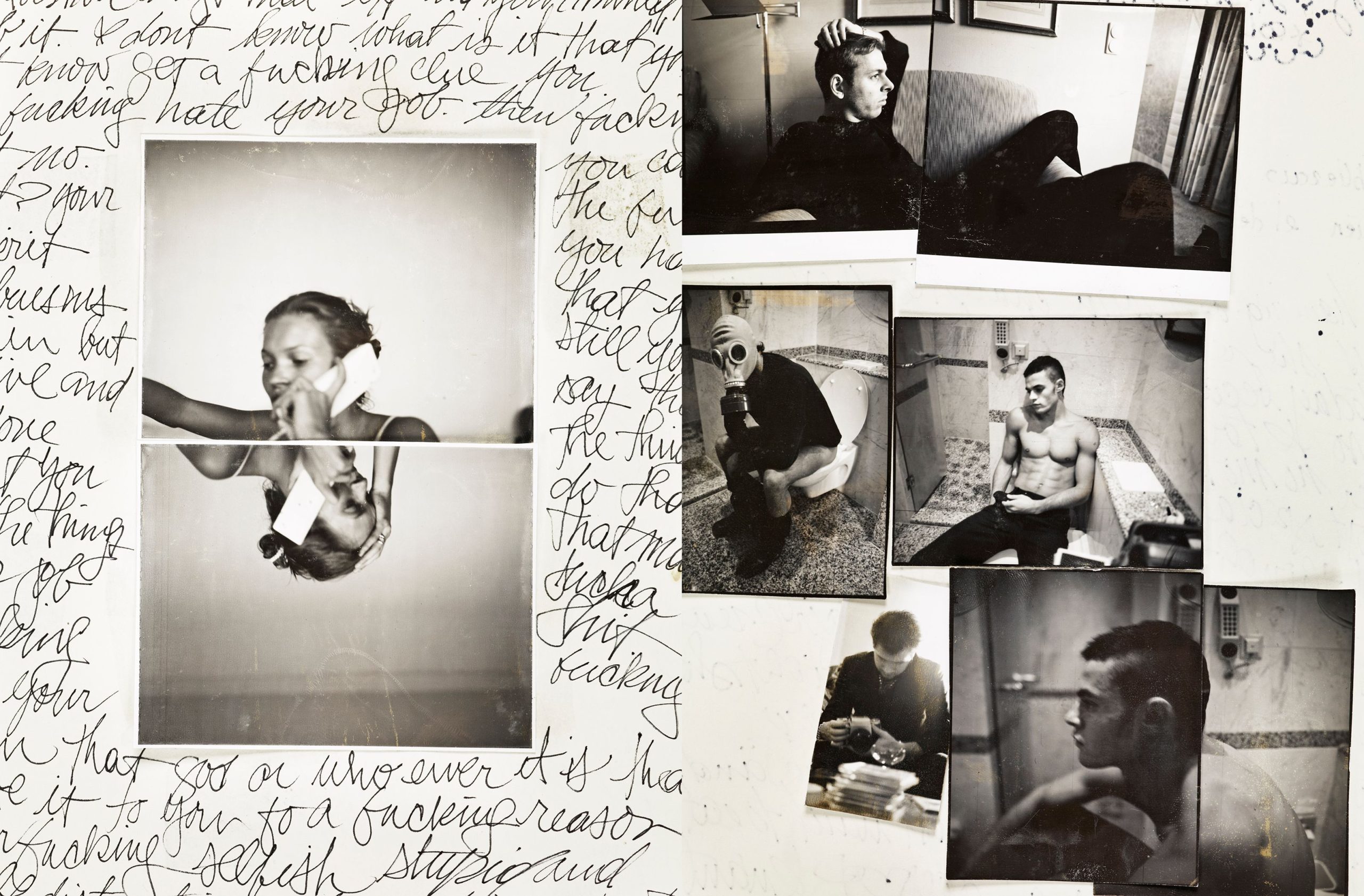
The five diaries, spanning the years between 1991 and 2000, bring together photographs, contact sheets, handwritten notes, drawings and fragments of everyday life. For the exhibition, Mario reproduced the pages of his original journals using color Xerox machines, then reassembled and bound them by hand. These are not conventional photographic books, nor simply archival documents. They occupy a fascinating territory between memory, artistic experimentation and the physical act of making.
There are portraits, faces, bodies, moments of everyday life, images of friends and lovers, familiar figures from the fashion world, and deeply personal traces of the people who surrounded him. There are handwritten words, repetitions, experiments, sequences of images that seem to follow the associative logic of memory rather than the conventions of photographic editing.
Looking at these pages, we are not being shown a collection of finished masterpieces. We are being invited into the process of becoming.
What makes this particularly fascinating is that Mario’s diaries were not simply something he created alongside his photographic career. They were fundamental to its development. He began taking pictures in New York in the late 1980s, teaching himself photography while documenting the world around him, even building a darkroom in his mother’s laundry room. It was precisely these personal diaries that, when he showed them to Calvin Klein in 1993, inspired the iconic Obsession campaign.
The boundary between personal work and commissioned photography was never as clear as we might imagine. For many great photographers, this distinction becomes almost meaningless. It is precisely their personal vision, shaped by experiences, relationships and an ongoing process of exploration, that makes their work immediately recognizable, regardless of the context in which it is created. At its highest level, fashion photography is no longer simply in the service of a product, but becomes a space for genuine artistic exploration.

Courtesy of Mario Sorrenti Diaries, LSD Paris

Courtesy of Mario Sorrenti Diaries, LSD Paris
Photography, in these diaries, is not simply the production of images. It is the expression of a life lived.
The photographs are inseparable from the people Mario loved, the places he inhabited and the cultural atmosphere that shaped him. What emerges is not only the development of a photographic language but the formation of a sensibility.
I was particularly touched by this because I lived in New York during those same years. Mario and I belong to the same generation, and although our experiences were our own, we inhabited the same city, at the same moment, within a cultural world that was undergoing an extraordinary transformation.
New York in the 1990s was a place of intense creative exchange, where fashion, photography, music, art and nightlife constantly intersected. There was a sense of freedom, experimentation and possibility, but also a rawness, an urgency, a willingness to take risks and to blur the boundaries between one’s personal life and creative work.
Looking through Mario’s diaries, I recognized something of that world. Not necessarily the same people or the same experiences, but the atmosphere, the energy, the particular feeling of being young in a city where life and creativity seemed impossible to separate.
There is also the extraordinary family Mario comes from, a remarkable constellation of creative talent. His mother, Francesca Sorrenti, a woman of exceptional talent and an enormously influential figure in the worlds of fashion and image-making; his sister Vanina, an extraordinarily gifted photographer in her own right; and his younger brother Davide, who died tragically young in 1997, an exceptional photographer whose work captured the spirit of a generation with rare sensitivity and immediacy.
In this family, photography has never been simply a profession. It has been a shared language, a way of relating to one another and to the world. Perhaps this helps explain why Mario’s work feels so deeply personal, even when it is created within the highly sophisticated machinery of the fashion industry.
Davide’s presence in the diaries is particularly poignant. Knowing his story, these images become more than fragments of a shared youth. They are traces of a relationship, of love, of loss, of a world that no longer exists except through the images that remain.

Courtesy of Mario Sorrenti Diaries, LSD Paris

Courtesy of Mario Sorrenti Diaries, LSD Paris
And this brings us back to something fundamental about photography: its extraordinary relationship with time.
A photograph preserves a moment while simultaneously reminding us that the moment is gone. But in Mario’s diaries, this relationship becomes even more complex. Photographs are placed alongside words, drawings, other photographs, fragments of thought. They are revisited, rearranged, reproduced and transformed. Memory becomes an active creative process rather than a passive act of preservation.
The use of Xerox is especially interesting in this respect. Reproduction here is not simply a means of copying an original. It becomes part of the artistic language itself. The texture, the imperfections, the altered colors, the materiality of the pages all contribute to the emotional experience of the work. The diaries remind us that photographs have a physical existence, and that the way we handle, sequence and preserve them can be as meaningful as the images themselves.
In an era when billions of photographs circulate through our screens, when images are increasingly detached from physical objects and, with artificial intelligence, can even be generated without any corresponding lived experience, this feels particularly significant.
We photograph everything, store everything, share everything. Yet how often do we return to those images and give them the attention necessary to become part of our memory? Mario’s diaries speak instead of time spent looking, selecting, arranging, touching and remembering: the physical labor of creating meaning from the fragments of one’s existence.
And perhaps this is why that small gallery in Paris was so crowded with young people.
I don’t think their fascination was simply nostalgic. Nostalgia implies a desire to return to something we have lost, but many of those visitors had never known the world these diaries describe. Perhaps what they were responding to was something more immediate and universal: the evidence of a real life, with all its beauty, contradictions, intimacy and imperfections.
We often discuss the signature of a photographer in terms of light, composition, color or technique. But perhaps the most distinctive element of an artist’s visual language lies somewhere deeper, in the particular way they have experienced the world. Before an image becomes iconic, before it enters the history of photography or the collective imagination, it begins with someone looking at something, or someone, and feeling compelled to remember.
Mario Sorrenti Diaries, 1991–2000, curated by Aaron Stern, is on view at LSD, 20 Rue de la Folie Méricourt, Paris, from November 12 to December 10, 2026.
